The Continuing Saga Of Dungeon Master Coffee Philosopher


We’re still doing it. DM’ing an original Dungeons & Dragons campaign. We’ve even added a new player, a friend of mine of several years who looks likely to hang around for a while (I think he was reassured that everyone in our little cabal is over thirty-five and has a professional career).

I worked up a plot of sorts and have a broad idea of where that plot will lead. But I was never great at plotting, so it’s nice that the party has taken off and done their own thing. Abetting that, I’ve tried to insert a certain randomness into the mix – mainly through the cheap trick of die rolls that select a random encounter from list, which list sometimes also includes key plot points, thereby encouraging folks to go off on tangents that I hadn’t ‘planned’ to happen yet.

As you can see, I’m still somewhat obsessed with limiting the ‘directedness’ of the game – not directing the players don’t the paths I want.

Have I ever explained what’s going on?

No?

Maybe tomorrow.

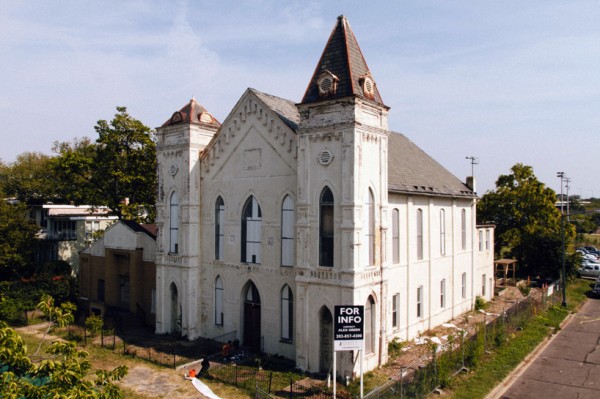
The Abandoned Former Friendship Baptist Church On 700 Delaware Ave SW Is Now Public Art


largest1

architizerhense2-600x399


6

5

Weekend Reading – We Have Ways Of Making You Talk, Professeur Derrida!


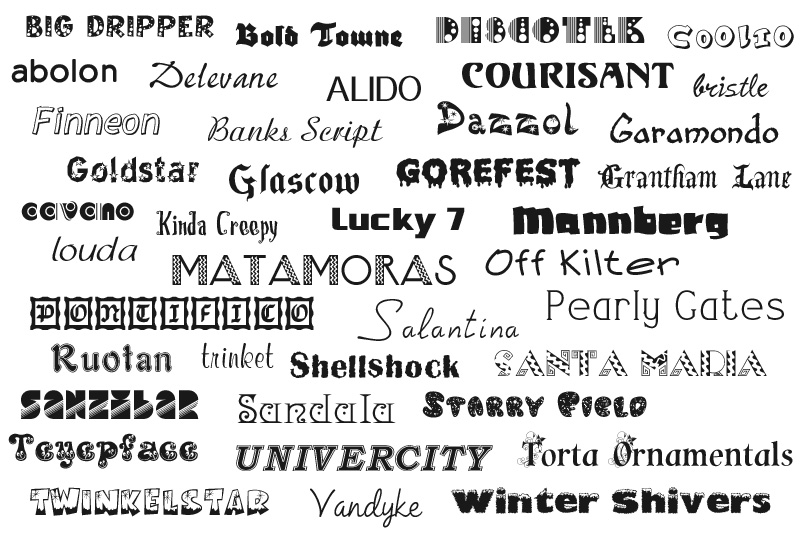
40-free-mac-fontsWhen Jacques Derrida was arrested.

“It is hard to imagine a destination like Union Station without a fully stocked bookstore…”

“We lost Borders. We cannot bear to lose you too.”

You are your font.

DC’s Best Bookstores


After DC got named the nation’s most literate city, someone got up and made themselves a list of our fine city’s best bookstores. Thankfully, they did not include some bookstore in Alexandria or another one of DC’s suburbs, which is something people do when making ‘best of’ lists about DC and which annoys me greatly. I don’t make a list of the five best coffeeshops in New York City and claim that number three is a hipster cafe in Jersey City, so don’t come around here and tell me the Arlington or Bethesda are part of DC.

You know what I like about this list? It doesn’t open up with Politics and Prose.

P&P is great bookstore, don’t get me wrong, but for the local man about town, I don’t actually think it’s the best.

This one names Kramer Books as the best. I’ll accept that. About ten years ago, I used to drink at the bar over there (yes, inside the bookstore) several times a week with a friend. Politics and Prose may be more nationally iconic, but as far as being a local culturally touchstone, Kramer Books probably better.

I’ve actually never been to the Lantern nor Books For America, both on the list. And I was disappointed that Bridge Street Books wasn’t on the list, though happy that our delightfully cluttered local hangout, Capitol Hill Bookstore, made the cut.


Washington Celebrities


So, I was walking down to the bank to withdraw some money for the offertory at church when I saw what seemed a familiar sight.

Andrew Schwartz, whose impromptu adoption of the lead role in the Folger’s Henry V had so impressed me, was walking down Pennsylvania Avenue.

Nothing special, but it was nice to be able to tell him in person how much I had enjoyed his performance.

So, that’s kind of what passes as a celebrity sighting in DC – or at least, what passes as a celebrity sighting once you’re bored of seeing Boehner standing outside a bar with a cigarette hanging out of his mouth.

The Sunday Paper – Roman A Clef


Politic0: The Novel

Beyond the ‘big six.’

Ferlinghetti: The Movie

Animal poetry.

Small town poetry scenes.

Mainstreamin’ Marx.

Weekend Reading – The Real Advantage


The reason why Borders went bankrupt and Barnes & Noble is still surviving actually has little to do with differing e-books and online strategies.

College kids still prefer the old fashioned kind ‘o textbook and aren’t really into ‘enhance e-books’ or other such nonsense.

What is ‘the work of art?’

An interview with Michael Moorcock.

For the third year in a row, Washington, DC is ranked the most literate city in America. I can only assume that my New Year’s resolution to read a book a week will help us secure the title a fourth year running, so… you’re welcome, DC.

Reviewed: Henry V At The Folger Shakespeare Library


Last night, I got my Christmas present – a night at the theater with a lovely lady.

She took me to see the Folger’s production of Henry V.

Back in the day (well, back in 1989), my friend Matt and I were taken by Beverly and Joe, two grown ups (Matt and I being in junior high) from my church (that was during an interlude in my longstanding atheism/agnosticism), to see the Kenneth Branagh movie of the play. It was definitely one of those defining moments in my life: the classics were freaking cool! People were executed, slaughtered in the field, hung from the neck until dead (I was a fourteen year old boy, so this was the kind of stuff that impressed me).

This Henry V was something very different.

The entire production emphasized the stage bound aspect of the play. The set itself was a series of scaffoldings which were set with beams on ropes that were partially lowered at various times to indicate various locales, but which still served to emphasize the artificiality of the set. Actors also played multiple roles, which, again, brought the audience’s gaze onto the fact that this was a play and not real. It wasn’t as explicit as that moment in The French Lieutenant’s Woman (the book, not the movie, people) when the author pulls up short and flat out tells the reader that this is just a book s/he is reading and that the characters aren’t real and none of this really happened, but it was pretty explicit. Though, of course, the broad sweep of events in Henry V actually happened.

Henry himself was played by Andrew Schwartz, instead of the usual actor, who was, apparently, ill last night. While he was at times uncertain and stumbled over a line or two, that also served the purpose. While still making clear the artificiality of the entire act of staging a play, it also really pushed the costs of war. This Henry was callow and uncertain and didn’t truly understand the cost of his actions to others around him. It’s actually hard to imagine anyone else playing the part in this production.

The notes in the playbill talked a good bit about how the quagmire-ish conflict in Ireland informed Shakespeare’s play. I don’t know whether it was intentional, but having read that, I can’t help but think of this and the Iraq War. The staged aspect brought to mind the political staging of the war by neocons for our consumption. At the end of the play, the Chorus reminds the audience that things went to hell in a hand basket almost immediately after the events depicted, what with  the disastrous, brief reign of Henry’s son (Henry VI) and the whole War of the Roses thing. So the entire episode could be viewed as the initial, made for television, stage of the Iraq War, when the statue toppled, before… the entire rest of the war and occupation.

Anyway, the run of Henry V has been extended, so go see it or something.

Don’t Be A Hater


I probably should have said, “don’t be an a–.”

My own, local Washington Post published itself an asinine and irritating little piece on poetry. I was seething. Luckily, someone else responded more productively than I could manage:

From coldfrontmag.com/news/open-letter-to-alexandra-petri

I am writing in response to your attack on American poetry in your Washington Post blog today.  Throughout your piece, you forward assumptions based on your own lack of exposure and allow these to stand as truth. I know it is just an opinion blog, but people have been convinced by less, and despite your “blog voice,” I sense you might really believe what you are saying. I will also assume you are sincere in stating: “I hate to type this and I hope that I am wrong.” So I am glad to let you know that poetry is fine. In fact, it is thriving…

I hope you’ll click on it and read the whole thing.

Music For The City Of Light


On January 11, I dragged my better half and her parents to a concert at the National Cathedral entitled, Music for the City of Light.

The program consisted of a mixture of choral and orchestral music from the second half of the seventeenth century by Lully and Charpentier. I was very excited to hear the music by Lully, because his name sounded very familiar; while I enjoyed his pieces, I know realize that I was thinking of the Spanish born philosopher usually known as Raymond Lully. This other Lully isn’t bad, though.

The music was beautiful. I particularly loved the sacred pieces.

But…

It all sounded like thin water because the National Cathedral is a terrible place of the kind of intimate music being performed. We’re talking purely acoustically. The sound that reached us (and we weren’t that far back) was very weak. I’m sorry, I’m not paying to hear concerts at the National Cathedral just so I can strain to hear it. That rich, full sound we associate with early Baroque music is lost and replaced by something much reedier in those acoustical conditions.

I had hoped to introduce my mother and father-in-law to some of my favorite kind of music and make a pitch for the richness of my culture’s musical canon. Instead, I wound boring them literally to sleep. But who can blame them? After all, it wasn’t like there were any loud noises to keep them awake.