The Flail At Twins Jazz


Saturday night, I saw the New York based jazz quintet, The Flail, at Twins Jazz on U Street. They were joined by a local guitarist (whose name, if I heard correctly, was John Lee; but don’t quote me on that).

They are clearly a very good group, with an innovative sound and great chemistry. You can hear the ‘but’ coming, can’t you? But… I was disappointed. Honestly, I thought the addition of the electric guitar was a bad thing. His sound was very demanding, very dominant. Except for one song, I felt it was distracting. The insistent noise of the guitar left little room for the band members to switch up and let others take the lead and solo, because it rarely seemed able to slip into the background and let others take center stage.

On another note, the pianist looked like a clean cut Allen Ginsberg – his wild, middle aged Ginsbergian mane pulled back in a pony tail and his thick, leftist beard well trimmed in its fullness. I had to go home and read Kaddish after seeing him.

Dumbarton Oaks


So, we were trying to find Dumbarton House, which, as it turns out, is completely unrelated Dumbarton Oaks (I still haven’t been to Dumbarton House).

On the plus, Dumbarton Oaks Garden is insanely relaxing.

On the downside, the entirety of the Dumbarton Oaks Museum, including the pre-Columbian art wing, designed by Philip Johnson (who I am a fan of; I actually used to pick up my paycheck from a building he designed in Minneapolis), was closed.

But, with a bag full of books bought from The Lantern, a lovely spring day, and time to kill, I still recommend visiting.

20130417-103204.jpg

Core Samples From The World (New Year’s Resolution, Book Fourteen)


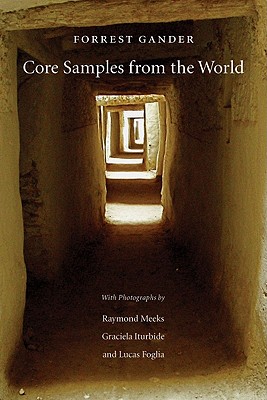
9780811218870Core Samples from the World is a beautiful and disquieting book, though not always disquieting in a good way.

As part of the Folger’s poetry series, Forrest Gander read at the Philips Collection, against the backdrop of an exhibition of works by Jean Dubuffet, Alfonso Ossorio, and Jackson Pollock.

The exhibition itself was very good, though most of the Dubuffet’s and Pollock’s I had seen elsewhere. Ossorio was new to me, so kept my attention much more strongly and moved me much more deeply. His merging of a unsettling passions, representation, anti-representation, and a deeply conflicted faith is wonderful to behold.

Forrest Gander is a poet I had been meaning to read and I’m glad for the excuse. He read not just against intellectual backdrop of the exhibition, but also against the very real backdrop of projections of various works from the exhibit. For each slide, he read a poem he felt was in correspondence with the work.

Unfortunately, Gander’s poetry and the work of the three artists demand close attention and my ability to appreciate both the poems and the art were diminished by split attention. Frankly, I was barely listening to the poems by the end. Which is too bad, because he’s an excellent poet.

Local poet, Sandra Beasley, moderated the discussion. I like some of her work and she’s clearly knowledgeable, but she talked too much. By which I mean to say, when the questions you are asking, in a public discussion like this, are longer than the answers you’re getting, it’s time to think up better ways of the asking the questions. She also brought up that Gander is a relationship with another man. The context was a question about living with another artist, but the fact of his sexual orientation was somewhat awkwardly inserted and the way he dodged around the question suggested to me that he wasn’t very glad that part of his life was brought up.

But on to Core Samples from the World!

The poems are interspersed and, to some extent, done in correspondence with photographs by Raymond Meeks, Graciela Iturbide, and Lucas Foglia. Of the three, only Iturbide was familiar to me.

The good stuff. Gander’s a good poet. Some gorgeous turns of phrase: stopless winds or A butcher draws his blade against the plush throat of a goat

Read that last one again. The interior rhyme (it’s from a prose poem section) of ‘throat’ and ‘goat’ and strange, beautiful insertion of ‘plush.’ Great stuff, eh?

And in the third section, there’s a long series of prose poems about a trip to Bosnia-Herzegovina. It’s hard to explain, but it’s magical. I rather thing that he does so well here because it’s about a more purely western culture (though eastern Europe).

Finally, it ends with one of the best descriptions of the feeling of being drunk you’re likely to find outside of a Kingsley Amis novel.

But…

A lot of ‘buts.’

Gander is a very, very good poet. This is not a very good book.

It feels unsettlingly paternalistic. The poems a somewhat narrative, world-wearingly detailing his trips to writers’ conferences in places like China and Mexico (it can read like a melancholy, non-hyper Tom Friedman who has actually learned to write – not just poetry, but anything). He interrupts ‘his’ poetry with sing-song three lines stanzas that read like mediocre translations from Tu Fu, but which are clearly intended to be the voice of these strange, foreigners he meets. And in combination with some photos that resemble a bit of poverty porn (though not all – and in the middle is strange photograph of young, blonde dressed like an extra from a Raquel Welch movie about dinosaurs, only one of her tastefully nipple covering furs is actually a fox stole; go figure).

I almost feel like ripping out the photographs and forcing myself to read each section of the longer poems out of context, away from each other, just to enjoy the language and skill. But I can’t, can I? I can’t separate it, can I?

Midnight Movie: ‘Flash Gordon’


Last weekend’s midnight movie at the E Street Cinema was the 1980 classic, Flash Gordon.

And it freaking rocked. Here are just a few reasons why:

It stars Max Von Sydow, prancing around in a pink satin pantsuit and a haze of psychosexual weirdness that would have made Ingmar Bergman commit ritual suicide, had he seen it.

Topol, best known for Fiddler on the Roof, never known for understated performances,  clearly prepared for this role by locking himself in sterile white room, empty save for a pencil, a ream of virgin paper, a vast quantity of LSD, and the script. He then based his performance on the notes he wrote to himself while locked in that room.

Brian Blessed wears wings and a scaled leather speedo. He also attacks the role of King of the Hawkmen with the sort of gusto one normally associates with bath salt sniffing cannibals. A gifted Shakespearean, he nonetheless believes that a failure to mug the camera and overact will result in a live car battery being clamped to his aged father’s withered testicles.

It’s got an alien princess who looks, dresses, and talks like a notably slurry Bond girl. And speaking of Bond, Timothy Dalton plays Prince Barin of Arborea. And his second in command is played by Riff Raff. Riff Raff, people.

Every costume was latter pilfered by George Lucas for The Empire Strikes Back and Return of the Jedi.

It advocates the little known theory that the most deadly martial art ever created is, in fact, the ground game advocated by legendary college football coach, Bear Bryant.

The score is by Queen, at their most bombastic. But in between Freddy Mercury doing whatever it is he does to sing those lines with a complete lack of irony (‘Flash… Ah Ahh… He’s a miracle’), Brian May is an awesome guitarist and they put some great, propulsive beats into the music.

And, for the first time since 1980, I got to see it on the big screen.

Union Station


I had a $25 gift card and a 20% coupon burning holes in my pockets, so I made the trek up to a Barnes and Noble. On my walk, I stopped at Union Station to see if it was still there. I knew they were closing it down (a dispute over rent increases) but thought I would support it while I could in hopes they might decide to stay (futile, I know). I was also thinking they might have a nice sale to clear out the stock.

But when I arrived, the windows were papered over and this enormous, lovely public space was gone. It had always had a surprisingly good selection , including an excellent array of periodicals. And now it’s gone.

I walked a mile further to the downtown store, where I bought Emil Cioran’s A Short History of Decay and an espresso.

While waiting for my espresso, I got an email from Barnes and Noble alerting me to the closure of the Union Station shop and offering a small discount on coffee or tea by way of consolation.

Was today the first day without it? Did it just close down? Had I happened to stop by yesterday, would it still have existed? It just seems an odd coincidence.

Pre-Raphaelite Exhibit At The National Gallery Of Art


preraphaelites-fsLast Sunday, we finally made it down to the National Gallery of Art to see the exhibition, Pre-Raphaelites: Victorian Art and Design, 1848-1900.

The Pre-Raphaelites are not the sort of movement you’d normally expect me to be excited about, but a while back, I’d started reading the novel, Possession. That novel is about some literary and archival sleuthing around the relationship between two fictional poets. However, their poetry was based on the that of Robert Browning and Christina Rossetti, the latter of whom is considered a Pre-Raphaelite poet. So I got a book of Pre-Raphaelite poetry and fell in love with the poems by Christina Rossetti, so bought her collection, Goblin Market and Other Poems. Loved it. So when an exhibition about the movement came to town, I wanted to see it.

And it’s great. Really wonderful. Go see it.

First of all, it’s filled with gorgeous art. If you like avant-garde art, you can see traces of Seccessionist art in it, and also just respect it for the fact that it was avant-garde at the time it was created. If you think Kandinsky and Pollock were the worst thing that happened to art, with the possible of the academic-artistic complex conspiring to make ugly, difficult, meaningless art the only good art.. well then, this is a ton of lovely, representational art.

The curating efforts, which revolved around themes like ‘Nature’ and ‘Paradise’ (oddly enough, a room devoted to crafts and furniture), were somewhat lacking in utility, but it was just great to see so much work from this period gathered together.

Manon Lescaut


I saw Manon Lescaut performed by the Washington National Opera at the Kennedy Center on Wednesday night.

I was very much looking forward to it, seeing it as sort of counterpoint to the wonderful Don Giovanni I saw last year, but with the unreliable lover being a woman (the titular Manon) rather than a man.

The music was wonderfully romantic, as you’d expect from a tragic love story by Puccini. But I just didn’t feel like, at least at this performance, the singers added much to it. No one really had that moment that made me go, ‘wow, that person just nailed it.’ The closest anyone came was Manon’s brother (simply called ‘Lescaut’), who captured the character’s rakish, lascivious greed, while never ignoring the (somewhat corrupted) core of fraternal love. Everyone else did their part, but maybe not much more.

Peregrine Espresso Officially Best In The East


Damn if Peregrine, which had it’s start over by Eastern Market, just a few blocks away from me, didn’t just win ‘America’s Best Coffeehouse Competition’ in New York.

When they first opened, I loved them. I still like them, but honestly, I feel like their coffee slipped a little in the last couple of years and sometimes… just sometimes… I feel like some other places (namely Pound and Sova) manage to brew a better brew.

But still. Damn good coffee. Good job, Peregrine.

Jeb Bush Really Trying to Screw Marco Rubio


It feels almost personal.

While he’s not come out of the gates too elegantly, Jeb came out of the gates not to subtly trying to hamstring Rubio.

Jeb came out an immediately seized the one issue Rubio was hoping would set him apart (and also mitigate, for the general election, his radical Tea Party-ism), immigration, and ran with all across the Sunday shows and dominated national coverage in a way that Rubio has failed to do (beyond reaching those Beltway pundits who are only read by other Beltway pundits).

And, he’s tied up all the big Florida fundraisers. This will hamper even Rubio’s ability to raise money for his Senate account, because he can transfer those federal dollars over to a presidential bid, so bundlers won’t want to fill that account either, but where it might really hurt is in those pseudo-outside groups (SuperPACs, 501C4s, etc), who won’t get some of those $25k-250k checks to fund his travel around the country, ostensibly doing something else, but really campaigning, and also to plain old promote his name and attack his enemies.

And all this before Jeb even gets into the game.

I still don’t think Jeb’ll get the nod. I think his time has passed. But he’ll have some of the best knife fighters in the game on his side and they’ll all be looking to take out a piece of Rubio. I suspect that, to some extent, Jeb just plain doesn’t like Rubio rising so high, so fast and stealing his thunder and that he’ll pull a Dick Gephardt (who basically sacrificed his own campaign in 2004 to take down Howard Dean) and just try to see to it that Rubio doesn’t get it (which could take the form of beating up on Rubio for President campaign or just making it too hard for Rubio, so that he stays in the Senate and misses his best/only chance to run).

Argo


I finally saw Argo the other night. It was still playing at the E Street Cinema in downtown DC.

And it was good.

I hadn’t seen any of the Oscar nominated films at that point, but I did see the awards and knew that Argo had won best picture and, having finally seen it, I had to ask, ‘was this a mediocre year for film?’

Because Argo is not a best picture winner, least ways not in any sort of a halfway decent year for movies. While watching it, I was enjoying myself, but whenever my mind went to that best picture prize, all I could think of was the eminently superior spy flick of a year or so back, Tinker Tailor Soldier Spy, which not only didn’t win best picture, but possibly wasn’t even the best filmed version of the novel.