‘Mary Stuart’


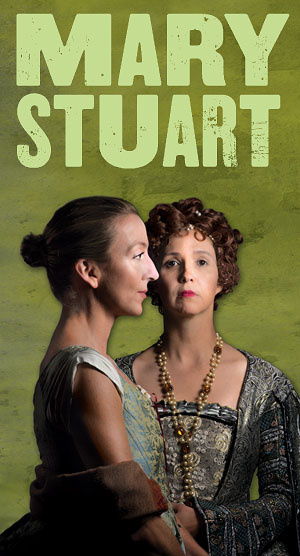
Mary StuartI saw Mary Stuart at the Folger the other day. It was a Peter Oswald translation of a Friedrich Schiller play that nicely combined the language Shakespearean style classicism and (also Shakespearean style) timelessness. He kept iambic pentameter rhythms and that certainly helped. Not the humanity spanning scale of Shakespeare, but good, nonetheless.

The set piece, as it were, was a meeting between Elizabeth and Mary, arranged so as to appear a chance meeting – with Elizabeth hunting near the castle where Mary was under lock and key and Mary, unusually, allowed some small taste of well guarded freedom in the outdoors.

In a way, the set piece was a let down. I was led to expect some showdown between the two that Mary’s wit, charm and inner nobility would win. Elizabeth, during part of Mary’s big speech, was looking up and to her right – directly towards where I was sitting. Her expression wonderfully captured a sense of contempt for Mary’s posturing.

Leicester was a wonderfully deceitful, semi-villain and Mary was great, but I was more impressed by Elizabeth – and not just that one moment. Her vanity and her fickle choice of favorites were well captured, but without sacrificing her realpolitik. It was all well and good to be high and mighty about royal prerogatives, but Elizabeth actually ruled, which came with as many compromises as powers.

‘The Dangerous Logic Of Wooing’ By Ernesto Neto


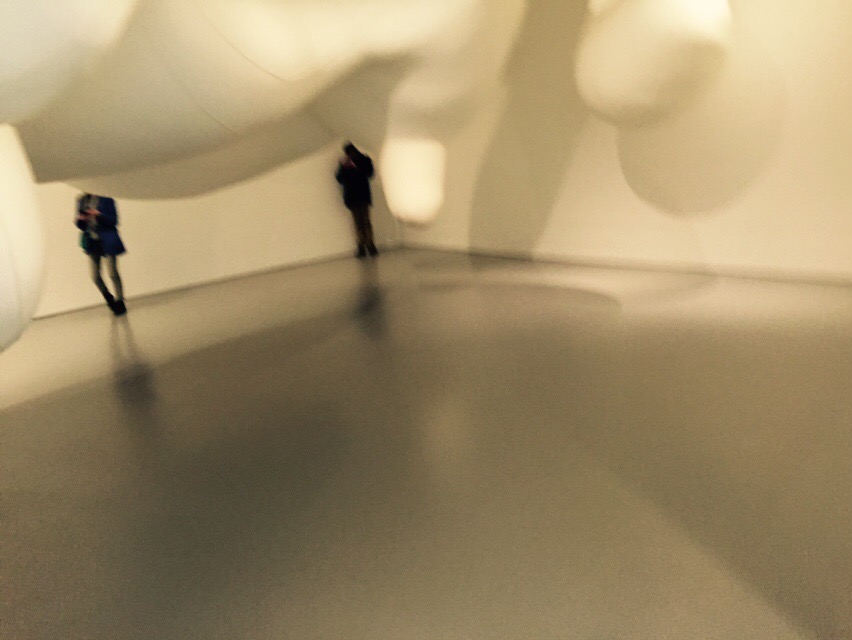
This isn’t a book, it’s large-ish art installation at the Hirshhorn Museum that particularly struck me a week or two ago.

Without knowing the title or reading the blurb, you could see that this was… not sexual, but reproductive. Organic.  The words and images that come to mind make it sound horribly unappealing and almost grotesque – pendulous testicles and breasts. But the work is not. It’s more primal, like an ancient fertility goddess with unnaturally wide hips and large, sagging breasts which is not intended to be a modern depiction of beauty, but rather of a certain kind of immortality of the human race, the ability to continue the species.

Forgive my terrible photography.

IMG_4463

IMG_4465

IMG_4464

More ‘Tinker Tailor Soldier Spy’


So, I watched episodes three and four at the Hill Center on Thursday.

With Netflix and a million television stations and streaming things, it’s easy to forget the pleasure of watching something with other people in a theater-like environment. I had a wonderful experience several years when we saw Casablanca on the big screen in a crowded theater. And don’t even get me started on watching The Rocky Horror Picture Show outside of its natural habitat – a midnight movie theater.

There is something about the shared experience that connects you with strangers.

And did you know that Patrick Stewart was in the old BBC series? Yup. He plays uber spymaster Karla, head of ‘Moscow Center.’ He has no dialogue. None. But he’s very good. He keeps totally impassive, ignoring Alec Guiness’ Smiley, but then showing delicate touches to indicate that he was actually filing away everything Smiley said – and also taking the lighter (if you haven’t read the book or seen this or the more recent, you will have no idea what I’m talking about and I’m not going to explain it to you – either read the book, see the movie, or just cheat and google it). He was only in his late thirties, but already completely bald on top. Not even a wisp, really. And already his hair with iron gray with some touches of black. He has a very distinctive (though also handsome) skull.

Rafael Campo At The Folger


9780822339601Rafael Campo read a wonderful lecture on Emily Dickinson and her relationship to science and medicine, interspersed with readings from Dickinson and his own poetry. Of course, I would have preferred less reading from a prepared lecture and more speaking. Among other things, the inevitably monotony of the reading voice sometimes made it hard to distinguish when he had left the realm of ‘discourse about Dickinson’ and started reading a poem by himself or Dickinson.

I bought a collection by Campo called The Enemy that was far better to read than I would have guessed by his earnest, but uncharismatic style behind the podium.

I wasn’t sure about Campo as the designated reader on a day honoring Emily Dickinson. I didn’t know much about him, but what I did know seemed far from Dickinson’s aesthetic. But he explained that he studied in Amherst and the Dickinson house was a source of poetry inspiration and solace to him, so all is forgiven! The collection even has a poem about reading Dickinson on the quad in college and the solace that she (along with Coleridge) provided.

As for Campo’s poetry, it is mixed.

There is a section about a trip to Paris which is beautiful and often haunting, with subtle politics, usually touching on issues around AIDS and its effect on America’s gay community. But there are also less subtle political poems in other section which comes across as heavy handed and too pat in their sentiments.

In general, he is very good when his poems are driven by place – or rather by memory of place. Provincetown, for example, appears often and is used to think about current loves, past loves, and how relationships have changed – for good and for ill – over time.

Ensemble Galilei At The National Gallery


I used to regularly attend the Sunday concerts at the National Gallery of Art. Usually they were some small group – a quartet or a duo (piano and voice; flute and guitar; harpsichord and violin; etc) – playing a mixture of older classics and some modern composers or off the beaten track.

This one was lured me in because it mentioned Marais, who was a great seventeenth and eighteenth century composer for the viol de gamba. But though they played a piece by Marais (and it was, of course, fantastic), they mostly played Scottish and northern European pieces and the combination was… eclectic. Frankly, I unsatisfied. I didn’t cohere for me. The mixture of Shetland reels, Greensleeves, and French composers from the Baroque was like a poorly curated exhibit, especially because little effort was made to explain to us (the audience) how the pieces made up a single program, beyond the simply fact of just being played together.

On the other hand, they have a nice exhibit of El Greco paintings. Mostly, they are paintings from the National Gallery’s permanent collection and some paintings from nearby museums (Dumbarton Oaks in DC and the Walter in Baltimore). Nothing spectacular, curation wise, but it’s just nice to see a bunch in one place.

Weekend Reading – The Lit Smugglers


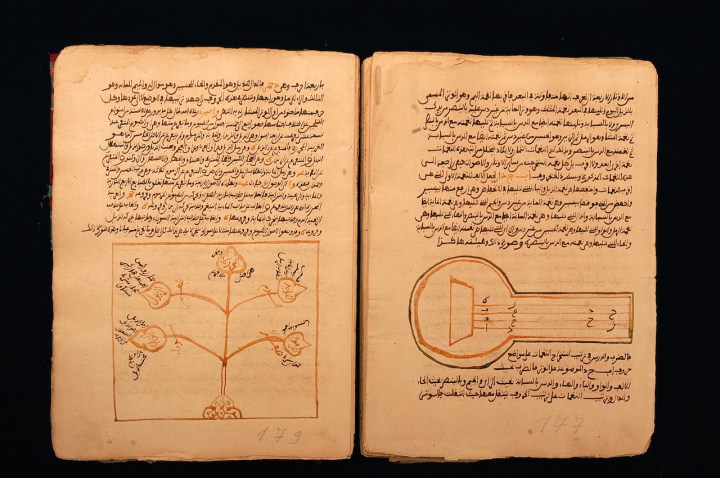
2013-Evacuation-manuscripts-Timbuktu-copyright-Prince-Claus-Fund-3The rescued literature of Timbuktu.

Digitizing the east.

The physics of Jackson Pollock.

‘La Boheme’ At The Kennedy Center


OPOSALa-boheme_400x400It’s hard to go terribly wrong with La Bohème. And to their credit, the Washington National Opera did not. They had two casts, but I checked a friend of mine who sings in the WNO (mostly small roles and the chorus) and he assured me that it was a case of an ‘A’ cast and  ‘B’ cast. And certainly, the folks I saw were pretty good. No one stood out in massive way (the way Abdrazakov did in Don Giovanni a few years ago), but everyone excellent. And while one thinks of a couple of the arias, really, La Bohème is an ensemble drama, so that’s just fine.

And yes, I cried. A moment, when Mimi is lying in bed and Rodolfo and all her friends are about – it was actually a moment of silence. And that was when I lost it. All the music building up this incredible sadness and regret and when it pauses, the floodgates open. The magic of Puccini, to take such a melodramatic plot, which is, on its own, too nonsensical to cause tears, and build this incredibly romantic, longing music around it.

Heather McHugh & Geoffrey Brock Read At The Folger Shakespeare Library


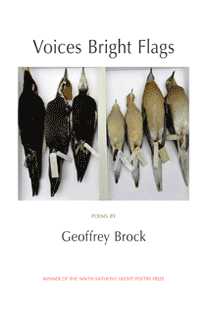
brockcoverThis was a sadly sparse reading. Not empty, but perhaps just 80% full and with upper balcony totally empty. Which is too bad, but Brock gave a great reading.

McHugh was the judge of the latest Anthony Hecht Poetry Prize and she chose a manuscript by Brock as the winner (thereby getting it published by Waywiser Press).

Some years back, I spent too much money on an oversize paperback by Richard Howard entitled, Inner Voices: Selected Poems, 1963-2003. For the life of me, I don’t know why I bought it. I hated it. A lot of the poems are written in the voices of historical figures. I mention this, because that is much of what Brock does, only I like his poetry.

McHugh was a little confusing. She spoke a lot about personal challenges and about her support for a particular cause: people who are long term caregivers for severely disabled relatives (usually their children). At one point, I thought she was reading a poem and then she looked up and started speaking about the cause and I could never tell whether these were asides during the reading of a poem or if none of it had been a poem.

I bought and Brock read from Voices Bright Flags. Very enjoyable. He’s got a nice, light touch and recognizable style, without being repetitive. A lot of serious poems, with passages about John Brown and the Civil War and slavery, but also some light humor about being a father with an insistent toddler. I actually remembered reading the first poem in the collection, Bryant Park at Dusk, in Poetry (the magazine).

I’ll excerpt from a poem about Ulysses S. Grant. Mostly because it’s a good poem, but also because Brock drolly noted that no one writes poems about President Grant.

My heart then like a puffed-up private boasting
he’s cut the enemy’s leg off
– Not his head?
– Sir, someone else had cut that off already.

August Kleinzahler At The Hill Center


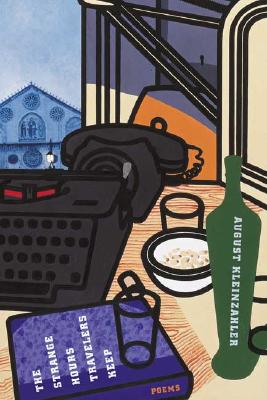
9780374529413A surprisingly engaging and enjoyable poet to listen to and the usual moderate of these conversations – the Washington Post‘s Ron Charles – stayed out of the way more often the usual, perhaps because the sanguine Kleinzahler was more willing than the melancholy Hirsch and the phlegmatic Szymbist to take control of the conversation (did you see what I did there with the four humours of medieval medicine?).

In his introduction, Charles noted that the poet, despite being famous for chronicling bars and diners and working class communities, was not a Bukowski. But the impression he gave was of a Robert Pinsky writing a Charles Bukowski. Does that make sense? Probably not. Well, I’m not going to explain.

The poet signed for me The Strange Hours Travelers Keep – which both delightfully named and has a wonderful cover. He aspires to Whitman’s continent spanning enthusiasm, but there is something narrower about him. The title comes from a line of William Carlos Williams and there is something of Spring & All in Kleinzahler (who is also a New Jersey poet). He wears his learning more broadly than Bukowski (again, like Williams), but has something of Bukowski’s resentment. Williams felt resentment, too, mainly for feeling left out of the conversation in favor of folks like Eliot and Pound, but this is a different kind of resentment. Something closer, indeed, the Bukowski. But more sober and plastered over with a fine appreciation of Milton.

There is a touch of misogyny to some of these poems – a ‘character’ in a poem calling Alma Mahler a ‘slut’ or a poem about a female poet who turned cruel eviscerations of her parents and the symbolic emasculation of a husband or lover into poetical success (defined, in this case, as grants, prizes, and choice campus appointments). I couldn’t call this trend pervasive or a trend, but just frequent enough to make me uncomfortable.

Kleinzahler has these wonderful exceptions to his high culture Whitman-ism. A lot of them have this delicious French influence, particularly the Surrealists (mainly Breton), though with too much conscious logic to is zig sagging motions to be truly Surrealist (and we are talking the actual movement; not ‘surrealist’ as short hand for ‘weird’), and also bits of Antonin Artaud’s structured madness. A lengthy prose poem, not suited to excerptation, I’m afraid, but that I highly recommend and which is well worth the price of the book: The History of Western Music: Chapter 4

The best poem that is also great distillation of his more usual style is the sad and melancholy portrait of faux-genteel poverty and terrifying loneliness, The Single Gentleman’s Chow Mein.

That his poems don’t take well to being shown in excerpts is a testament to how well they cohere, even when they appear random (that touch of Surrealism) or stream of consciousness.
Watching ‘Henry V’


I came across this article on watching an understudy play Henry V at the Folger production of Henry V from a season or two ago. As it happens, I saw that same production and also saw it with the understudy.

The early reviews had raved about the original actor and his commanding performance. The article writer was very hard on the understudy (though it should be said, I am pretty sure that the performance I saw was neither of the ones she saw). I actually liked him, though, and for many of the reasons that she did not.

I do not think it is set in stone that Henry is a confident king when the play begins; that he had exorcised all his demons in the previous, relevant plays (Henry IV, Parts  I and II). I liked this uncertain king. A running theme in many Shakespeare plays is the conflict between the medieval and the modern. Romeo is conflicted by the medieval requirement for retribution and modern ideas of order (and also marrying for love, but that’s another topic). Hamlet is the quintessential character caught by that conflict: the warlike, medieval man that is the ghost of his father versus a Hamlet that needs to understand why and who questions ideas of valor and vengeance.

Why can’t Henry V be similarly conflicted? On the edge of the renaissance and the end of the high middle ages, is it such an outlandish interpretation that he could question his own fitness to be a medieval man of action?