Rita Dove At The Folger & ‘On The Bus With Rosa Parks’


9780393320268

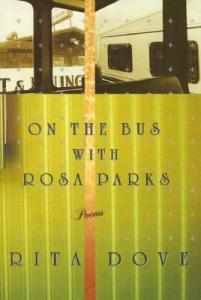
Maybe not my finest example of supporting poetry and poets, but I bought On the Bus with Rosa Parks at Politics and Prose because it was on their remaindered books shelf. If you stop by there, the poetry selections available for between $5.99 and $7.99 are really spectacular.

Rita Dove is a great speaker, able to be simultaneously engaging and intellectually rigorous (the sort of intellectual rigor lacking when Simic and Wright recently shared another stage). She has never been a favorite poet, but she is, at her best, formally interesting (at her worst, she plays with forms for the sake of playing withe forms). I didn’t catch it, but someone in the audience asked about her strategy of making the first stanza of a poem she read into a villanelle. Just a reminder that I need to read more into the traditional forms, sonnets and the like. Can’t all be free verse, my friends, can it?

No one is going to call On the Bus with Rosa Parks her finest collection, but it’s a nice showcase of her strengths. She frequently writes from the perspective of ‘characters’ and while it’s easy to say that those characters are almost invariably black, they are also frequently different from her in every other way. Dove has great way of writing unflinchingly, but also compassionately about the struggles of men with visions and expectations of masculinity.

From Graduation, Grammar School

Joe
sees hi son
flicker. Although
the air is not a glass,
watches as he puts his lips to
the brim–then turns away, bored.
He is not mine, this son
who ripens, quiet
poison on a
shelf.
Mary Ruefle At The Hill Center


Mary Ruefle appeared at the Hill Center and was a very engaging presence in the conversation with the Post‘s Ron Charles.

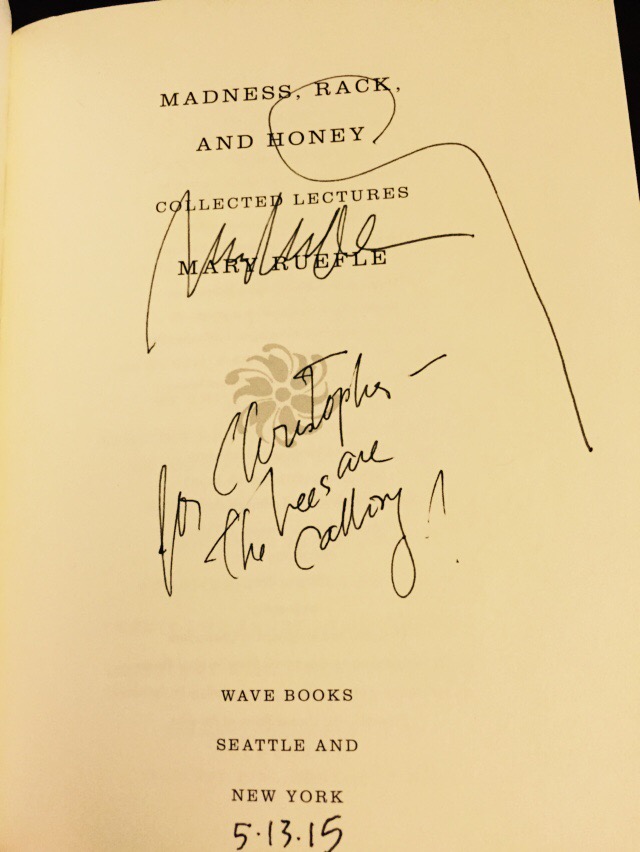
She also signed my copy of Madness, Rack, and Honey – with a special little something on account of my name (which is ‘Honey,’ by the way).


‘Persuasion’ By Jane Austen; Also, ‘Filthy Lucre’ At The Sackler Gallery


Please note: this is not me (and I don’t mean that in a ‘this is not a pipe’ way)
 I was going to go to a classics book club at my local Barnes & Noble, but instead went to an after hours thing at the Asian Art Museum. But in prep for the possible book club attendance, I picked up the chosen book, Jane Austen’s Persuasion.

When I bought it at the used bookstore, I was told (not unkindly) by the owner that I was the first man to have bought a Jane Austen novel from him. I think it was a compliment, but you’re never quite sure if it reflects as well on you as you think it does.

So, I’d read it before, enjoyed. That’s that.

But I picked it up again for this book club thing and I was… disappointed. Can one say that about Jane Austen? Pride and Prejudice is a model of gem-like perfection. My second reading of Persuasion left me a little unsatisfied.

Anne Elliot’s interior life lacks the richness of Elizabeth Bennett’s. She is frankly less interesting, yet we are held very much within her third person limited perspective. While one does not read Austen for lush geographical details nor for the richness of her descriptions of rooms or people, I dare you to read Pride and Prejudice and not come away with a very personal vision of the environs. Whereas, Persuasion‘s market town and then Bath are very vague. The people, too, leave me with no clear image of them (as for Pride and Prejudice, my generation has a very clear picture of the characters and they look remarkably like Jennifer Ehle and Colin Firth).

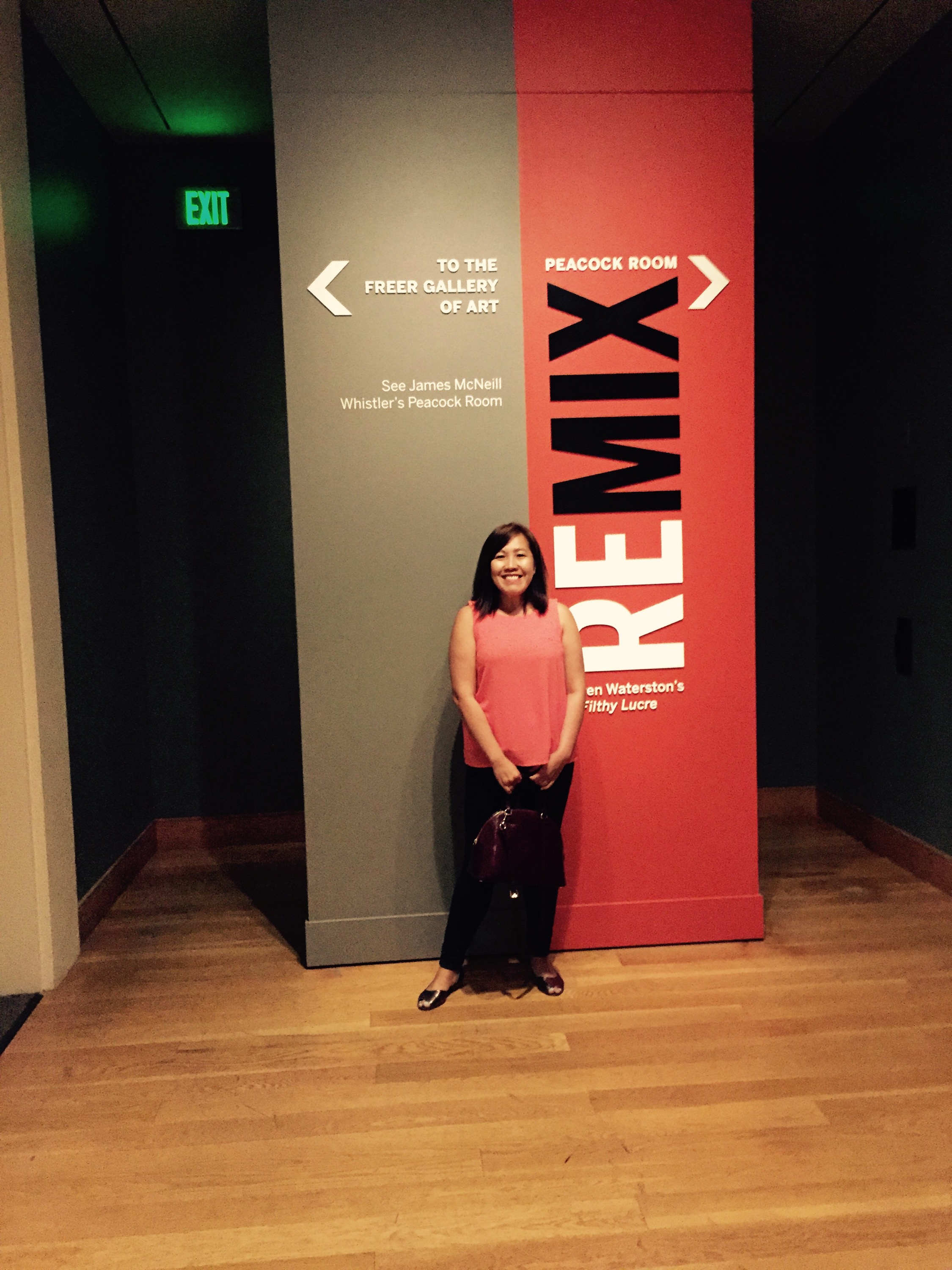
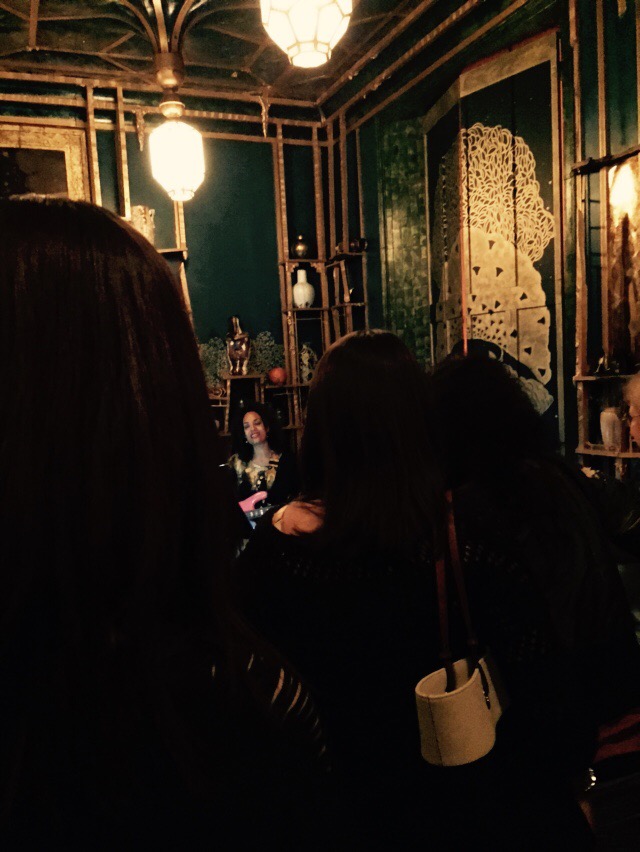
So, instead of that, we went an after hours open house at the Sackler-Freer Gallery (the African and Asian art museums, respectively, of the Smithsonian) where they kicked off an installation project riffing on Whistler’s famed Peacock Room (which is a room he decorated and designed for a wealthy liverpudlian and which has been moved entirely to the Freer Gallery), entitled Filthy Lucre. It’s starting point was the fights over money between Whistler and his patron about the final cost of the Peacock Room. Basically, it’s a closed room installation where the room is redone as someone decaying, sagging. The ceiling bursting with age and water damage; asian pottery shattered; the walls scarred with age and mold and lord knows what else. For the night, the music/performance art group BETTY played within the room. All in all, it was awesome.

‘Rosencrantz And Guildenstern Are Dead’


As soon as I knew the play was on the schedule for this season, I knew that I wanted to see it. The only Tom Stoppard plays I have seen performed at Arcadia (which, oddly, I have seen on three separate occasions: once in Atlanta; once in Montgomery, Alabama; and once in at the Folger) and The Invention of Love. Being a great lover of Hamlet, it irked me that I’d never had the chance to see this particular play.

For much of the play, it is just the two characters on stage, alone. Other characters walk in an out, but they are peripheral to the ‘real’ world of Hamlet. It’s at once hilarious and terribly sad and if you’re in DC, I hope you’ll see it at the Folger. It made me think of the lines from the Pink Floyd song, Wish You Were Here: Did you exchange/a walk on part in the war/for a leading role in a cage?

Rosencrantz and Guildenstern are trapped as walk on parts in a cage, without any real agency. They exist only to propel the progress of their betters/greaters, i.e., the leading characters in Hamlet. It left me feeling very melancholy because it suggests that it may never be possible to understand one’s purpose, even if one knows one’s purpose, and that knowledge could be meaningless because it comes without a view of the larger picture.

It is probably also the only play I have ever seen that addresses George Berkeley’s metaphysics (in a short, bastardized form: does anything exist if it not perceived?).

Midweek Staff Meeting – It’s Not So Bad In Iowa


Art Center Courtyard bw
Des Moines Art Center

I liked that this list of 19 free art museums included the Des Moines Art Center. I visited that museum at least half a dozen times while living in that city and it’s really a great example of how a smaller museum can build a fun experience. Some great contemporary exhibits, some big outdoor sculptures that are almost landscape installations, and an interesting and fun looking building to house the collection.

Temple of Baal in Palmyra
There are so many human tragedies occurring around the world, but I would be lying if I didn’t acknowledge that the history major in me feels most deeply hurt by the cultural artifacts being destroyed. Since this was written, ISIS captured the ancient city. Let’s hope they leave them untouched.

This is what walkability creates – fitter, healthier residents.

I have not followed this controversy, nor I have read much by Vanessa Place, except the slim, co-written volume, Notes On Conceptualisms, but I’m going to fall on the side of ‘not cool, Vanessa.’

But that’s certainly not the only point of view.

Midweek Staff Meeting – Hobbit Houses


mushroomhouse_one

Poet Mary Ruefle will be at the Hill Center tonight. You should go. I am.

I wish they’d review more poetry, but I guess that I’ll settle for New York Times review of a poet’s memoir (Tracy Smith in this case; I heard her read and she’s very good).

Okay, okay. I get it. This looks fun. #Bookface. Just… read the article I guess. Easier than my trying to explain it.

You missed out on your chance to live in a… above ground hobbit hole? Flintstones cosplay re-enactment set? Move-in ready mushroom?

This New Yorker article struck a chord with me, as someone who enjoys reading nineteenth century literature. I have mentioned a couple of times that I am reading from Richard Burton’s translation of The Arabian Nights and some of the racial language goes well beyond cringe-worthy. Of course, this article was written by someone of Turkish descent and I never even thought of how often ‘turk’ was used as a sort of insult or shorthand for someone or something brutish in nineteenth century literature So… food for thought.

Who cares about the Paris Commune?

This… just because I’m a sucker for this kind of stuff.


Dumbarton Oaks Museum & Research Library


I’d visited the Dumbarton Oaks Gardens (which are an absolutely fantastic way to spend a nice afternoon; I brought a collection of essays by the nineteenth century critic and essayist, John Ruskin, because these gardens deserve to be appreciated next to some eighteenth or nineteenth century literature; in point of fact, I actually brought a collection of poems by William Cowper, just in case we could also visit the gardens, but there wasn’t enough time), but never the attached museum. So, on Sunday, we went.

A couple of decades ago, I was very intrigued by the architect Philip Johnson. One of his notable buildings was the Dumbarton addition, designed to display its Pre-Columbian art. It’s an amazingly well designed little wing. Circular rooms adjoining each other to create a larger circle, with the floors being golden wood radiating out to an outer green, white veined marble ring. The move away from lines and edges helped take me away from Western European modes of geometric thought (I wouldn’t necessarily say that the art therein enclosed was necessarily non-linear nor circular; the important part was the dislocation from ingrained modes of thinking). The golden wood matched the reappearance of wood and especially gold in the materials used in the art, while the marble reflected the use of jade, especially, but was also in dialogue with the turquoise.

The art itself is amazing, but there is always a ‘but.’ It was too disconnected. Not enough effort was made to help us see the pieces in context. There were so many varied and wildly different cultures in Mexico and Central and South America before my people (broadly speaking) gifted two continents with small pox and influenza, but the viewer is never given enough to understand Olmec versus Moche cultures, so that the collection becomes little more than an assemblage of beautiful and stunning bric-a-brac.


Not Dead Yet – Weekend Reading


A reading of Molière, Jean François de Troy, about 1728

Yes, that was a Monty Python reference, but I’m referring to old fashioned bookstores. Unbelievably, there is a book store in DC that I haven’t yet visited. It’s in Petworth and is called Upshur Street Books.

What? No Shakespeare! Inconceivable! And yes, that’s another movie reference.

This just sounds awesome. How can I get myself invited to one of these ‘Little Salons?’

The ‘mind’ of poetry. But, seriously – you used the Laffer Curve to prove your point? I mean, you do know that the Laffer Curve is almost completely bogus?

This is just kind of cool – a collection of short reviews of both books in Ace’s ‘Doubles’ series. I just read one with The Caves of Mars on one side and The Space Mercenaries on the other. However, there is no review of that book(s) on this site. But that’s okay. You are quite literally visiting a site – right now – that reviews both those books. There’s a search feature. Feel free to use it.

I have heard that the Philly poetry scene is pretty cool and happening. It even got mentioned on Gilmore Girls once.

Nothing short of genius will do. Genius… and no sex. Wait… what?

Typewriters I have known.

Poets Laureate


Thursday, April 30, was the final, formal appearance of current Poet Laureate, Charles Wright, at the Library of Congress. Rather than do a lecture, there was a conversation between Wright and the fifteenth Poet Laureate (Wright is the twentieth), Charles Simic. Don Share, the editor of Poetry, moderated and asked the questions.

I used to be a great fan of Simic and while I don’t read as much anymore, his collection of prose poems, The World Doesn’t End, had an earth shattering effect on my sense of poetry. Wright is someone who I only learned to enjoy after I first heard him read at the Folger Shakespeare Library.

Everyone on stage was charming and intelligent and witty, but there was too much charm and wit on display and not enough talk about poetry. I like Share, but I rather wish his more contemplative editorial predecessor, Christian Wiman, has been on stage.

I brought a copy of The World of the Ten Thousand Things: Poems 1980-1990 for Wright to sign. The later poems in there, taken from Zone Journals, struck me very forcibly as being reminiscent of Pound’s Cantos (everywhere, I am constantly reminded that I haven’t finished my systematic reading of it yet). Partly, it was the Whitman-esque form of the lines and stanzas, but also the deep influence of Italy on both men. But you could tell that Wright had once been in love with Pound and carried the Cantos with him in a backpack. During part of the conversation, Wright did mention the Cantos and Pound and their crazy genius. He clearly loved Pound very much. When I asked him about Pound, he said he wasn’t really thinking about that ‘crazy genius’ when he wrote Zone Journals. He had read the Cantos as a young man, but not since. Which is fair. Works like that are for a young man’s adoration and an older man’s guarded nostalgia.

The Red Line


The Red Line is a swirling, sucking abyss of despair, illuminated only by the dim and disappointing light of false hope.