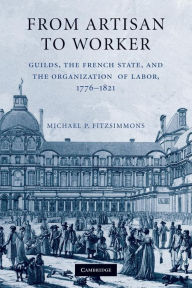
‘From Artisan to Worker: Guilds, the French State, and the Organization of Labor, 1776-1821’ By Michael Fitzsimmons


Artisan to WorkerA caveat here: Fitzsimmons was one of my professors in college.

I had to get my reader card for the Library of Congress to find a copy of this book (it’s irritatingly difficult and expensive to get copies of academic works) and, of course, I had to read it in one of the Library’s reading rooms (not the cool one, but a smaller one, but closer to the stacks where this book was stored, so delivery was faster).

One of the less written about consequences of the French Revolution was the dissolution of the guilds and worker managed corporate entities (though, not all workers – just ‘masters,’ as opposed to apprentices). Without overromanticizing the guild structure, it’s hard not to view this as a loss for working people. He never uses the words, but in the titular move from ‘artisan’ to ‘worker,’ it’s hard not to think of Marx’s famous alienation of man from the product of his own work.

An early anecdote about a man who tried to get around the guild system in the expansion of his wallpaper manufacturing business is illustrative of what would be lost without guilds. Jean-Baptiste Reveillon wanted to streamline and unite all aspects of production, from papermaking to printing – and to do so outside of the guild structure. He succeeded, at least for a while, and at the height of his success, he used his wealth to push for a decrease in the daily minimum wage to something roughly equivalent to the cost of a loaf of bread.

A few little bits that struck me:

Paris is the center of France in a way that is not true of many of other countries’ capitals and largest cities. In my own experience, Bangkok might be an exception.

Even as early as the Bourbon Restoration, the Chamber of Commerce opposed the concept of organized workers.

For better or for worse, mechanization would proceed unimpeded by guilds or regulations, generating greater social injustice than the system of corporations had engendered…

Note: in this case, corporation is meant in a different sense than in modern English and refers to various guilds and professional/worker associations.

The Sunday Paper: It’s Not Very Good


697_234On sort of defending Vanessa Place. But not really. But, yeah.

Two poets were included in the recent list of MacArthur Genius Grant winners (and yes, I know that we’re not really supposed to call them ‘genius grants’ or ‘genius awards,’ but, whatever, everyone does, so what are you clinging to? also, Ben Lerner is probably better known as a novelist, but, whatever).

If you’re looking for free tickets to concerts at the Library of Congress, you’re in luck – no more service charges from Ticketmaster! But you’re also out of luck, because they’re mostly sold out (though you can still try and get ‘rush’ tickets before the show).

And there may be a hurricane hitting me today or tomorrow. Wish me luck.


texts&beheadings/ElizabethR


BAM_image300As part of a series of plays by and/or about women that is currently appearing throughout the city, the Folger Shakespeare Library put on texts&beheadings/ElizabethR.

It’s far better than the title, which sounds like it was written by someone who’d just read of tone essays of by second rate Derrida disciples.

On stage are four ‘Elizabeths,’ each representing, in part, different periods of her life, but mostly different aspects of her life. For example, the last one to be featured (in what the cast declared to be Movement 4), mostly focused on her strident anger at attempts to marginalize her or threaten her reign or right to rule.

Each of the four movements featured one actress whose ‘lines’ were almost exclusively from the writings on Queen Elizabeth herself – from her prayers, her letters, her poetry, and her speeches to Parliament. The other three would speak more colloquially, providing background and context.

It was absolutely gripping and compelling and it seems petty to criticize, but I will anyway. One actress had a strong accent (Spanish, I think), which detracted, for me, from her portrayal as that quintessentially English figure. On a more existential level, as fantastic as it was, what was the purpose? What were we intended to learn or walk from it with? I’m not clear.

But still. A Shakespeare theater was the perfect outlet for this, because any production of Shakespeare invariably is at least partly about showing this centuries old writer, this man of his times, wrote works that are relevant and timely/timeless. If this play (performance? production? it’s not exactly a play, is it?) had a purpose, at least part is showing how Queen Elizabeth’s existential, feminist struggles for power, for the right to power, and for the right to determination are as timeless and timely as they are of their time.

Whiskey, Cocktails, And My Dinner With Andre


A few weeks ago, three of us went to Breugger’s, a sort of fancy, craft cocktail kind ‘o place near my home. I forget exactly what I ordered (though I recall having my pronunciation corrected by the waiter), but it was after I finished that I decided to give up on cocktails.

We’re not talking about walking away from having a mojito on vacation on a hot summer day, but no more drinks that take perfectly good liquor and sweeten it up for someone else’s palate.

Later that evening, I ordered myself a glass (neat) of decently aged MacCallan. After one sip, I wondered what I had been thinking before. For the same price of an overpriced cocktail, here I was enjoying the taste of fine scotch.

For my birthday, my better half took me out to a nice restaurant near Union Station. Whenever I go out to a nice restaurant and can safely indulge in several courses and end with some sort of digestif, whether espresso, brandy, whiskey, port, or the like, I always think about My Dinner with Andre.

The titular Andre (Andre Gregory) died not too many years ago (just one or two). I never saw him much else, except a filmed staging of Uncle Vanya called Vanya on 42nd Street, which, incidentally, also featured Wallace Shawn.

Anyway, rarely has two men eating dinner been so riveting. Of course, it’s also frustrating. As a viewer, I find myself in Shawn’s skeptical camp. Also, his more financially struggling camp. Gregory’s comparative wealth gives him options to indulge in mysticism and contemplation not available to the forever struggling playwright and sometimes actor. But what a movie. And the food always sounds delicious, without being obtrusive within the ‘story.’

I Finally Got My Better Half To Come With Me To #LittleSalonDC


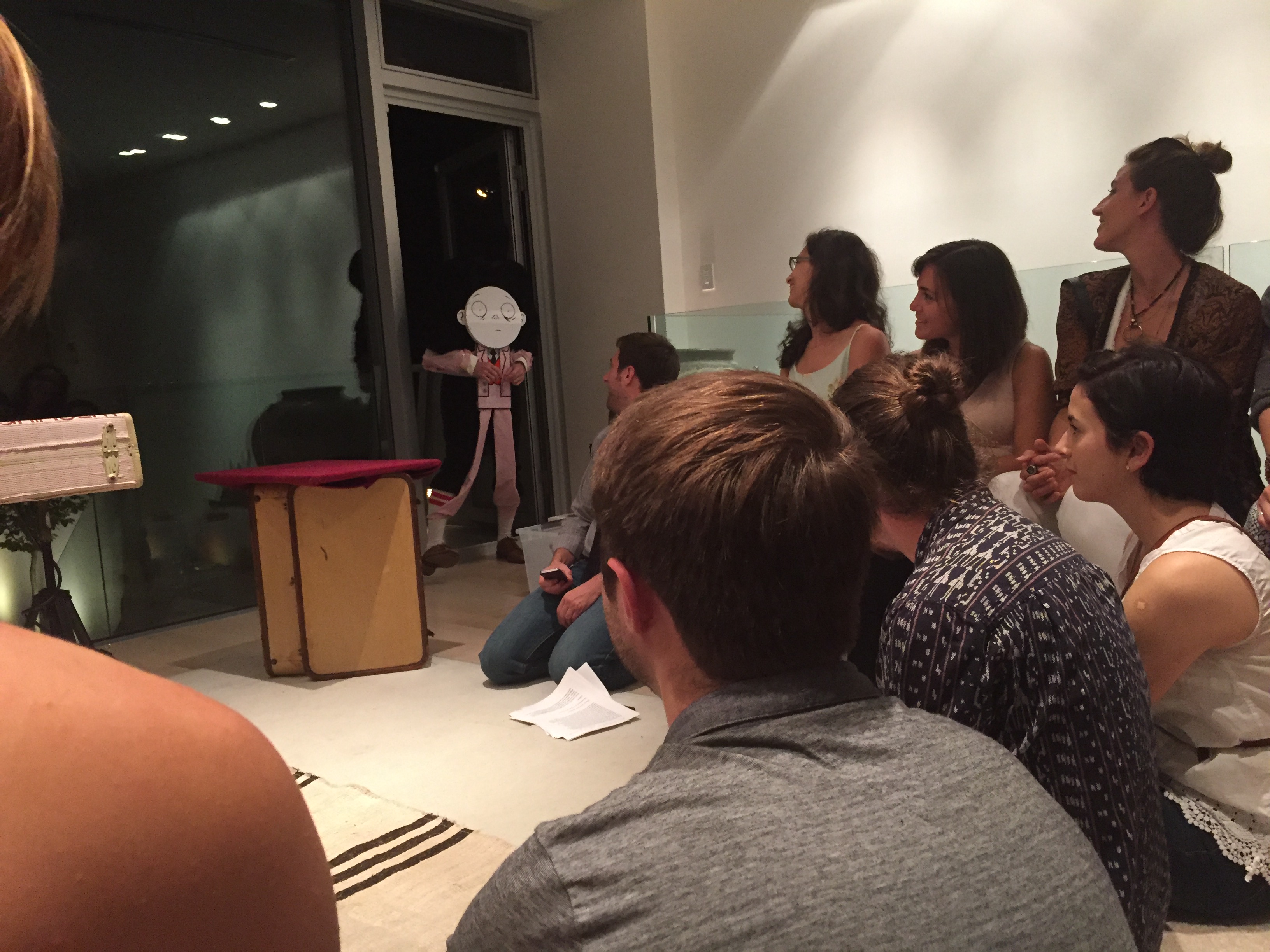
PuppetIt wasn’t that she found the idea particularly objectionable, but that she was out of town every time I went (purely coincidence, I assure you). She hemmed and hawed a little, but in the end, it was a great night and I think she enjoyed it.

Flying Guillotine Press launched new book of collaborative poetry by sixty odd writers called Breaking the Lines. I checked it out, but it wasn’t really my bag, but I did pick up another one of their books, Stephanie Balzer’s WED JAN 30 12:58:10 2013 – THU DEC 20 14:16:36 2012. There were also jam samples from PinUp Preserves, but someone I missed those.

The opening was some poetry by Lucian Mattison and… can I admit he didn’t really do it for me? From DC’s ‘Opera on Tap’ (wherein people sing opera at bars) were Kristina Riegle, Carla Rountree, and David Chavez. They actually sang from musical theater, but they were great performers, as well as being excellent singers. I even got some special attention during ‘I Hate Men,’ because when the line about men with chest hair arrived, well, I was the only person near the front with  suitably Sean Connery-esque fur. I don’t get a huge amount of attention from ladies these days, so we take what we can get, even if it’s being singled out during a song entitled, ‘I Hate Men.’ Finally, there was a vaudeville style act by Mark Jaster and Sabrina Mandell (from Happenstance Theater) and puppetry by Sarah Olmsted Thomas and Alex Vernon (also occasionally from Happenstance Theater). The puppetry was absolutely magical, though it would take too long to explain, so if you live near DC, try and find a time to see it and if you don’t, well, sucks to be you.

Seeing His Holiness At The Capitol


I wasn’t one of the handful inside the Capitol, but was one of the ticketed folks on the West Lawn of the Capitol. We waited (the gates opened at five am – though I was not there nearly so early) for him to arrive and watched his speech on the jumbotrons (bless you, Pope Francis for spending so much time on the need to abolish the death penalty!).

When he came out, he was a vaguely anthropoid shape, dressed in white on a distant balcony. The experience was not physical closeness, nor even the presence of the Pontiff, which could have just as easily been experienced with far more clarity on a television (and perhaps more enthusiasm; it wasn’t the most rabid crowd I’d ever been in). Rather it was knowing that this was an important moment and you were there. Like the days when we have gone to the White House, such as when Osama Bin Laden was killed or Obama re-elected, when we went not to change history, because history was already changed, but to be there, at a symbolically important location, at a symbolically important time when something important (and good) was happening. Such things are important, personally.

Midweek Staff Meeting: Telecommuting


hirshhorn-song-1-1024x681I actually have no article to post here about telecommuting, but his Holiness is visiting DC and, even though I am writing this Monday evening, I feel confident saying that traffic will indeed by horrible and snarling today (Wednesday). A lot of folks are telecommuting and, really, I’m hoping I will be allowed to, as well, though it’s hard to say and my office doesn’t really have a policy on this.

Hume and Buddhism. Actually, I think this kind of link can be a little tendentious, especially trying to show that Hume was actually influenced by Buddhism. But, whatever. Hume is really cool, regardless.

You will be missed, C.K. Williams.

A nice, balanced article about the new head of my favorite museum in DC, the Hirshhorn.


Weekend Reading: Grillo


The Colonial Market & Fair at Mount Vernon is nice excuse to visit a very nice that happens to be very close by. Not ‘let’s jump on the Metro’ close, but definitely ‘it’s a short and fairly pleasant drive, much of along the river’ close.

It’s cool that people are supporting lit mags, but I’m not sure if this is a sustainable model. Also, stop throwing the word ‘avant-garde’ around so much. It doesn’t mean what you think it means.

Now I want to get this new translation of Mallarme.

Favorite Bookstores: The Clearance Shelves At Politics & Prose


If, when you walk into Politics & Prose, you take the stairs down and then take a left and walk along the wall of the stairs, you will find shelves of various things, including drama and, most importantly, poetry.

Lots of poetry. Good poetry. Inexepensively priced poetry. Hardback copies for $7.99. Paperbacks for $6.99, $5.99, $4.99, $3.99.

I’ve bought books by Christian Wiman, Rita Dove, Franz Wright, Anne Carson, and Liu Xiaobo. I’ve passed by, because my arms were already full and my small budget already busted, books by John Ashberry, Frederick Seidel, and Augsut Kleinzahler.

Check it out. It never disappoints.

Weekend Reading: Community


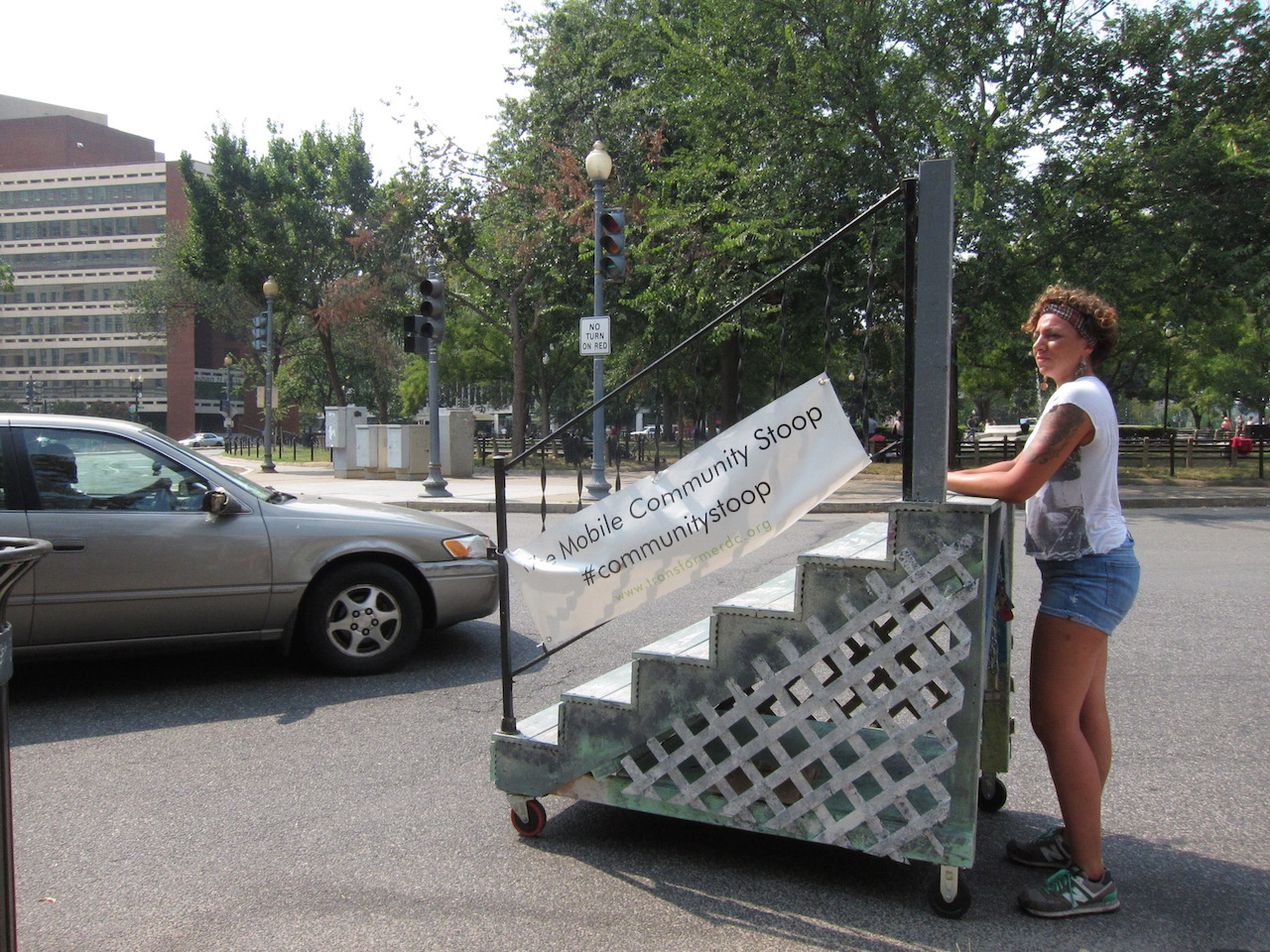
IMG_4342It’s an old argument and can frankly get boring, but it also has some merit. The sense of community created by people sitting on their stoops and front porches and interacting with their neighbors. While that’s hurt by the increase in apartment buildings and condos, our city frankly needs more and denser housing (it also needs a lot more affordable housing, but that’s another matter – but, in any case, more single family homes are almost certainly not the answer to the problem) But lest you think I’m some sort of grinch, I think this ‘mobile stoop’ is a great idea.

At the end of a terrifyingly claustrophic passage… a treasure trove of fossils and a new hominid. But I’m getting the willies just thinking about getting stuck in the narrow chute.

The destruction of a ruin is like the desecration of a body. It is a vengeance wreaked on the past in order to embitter the future. And how often it is that those who destroy ruins are the same ones who desecrate bodies.