Movies & Masterpieces


I was reading this article in The Nation about the movies and was struck by one line:

Since, moreover, the mass audience is so calculatingly considered in the actual making of film—and since any one film is put together by so large a number of people—the films reveal more about society as a whole than any other works of art except literary masterpieces.

The comparison of the anthropological aspects of the greatest works of literature to cinema. Specifically, to the mass (or, as Dwight McDonald might say, ‘masscult’) cinema, as opposed to the cinema of the auteur.

It rings true, doesn’t it? But what should we think of it? That it takes an army of producers, writers, and marketers, as well as a hundred million dollars, to reproduce the reproductive/reflective (see what I did there? ‘reproduce’ and ‘reproductive?’ I didn’t need to use ‘reproductive’ and ‘reflective’ but it just seemed too cool an alliteration/repitition to pass up) of a Roth or a Zola. One assumes that Ulysses or The Brothers Karamazov could only be matched by the complete and combined ouevres of Michael Bay and Steven Spielberg.

But still, we haven’t properly answered or addressed the question of what it means if popular and frequently mediocre constructs like the year end box office top ten can perform a major function (? ) of literary masterpieces?
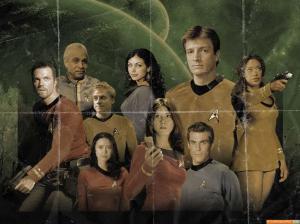
I Would Watch This Star Trek Movie, Too


firefly-star-trek

I Don’t Know If I Want To See ‘The Hobbit’


You would have thought that I would have bundled myself and the family out of the house at 11 pm in order to have seen it at 12:01 am on its opening day. After all, I did that with The Lord of the Rings films.

But I felt myself reluctant.

What I have read about the movie makes me uneasy. Turning it into a trilogy. Apparently, making the raid into the dungeons of the Witch-King of Angmar part of the story, rather than a tale told by Gandalf within the story. In general, making The Hobbit more epic, when the joys of the novel were in its slightness.

Built on a great, mythic foundation, but ultimately the story of friendship and the story of a sedentary man (or hobbit, actually) growing into himself as a resourceful and (when necessary) brave traveler. And the book within the book – the book that Bilbo Baggins writes about his adventures (and which Frodo completes) is titled There and Back Again. ‘Back Again.’ Not an epic. Not really, half the title of Bilbo’s book references the joys of returning to family and friends, hearth and home. Coming back changed, but coming back, nonetheless. In fact, it was only after this adventure that Bilbo adopted his cousin/nephew, Frodo, as his heir. He left a solitary bachelor and came back appreciating the family one makes for one’s self.

This is a very different kind of thing than an epic and that’s just fine.

So, I fine myself reluctant.

Education For Immigrants


Lost in time. Surrounded by evil. Low on gas.

That’s right. I’m making an elderly Thai couple here in this country on a tourist visa watch Evil Dead 3: Army of Darkness.

TOUT VA BIEN By Suzanne Stein – AT THE MOVIES


AT THE MOVIES (this section’s titled was not boldface type) mimics title cards (I’m sure they have other uses, but I think of them as the title cards showing dialogue in silent movies).

There are classical references to the myth of Orpheus, Eurydice, and their trip to the underworld and also to Jean Cocteau (there is a ‘character’ named Heurtebise, after a character in a Cocteau film, but like much of this, I don’t know what the references are supposed to accomplish).

Overall, it’s not bad. The problem is that Anne Carson has done it all and generally done it better.

In terms of integrating classical myths into contemporarily relevant poetry, read Autobiography of Red.

For this conceit of films and title cards? Carson did a series of poems called TV Men (I particularly remember her TV Men: Artaud, utilizing the brilliant, tragic, mad figure of Antonin Artaud).

There is a running theme about death and (lack of) existence. Conceptual poetry seems almost invariably to be ontological poetry (sometime epistemological, but more often ontological) and this does implicitly ask the implied questions in that model and does so in a fashion that is interesting and well done. But neither interesting nor well done enough, I fear.

The Earth Dies Screaming


Star Trek: Into Darkness


Star Trek Into Darkness

Remember WENN


I used to love this show, though sadly, I can’t find anymore episodes online and it was never released on DVD (though there are, apparently, some old VHS copies of some of the episodes running around…).

http://www.dailymotion.com/video/xkesqz_remember-wenn-season-01-episode-01_shortfilms

Harrison Ford Is A Replicant


I’m watching Blade Runner (one of the director’s cut versions, of course – sans voiceover) and even though Ford was 39 or 40 during filming, when you watch it, all you can think is ‘he looks so young.’

It ain’t human. I’m  38 and no one ever comments on how young I look (though I get plenty of comments about the grey in beard and semi-questions like, ‘so what are you… in your forties?’).

The Sunday Newspaper – Death & Poetry


The dying poet.

If you want a confessional, read his books, not his diaries.

The (not so) secret radicalism of Paul Ryan.

Has she seen Episode II?

Send someone you know (or someone you don’t know) a book of poetry.