
Skylight Books – One of My Favorite Bookstores


It seems shameful to me now that, while discussing my favorite bookstores, I have so far failed to mention Los Angeles’ greatest bookstore, Skylight Books.

Located in the hip Los Feliz neighborhood, it has successfully fought off the woes affecting other indies and the bookselling industry as whole and has nearly doubled in size in the last few years, annexing the space next to them.

I discovered Skylight when my friend and co-worker, Grace Lee, took me the Dresden, a bar in Los Feliz just down the street from Skylight Books. It was closed, but just looking through the big storefront window, I could tell it was a place I wanted to visit. The following weekend, I made my first visit.

It is one of those bookstores that makes a special point not to focus on picking up the latest bestsellers, but on books that are good or unique or interesting. Rather than stocking their poetry section with nothing but regurgitations of the greatest hits of long dead white men, they focused on local poets, on contemporary poets, on avant-garde poets, on women poets, on poets of color.

Their philosophy section wasn’t filled with stuff like The Matrix and Philosophy, but with volumes by Alain Badiou and Gilles Deleuze.

They had a whole rack devoted to ‘zines published by local artists and authors.

And their readings… oh the readings.

Skylight Books may very well be my favorite bookstore of all time. I would say that it is even worth a plane ticket to Los Angeles just to visit it.

10 Greatest Poets


Poet and professor Dean Rader is working a list of the ten greatest poets for the San Francisco Chronicle. The idea is to mimic the “10 Greatest Composers” put together by the New York Times.

Let me start of by saying how pleased I am to see a major city daily writing about poetry, especially on an extended basis (the series will go on for two weeks, as Rader considers very options within the pages of the paper).  Let me also offer my two cents:

1. William Shakespeare

2. Charles Baudelaire

3. Aleksandr Pushkin

4. George Gordon Lord Byron

5. Percy Bysshe Shelley

6. Rainier Maria Rilke

7. T. S. Eliot

8. Emily Dickinson

9. Dante Aligheri

10. Walt Whitman

Runners-Up: Paul Eluard, Boris Pasternak, Ezra Pound, Arthur Rimbaud, Pablo Neruda, Edgar Allan Poe

My list is, clearly, biased to only include the western canon. This is a limitation of my own knowledge and experience, rather than a statement on world poetry. It is also biased towards English language poetry, for much the same reasons.

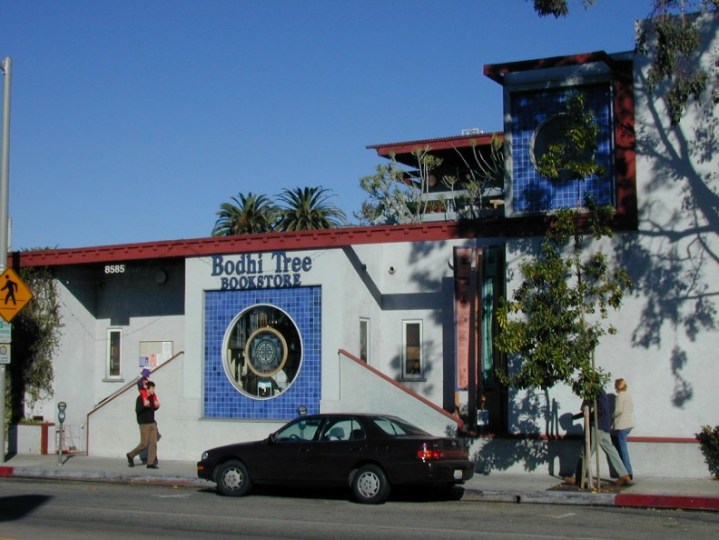
My Favorite Bookstores: The Bodhi Tree


I have only rarely done yoga. I’ve never been particularly spiritual. I don’t believe in New Age theories. Yet I am fascinated by the collection of spiritual and New Age books at the Bodhi Tree Bookstore in Melrose in Los Angeles. I discovered it quite by accident, just exploring the town one weekend, but came back frequently.

Unfortunately, the Bodhi Tree is in imminent danger of closing. Right now, it is only guaranteed to be open through the fall of 2011, though they are working hard to find a new owner who will keep it alive in the manner which it deserves.

For the moment, though, it is a wonderful community gathering spot.

Even if, like me, you are not into New Age stuff, they had a solid poetry section, a wonderful selection of primary texts in Asian philosophy and thought. Also, as a historian, I find Theosophy fascinating and they had a great many primary texts by Blavatsky and here successors, students, and followers. And they did not ignore Christian, Jewish, and Islamic thought and texts, either.

I don’t know what will happen to the Bodhi Tree, but I pray it can survive in a form which can continue to serve those who seek some sort of solace from its shelves.


The LA Lit Scene


I came across this great little piece about some of the wonderful lit mags being published in Los Angeles County. I loved living in Los Angeles and feel the town does not get enough credit for its literary scene. Besides hosting some of my favorite independent bookstores like Skylight Books and the Bodhi Tree Bookstore, I also attended some great readings and literary happenings. And that article focuses only on the big dogs of the local lit mag scene, but overlooks the fantastic ‘zines being put out in the area. Skylight Books famously has a great collection of these locally produced ‘zines and I bought a great many from them while I lived there.

One of My Favorite Bookstores: The Borders Books & Music in Hollywood


I admit to being very fond of Borders. Yes, this is hypocritical of me, having spent so much blog space arguing for spending one’s dollars at independent bookstores. And I do try. But when I lived in Hollywood, I used to visit the Borders on the corner of Sunset and Vine several times a week, buying a new book almost every week (god bless Borders‘ rewards program!). I did prefer Skylight Books, but Borders was within easy walking distance.

Borders, admittedly, was not so comfy as Barnes & Noble (the standard decor of a Borders is a little anti-septic). This was exacerbated by the fact that my Borders (the one in Hollywood) didn’t have nice little café to relax in (though there was a wonderful little coffeehouse just a block away where I used to take my laptop and do a little bit o’ work).

There were so many books and authors that I discovered at the Borders: Fredric Jameson’s Archaeologies of the Future, Simone de Beauvoir’s The Mandarins, Haruki Murakami’s The Wind-Up Bird Chronicle, France Yates’ Giordano Bruno and the Hermetic Tradition, Kenneth Rexroth’s The Complete Poems of Kenneth Rexroth and 100 Poems from the Japanese.

So, if this is the beginning of the end for Borders, I will mourn for it. The one nearest me now – it used to be on 12th in downtown Washington, DC – is gone. There is another, a little further away (though close to my old office) on 18th. It is not as cozy as it could be (as this article explains – though in answer to the question it poses, the answer is yes, we should mourn).

Let me direct you to this article explaining why the demise of Borders is bad for all of us (though he is wrong about the reverberations spreading to Barnes and Noble).

In honor of my fond memories, I have chosen to direct anyone who clicks on the links to any of the books I mentioned to Borders‘ online store.

going going


The other day, I pulled a little chapbook called  going   going by Jen Hofer out of my bookcase. I was just looking for something small to put in my pocket and read when going out to grab some noodles and pick up my niece, who was taking one of the Chinatown buses in town.

I remember very clearly buying this chapbook. It was at a Poets Against the War reading at Skylight Books. I went because I love Skylight Books and because Wayne Kramer was reading. Wayne showed up in an orange, prison jumpsuit and read some works in his hyper, rat-a-tat-tat style (he reminds me, in that respect of my friend, the Florida poet Brad Morewood – though Brad has never been, so far as I know, a seminal punk musician like Wayne).

I can also say without a doubt, that this occurred on January 13th, 2008. I know that because Jen wrote it in the chapbook.

going  going is a little handmade number, constructed out of index cards and postcard from Death Valley, clipped together at the upper left hand corner. Whether it was done on a typewriter or not, it wonderfully mimics the font of an old, manual typewriter. The whole thing has a sort of Larry Eigner feel (though I say this having read very little of Eigner – I leave it to my betters to correct me in my comparison).

It is a good, hard edged books of politically aware (if not always explicitly political) poetry. It was put out by the small internet mag and sometime chapbook publisher, Dusie if you wanted to try and find it.

re: evolution


re: evolution, another book from Les Figues Press, did not immediately hit me the way that Voice of Ice, Voix de Glace did, but that does not make itless of a work.

The work is divided up in small sections – an “introduction,” 48 “chapters,” a “denouement,” “the end,” and finally a section that mimics (but is not) end notes entitled “research paper.”

The dominant tool is one of deconstructing language, science, and culture. re: evolution also contains more than a whiff of feminism – with the deconstruction seemingly put to the task avoiding redcuctivism by objectification or fetishism. Unfortunately, it also led to the relative absence of any eroticism. Not strictly sexual, but the sense the writer “desires” the words, “desires” the poetry s/he is writing is not there – not for me anyway. But am I just inflicting/projecting my own gendered sexuality onto the work?

Voice of Ice, Voix de Glace: Redux


I actually contact Alta Ifland to compliment her on her collection. During our brief correspondence, I asked in what language she had originally written Voice of Ice, Voix de Glace – French or English. Contrary to my original assumption, she assured me that French was the original language – sort of. Many of the pieces were essentially written simultaneously – the French and English, I mean. She also said that she has given up (for the moment) writing in French.

Les Figues Press: Voice of Ice, Voix de Glace


My books from Los Angeles’ own Les Figues finally arrived – are:evolution, and Voice of Ice. They also sent me a bonus – Stephanie Taylor’s Chop Shop. Very, very generous of them. I love free books. In fact, I encourage all publishers of poetry and quality literature to send me free books. I promise to review them all for you!

[Pause]

[The sound of crickets]

Well, no takers so far. I will continue to pay for my books, on the whole, it appears. On to Voice of Ice, Voix de Glace.

Basically, I love it.

I have mentioned in the past how I have difficulty really getting into some genres of avant-garde poetry. I respect Ron Silliman, but I don’t pretend to understand Tjanting. +’me’ S-pace (another Les Figues publication) confused me.

One sort of expects that virtually everything that Les Figues publishes would be a bit out of my league. Not so, this time.

Voice of Ice, Voix de Glace is a series of prose poems written in French on the left hand side and English on the right. This was almost certainly written in English and then translated into French (the absence of translator credits and my meager French are the basis for this assumption). The poems follow a sort of life cycle pattern, from birth to death. There is an obsession with the body (and the destruction of the body), particularly with eyes and tears. At first, this might make the focus seem ontological – which, according to Fredric Jameson, who, in his Postmodernism, or the Cultural Logic of Late Capitalism, wrote that the difference between modernism and postmodernism was paradigmatic break between the epistemological and the ontological. In that sense, it would suggest that a focus on the nature, construction, and dissolution of the body would place Voice of Ice firmly in the ontological category. However, the use of the body seems strongly metaphorical, as a means of self-awareness – putting it squarely in the epistemological side of the equation (though something so stark as epistemological versus ontological is always going to be false dichotomy – but that doesn’t mean it can’t be a useful tool).

The style is vaguely surrealistic, but unlike, say, an Eluard or Char, whose surrealism is marked by ontological shifts within a poem, Ifland, once she has established the “reality” of a particular poem, tends to stay within that reality. The best comparison would probably be to the prose poems of Arthur Rimbaud, rather than surrealists of the early twentieth century. Which just goes back to my assertion that the poems are more within the realm of modernism than postmodernism.

* * * * *

I just read that the poems were originally written in French and then translated by Ifland into English. From reading it, this seemed unlikely to me (the French seemed to close to a word for word translation of the English and what I saw lacked colloquial phrases that resist literal translations), but lacking inside knowledge, I will defer to others on this.

‘My Vocabulary Did This To Me’


I picked up a copy of Jack Spicer’s My Vocabulary Did This To Me. This was an “it” book a while back, so I am totally just following the herd on this one. Except, I waited until it came out in softback and was significantly cheaper. What can I say?

My time living in California was a wonderful and creatively fertile experience for me. Spicer primarily interests me as someone who saw himself as a regionalists – almost never selling his books outside of the greater San Francisco area during his lifetime. Of course, I am also interested in periods like the Berkeley Renaissance of the late forties and fifties as an example of those glorious moments in literary history that I keep on missing.

Stylistically, I can appreciate Spicer as synthesizing Language Poetry (which I don’t always understand/appreciate) and Surrealism (which I generally feel that I do understand/appreciate).