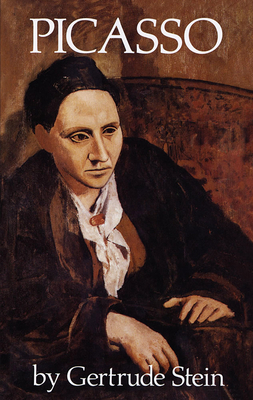
‘Picasso’ by Gertrude Stein (New Year’s Resolution, Book Twenty-Three)


At first it seemed to me that Gertrude Stein was writing like Hemingway. She’s actually writing very specifically like Hemingway did in A Moveable Feast. Especially the bits featuring… Gertrude Stein. Only with more commas (more about that later).

A Moveable Feast is a great read for content, but the writing itself is c–p. We pretend it’s not because we want so much to like it. Sort of like The Old Man and the Sea. When all either of them really are is better than the most execrable of Hemingway’s later work (I’m looking at you, Across the River and Into the Trees).

A friend once told me that Stein’s Making of Americans reads like Henry James, but with two out of three punctuation marks removed and replaced with ‘and.’ Well, Picasso reads like bad Hemingway, but with triple the number of commas and every third comma placed randomly within a sentence. This can make things difficult to understand, as you ask yourself, now, is she creating a new dependent or independent clause that will change the meaning of this sentence or is she just having fun with commas? And if you don’t know what I mean about commas changing the meaning of a sentence, check out the book Eats Shoots and Leaves.

No one in their right mind would read Stein on Picasso in order to understand Picasso. No, you read it in order to read Stein. Just like you don’t read Heidegger on Nietzsche to get anything like a better understanding of Nietzsche.

But… I did get a couple of insights.

She writes very briefly (little more than acknowledgement) of his blue period, but that talks about a slightly later ‘harlequin and rose’ period. She also says this period appeared twice! I had always thought of his clowns appearing in his blue period and don’t know what to make of this claim.

She eschews personal psychology (nothing, for example, about the melancholy of his blue period), but is obsessive about a sort of cultural psychology, with Picasso, in her estimation, being heavily defined by his ‘Spanish-ness.’ But this does lead her to make a remark about the influence of calligraphy on Picasso. You can see something of calligraphy in his ability to create images and complete shapes through a few broad strokes. And, thought she gets some facts and history wrong, she is clearly trying to show the influence of the non-representational religious art and the use of Arabic calligraphy in Muslim Spain.

Finally, and to close on something positive to say, I was pulled up short by one bit. I was dismissive of her attempts to connect his to a certain ‘Russian-ness’ and talk about a Russian period, but then I saw a reproduction of Picasso’s FEMME AU SOURIRE. It wasn’t Russian in the sense that Stein was talking about (or else she completely misreads whatever the Russian character might be), but that 1929 painting really does resemble something from the pre-Stalin, post-Revolution, Russian avant-garde!

Near White Sands, New Mexico


WhiteSandsNM

Midweek Staff Meeting – Dinosaurs Of Tibet


The Dalai Llama as a man of the right.

Just… so sad.

A portrait of Descartes.

Poetry doesn’t need to be nice and maybe it oughtn’t be.

I won’t lie. Being Texas, I’m surprised that any group of white people clung to bilingualism for this long.

Midweek Staff Meeting – What Should You Do?


Kant’s guide to sex.

How can you hate your own father?

Michigan modern.

In modern Greece, what is a poet to do?

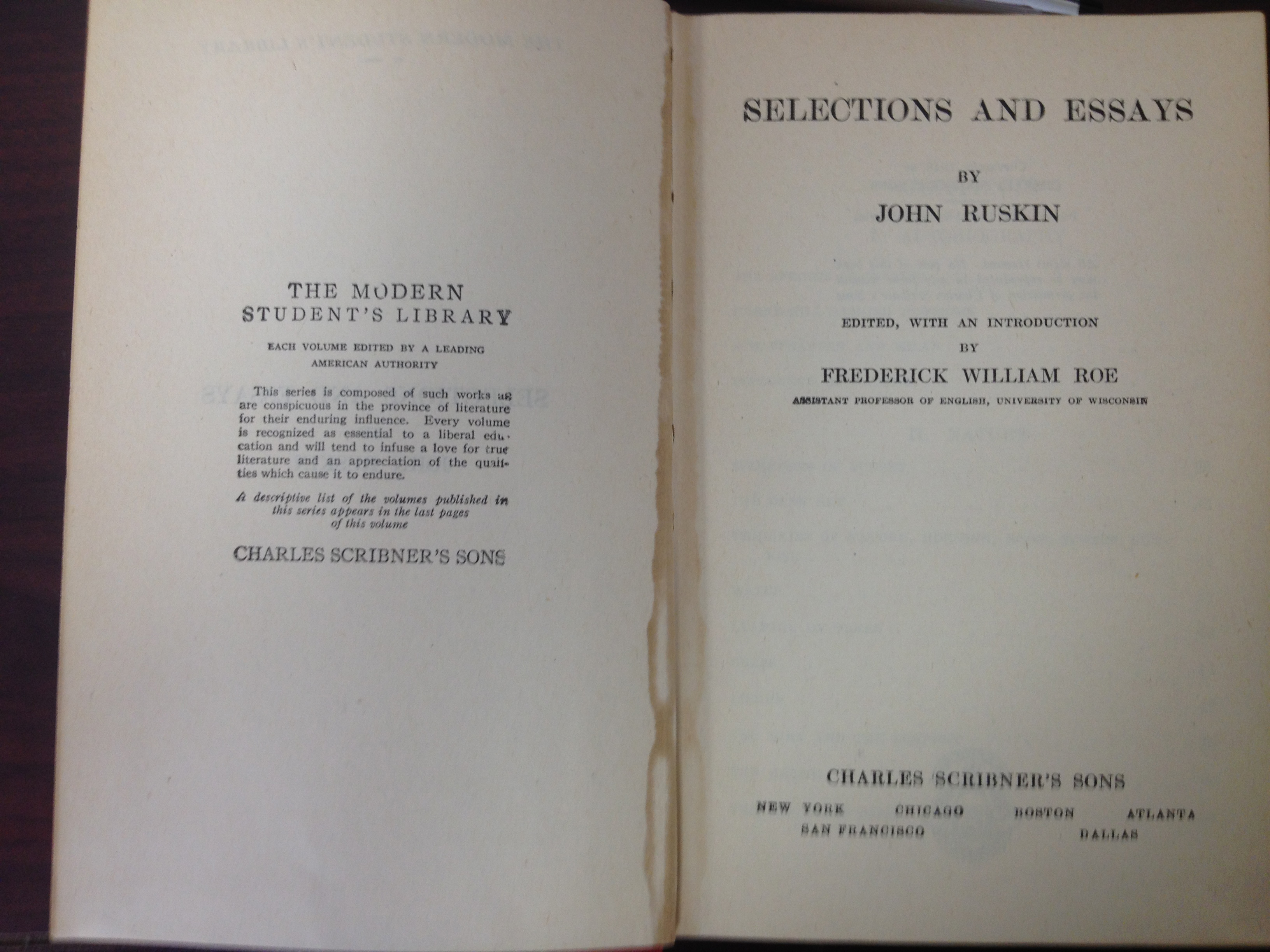
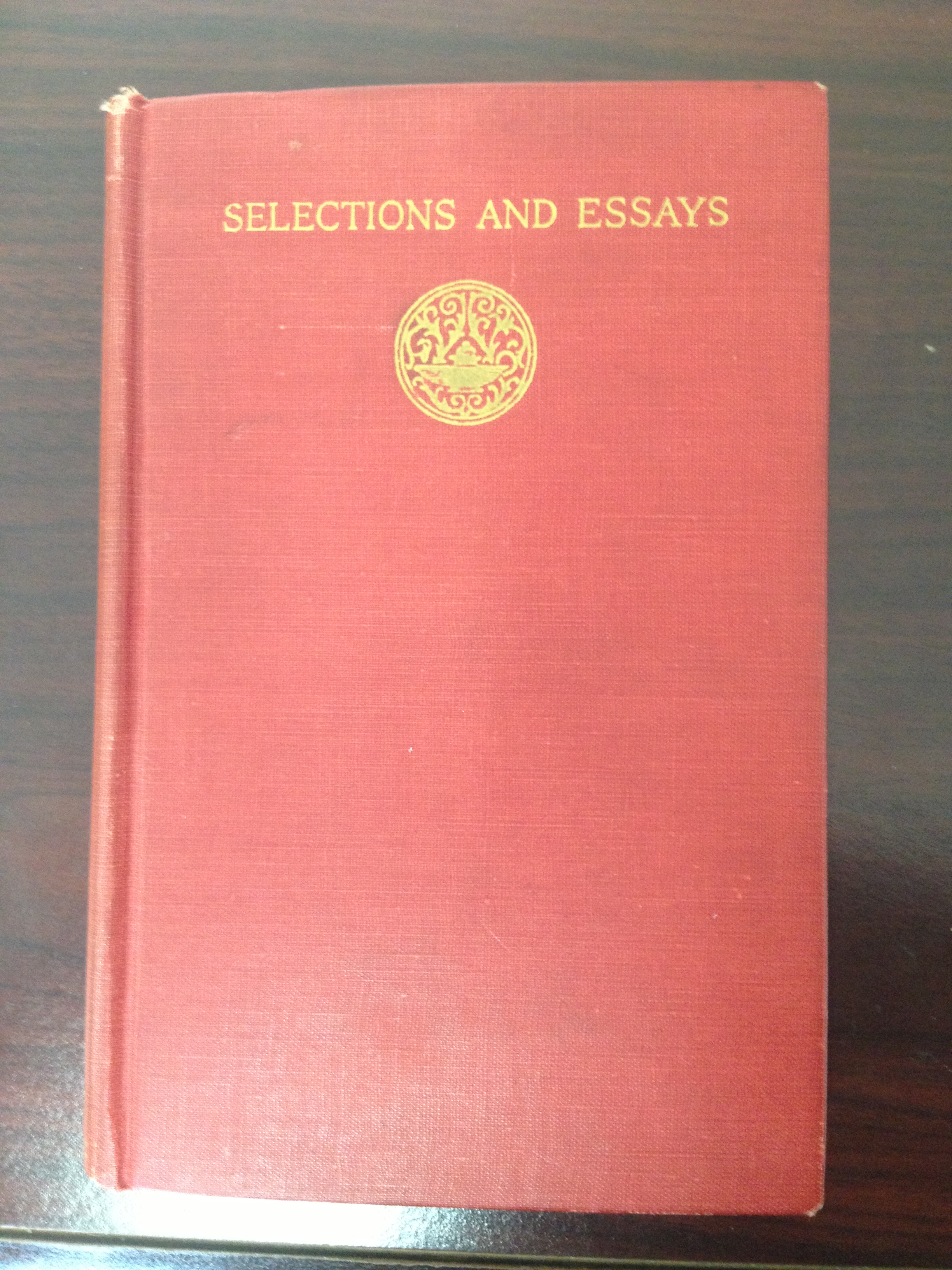
‘Selections and Essays’ (New Year’s Resolution, Book Sixteen)


photo (1)At the Lantern, in Georgetown, a fantastic (and cheap!) used bookstore filled with high quality, interesting books, I gathered up a whole mess o’ reading, including this collection by the nineteenth century art critic, John Ruskin.

Ruskin was a cheerleader for the Pre-Raphaelite painters.

In fact, when I was buying the book (books, in truth; five to be exact), the sweet young girl (I’m guessing a Georgetown student) at the desk and I got into a conversation about him and the Pre-Raphaelites. She was planning on seeing the exhibit and asked, rather pointedly, where I found the book. I think she had been looking for a collection of Ruskin’s writings and was a little miffed that I, a stranger to this place, had found it first. Then the conversation moved to Andrew Lloyd Webber (the older woman who runs the shop joining in at this point). In case you were wondering, I like Jesus Christ Superstar and that’s it. The rest is trash.

So, Selections and Essays dives very quickly into selections that get into the heart of what informed Ruskin’s taste and his theory of art.

Firstly, in some autobiographical pieces, he returns again and again to how his mother required him to read deeply into the Bible, memorizing passages and reading the whole thing from cover to cover several times as a child. There’s also some stuff about reading Sir Walter Scott’s Waverly novels over and over again as a family, but I think that’s less relevant (which no doubt means it is the coda to all of Ruskin’s later thought).

Then, in his rapt discussions of the appearances of nature in nature (first, the thick, creamy, curdling, overlapping, massy foam, which remains for a moment only after the fall of the wave), you can see how Ruskin could have appreciated Turner’s later and more impressionistic (small ‘i’ – Turner was no Impressionist) landscapes.

Ruskin believed that personal, moral feelings were imparted to art (and therefore necessary for art?) and that art called for an accurate, yet also naturalistic depiction of the natural world, by which I mean, the rural world (no urban cityscapes, for him, no thank you, please). The moral is especially critical. He ultimately see aesthetics as a moral science (he even prefers to call it theoria or the theoretic faculty to distinguish it from traditional aesthetics).

He is almost prescriptive. When ostensibly writing about art, he is actually writing about nature, but, really, he is writing how artists ought to depict nature by describing how nature appears to the viewer (sometimes, from several different viewing angles).

Let us have learned and faithful historical paintings – touching and thoughtful representations of human nature, in dramatical painting…

Because of his relation to the Pre-Raphaelites, I noticed that he called Michel Angelo [sic] the ‘Homer of Painting,’ Michelangelo being, as it were, Raphael’s immediate predecessor, a true ‘Pre-Raphaelite.’

To ramble a bit, have you read Elaine Scarry’s On Beauty and Being Just? Because she must have read Ruskin. They’re coming at from different angles, in the sense that Scarry begins with the idea that, these days, there is a need to justify beauty and uses moral reasoning to do so. Ruskin, of photocourse, is not justifying beauty, but he still finds its core in moral reasoning.

I didn’t quite know what to think about his political writings, which, apparently, were his obsession (in an early essay he is clear that he comes from a family of lifelong Tories and also so self-identifies, though he sounds to me like an advocate of what today would be called democratic-socialism or European style socialism). He claims to hate liberalism, which seems confusing (because he is surely advocating liberal ideas) until you remember that in the nineteenth century ‘Liberal’ meant more a sort of middle class libertarianism.

These were the days when ‘economics’ was called study of ‘political economy’ and he clearly shows the difference that makes (and also how poorly understood much of economics was; this is not a criticism of Ruskin, but things got a lot clearer post-Keynes). He rightly understands that wealth (riches, he says) is actually about power. I don’t know how widely understood or how widely stated that was, but if it was neither, here’s a fine example of how the mindset taken when the field is called ‘political economy’ can lead to some good insights.

I noted one passage on page 340 that stuck out because he seemed to be advocating for Glass-Stegall!

…that the private business of speculating with other people’s money should take another name than ‘banking.’

The most shocking passages are when he writes critically, dismissively of Greek art and architecture. I had never heard of a nineteenth century Englishman writing less than admiringly, fawningly about the glories of Greece. Frankly, I don’t know what to think. I mean, I like ancient Greek art and architecture and poetry and culture. I feel like I’ve been found out as some sort of Dwight McDonald style midcult bourgeois fraud. Once again though, you can see that connection to the ideas that inspired the Pre-Raphaelites, this deep love, almost to the exclusion of all else, of the art and architecture of the period in western Europe from the eleventh century until just before Raphael.

Weekend Reading – West Virginia Leads The Way


A Republican politician in West Virginia wants to put science fiction in schools.

A magical time, with sexual fetishists, future mass murderers, and radical intellectuals (sometimes, all three at once).

Decline of a once (surprisingly) great art museum.

Takeaway quote: ‘Philosophy – it’s a bag of d–ks.’

The bookishness of books.

The Sunday Paper – Even My Cane Fornicates


Sexy, Victorian-style walking.

‘Spring Breakers’ given a surprisingly positive analysis from (a) perspective of feminist theory.

How much for that museum in the window?

Dumbarton Oaks


So, we were trying to find Dumbarton House, which, as it turns out, is completely unrelated Dumbarton Oaks (I still haven’t been to Dumbarton House).

On the plus, Dumbarton Oaks Garden is insanely relaxing.

On the downside, the entirety of the Dumbarton Oaks Museum, including the pre-Columbian art wing, designed by Philip Johnson (who I am a fan of; I actually used to pick up my paycheck from a building he designed in Minneapolis), was closed.

But, with a bag full of books bought from The Lantern, a lovely spring day, and time to kill, I still recommend visiting.

20130417-103204.jpg

Devil Dinosaur


I read three different DC Comics: Aquaman (which I am about to give up on), Batman, and Action Comics (which I was going to give up on, but I have decided to power through).

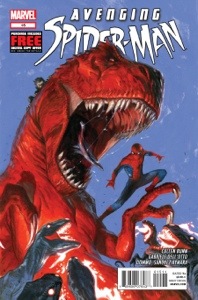
So while I was buying a bunch, catching up after two months of inattention, I saw a familiar looking shape on the cover of an Avenging Spiderman comic.

Devil Dinosaur was a later seventies, Jack Kirby comic. It never really caught on didn’t even make to ten issues. And it’s my favorite.

He and his pre-human companion, Moon Boy, are occasionally introduced into other comics from the Marvel Universe, but too often, it seems, as a sort of joke.

But in this two issue, Spider Man story arc, he’s treated (though it’s also suggested that Devil is a woman) reasonably respectfully.

I can only hope this repeated.

20130413-163229.jpg

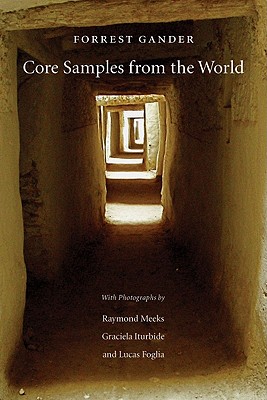
Core Samples From The World (New Year’s Resolution, Book Fourteen)


9780811218870Core Samples from the World is a beautiful and disquieting book, though not always disquieting in a good way.

As part of the Folger’s poetry series, Forrest Gander read at the Philips Collection, against the backdrop of an exhibition of works by Jean Dubuffet, Alfonso Ossorio, and Jackson Pollock.

The exhibition itself was very good, though most of the Dubuffet’s and Pollock’s I had seen elsewhere. Ossorio was new to me, so kept my attention much more strongly and moved me much more deeply. His merging of a unsettling passions, representation, anti-representation, and a deeply conflicted faith is wonderful to behold.

Forrest Gander is a poet I had been meaning to read and I’m glad for the excuse. He read not just against intellectual backdrop of the exhibition, but also against the very real backdrop of projections of various works from the exhibit. For each slide, he read a poem he felt was in correspondence with the work.

Unfortunately, Gander’s poetry and the work of the three artists demand close attention and my ability to appreciate both the poems and the art were diminished by split attention. Frankly, I was barely listening to the poems by the end. Which is too bad, because he’s an excellent poet.

Local poet, Sandra Beasley, moderated the discussion. I like some of her work and she’s clearly knowledgeable, but she talked too much. By which I mean to say, when the questions you are asking, in a public discussion like this, are longer than the answers you’re getting, it’s time to think up better ways of the asking the questions. She also brought up that Gander is a relationship with another man. The context was a question about living with another artist, but the fact of his sexual orientation was somewhat awkwardly inserted and the way he dodged around the question suggested to me that he wasn’t very glad that part of his life was brought up.

But on to Core Samples from the World!

The poems are interspersed and, to some extent, done in correspondence with photographs by Raymond Meeks, Graciela Iturbide, and Lucas Foglia. Of the three, only Iturbide was familiar to me.

The good stuff. Gander’s a good poet. Some gorgeous turns of phrase: stopless winds or A butcher draws his blade against the plush throat of a goat

Read that last one again. The interior rhyme (it’s from a prose poem section) of ‘throat’ and ‘goat’ and strange, beautiful insertion of ‘plush.’ Great stuff, eh?

And in the third section, there’s a long series of prose poems about a trip to Bosnia-Herzegovina. It’s hard to explain, but it’s magical. I rather thing that he does so well here because it’s about a more purely western culture (though eastern Europe).

Finally, it ends with one of the best descriptions of the feeling of being drunk you’re likely to find outside of a Kingsley Amis novel.

But…

A lot of ‘buts.’

Gander is a very, very good poet. This is not a very good book.

It feels unsettlingly paternalistic. The poems a somewhat narrative, world-wearingly detailing his trips to writers’ conferences in places like China and Mexico (it can read like a melancholy, non-hyper Tom Friedman who has actually learned to write – not just poetry, but anything). He interrupts ‘his’ poetry with sing-song three lines stanzas that read like mediocre translations from Tu Fu, but which are clearly intended to be the voice of these strange, foreigners he meets. And in combination with some photos that resemble a bit of poverty porn (though not all – and in the middle is strange photograph of young, blonde dressed like an extra from a Raquel Welch movie about dinosaurs, only one of her tastefully nipple covering furs is actually a fox stole; go figure).

I almost feel like ripping out the photographs and forcing myself to read each section of the longer poems out of context, away from each other, just to enjoy the language and skill. But I can’t, can I? I can’t separate it, can I?