Memorializing the dead through conceptualist poetry/art.
And now for some Dungons and Dragons humor…

Memorializing the dead through conceptualist poetry/art.
And now for some Dungons and Dragons humor…
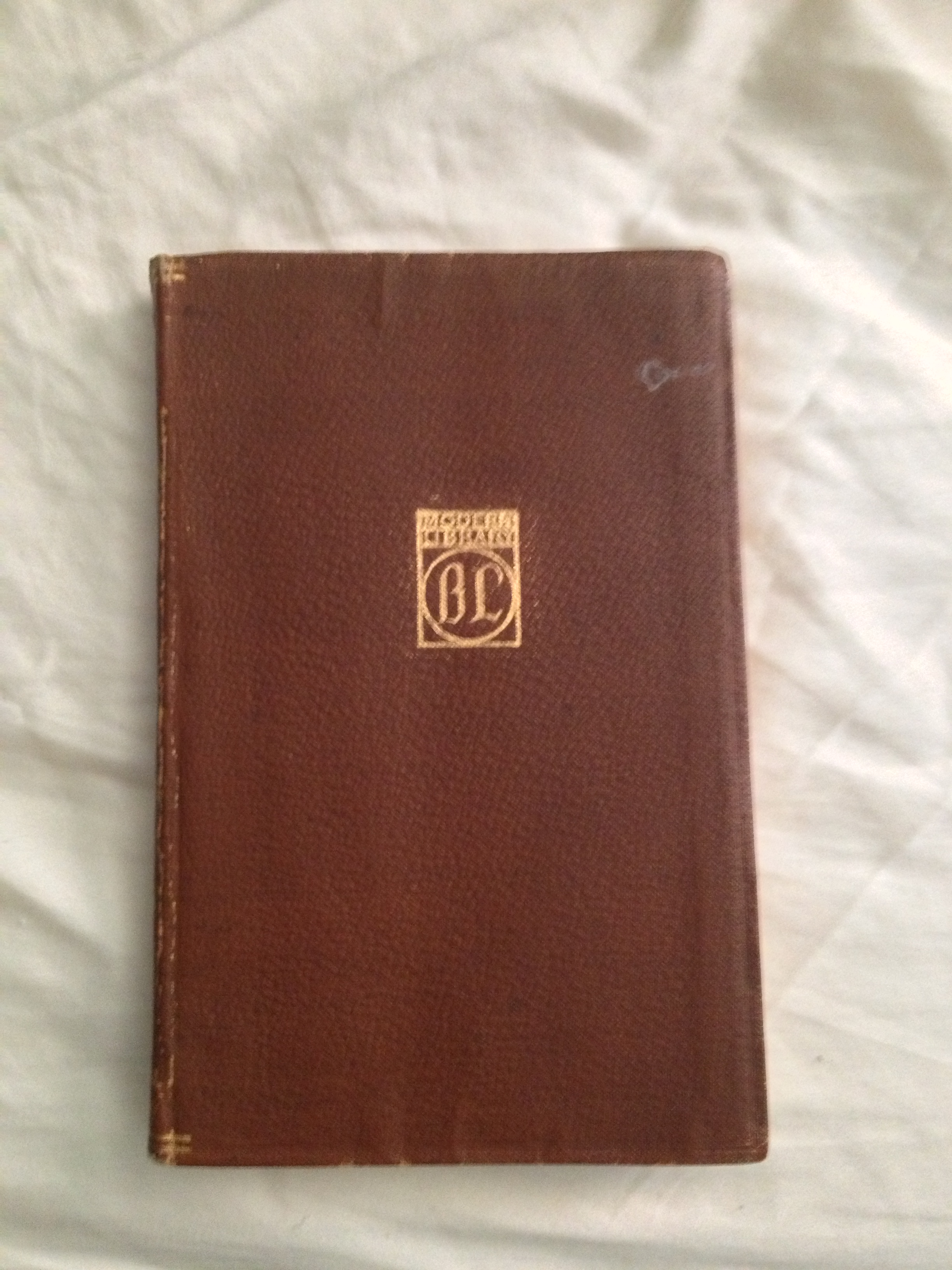 Walter Pater’s Renaissance is a collection of essays mostly, though, oddly, not exclusively, on topics related to the Renaissance. The introduction (by Arthus Symons) acknowledges Pater as being among the second tier of nineteenth century British prose stylists and historians, but still worth reading. He’s basically right. This book is a light and airy pastry, dusted with fine sugar. Delicious and sweet, but quickly dispatched and and forgotten (except should one see it again on the shelf, in which case some fond memories might re-emerge).
An effort is made by Pater to recognize some of the lesser lights and aspects of the time. Botticelli, for example (who is only lesser in comparison to Michelangelo, Da Vince, and Raphael), and some French writers and literature. A sort of aesthetically minded humanism unites his writings, but there is little enough that passes for a thesis in any of the essays. He tries to find something new to say about the works of the artists, but he never quite settles nor properly explains it. For example, there’s something he wants to say about the poetry of Michelangelos’s statues or how the art of poetry is somehow expressed in them (while failing to say much about the rather good poetry that Michelangelo happened to write), but I don’t really know what it is that he wants to say.
Excepting an author’s conclusion, the final essay is the best. It is also not about the Renaissance. It’s about Johann Joachim  Winckelmann, an eighteenth century art critic/historian who wrote about Greek art and literature. It’s the longest essay and a real passion comes through. For Pater, I think, Winckelmann represents a scholarly ideal that critics like himself should strive to emulate. Winckelmann’s love for the Greeks is well captured by Pater. This essay, I could see myself going back and reading again.
Overall, Pater is no Ruskin. But it’s a reminder that the great nineteenth century essayists were pretty wonderful. Makes one adopt a sort of declinism when thinking about the modern essayist (who is, often, really a humorist).
Finally, there is an inscription:
M J Hutchins
July, 1920
This book was gifted nearly a century.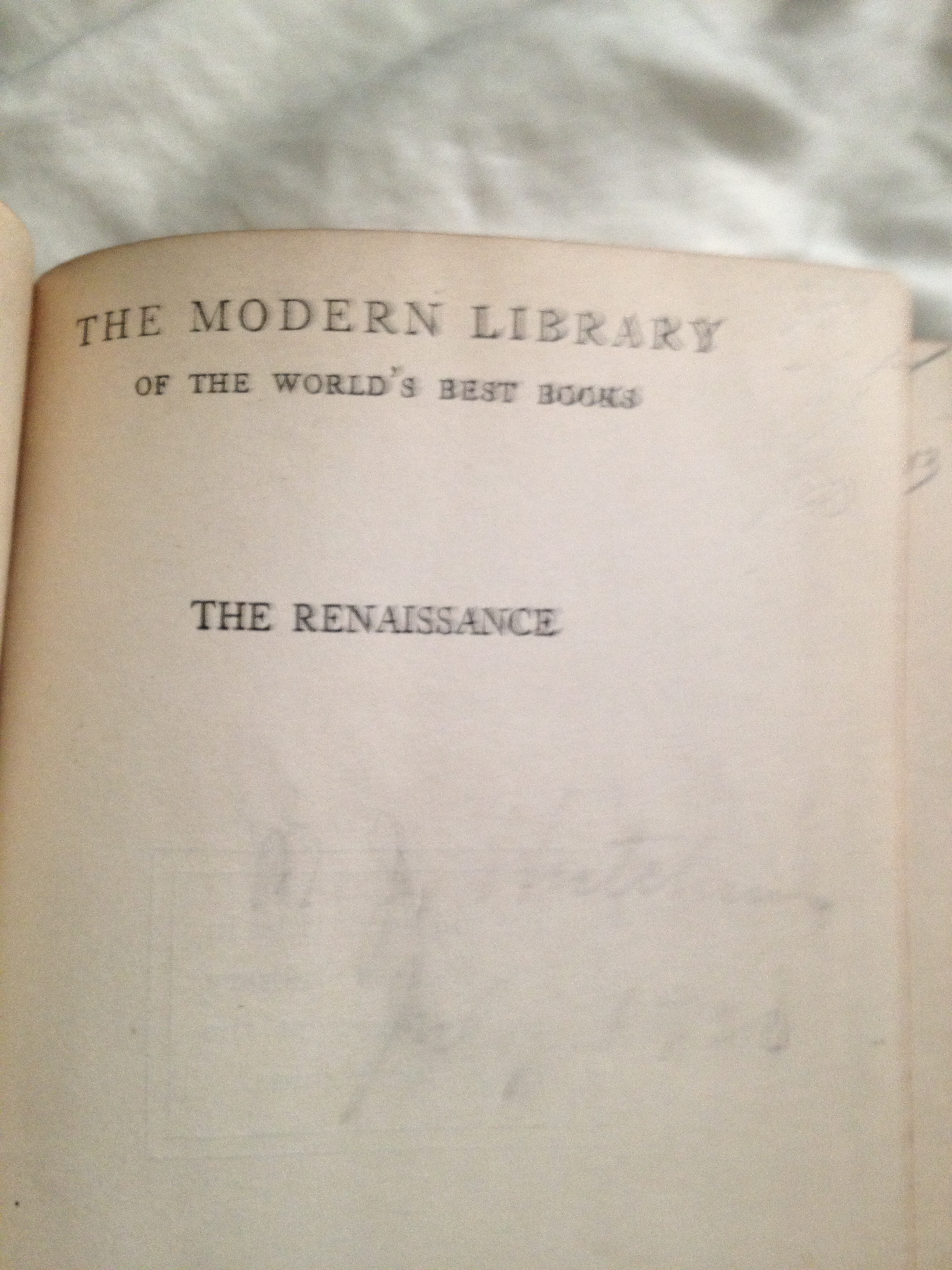


 the coffee philosopher