IMG_0562.JPG

The Formation Is Not The Problem


I totally reject the premise that Juventus’ problem in the Champions League is their 3-5-2 formation. Totally and without reservation. Formations, provided one has the players to execute and the tactical nous to make adjustments to a particular player’s role (go a little wider or tuck in a little more; attack more or stay back; mark or press this opposing player), are beside the point.

Manchester City has struggled in the Champions League with a far more expensively assembled lineup, yet no one is blaming Manuel Pelligini’s formation on their shortcomings.

The Champions League is difficult and Juventus, with the exception of their goalkeeper, the ageless Gianluigi Buffon and Andre Pirlo, and their tireless terrier of a striker, Carlos Tevez, does not have many players with experience in the latter stages of the tournament. Switching to a 4-2-3-1 or 4-3-3 or 4-3-1-2 or a 3-3-1-3 (shout out to Marcelo Bielsa on that last one) is not the answer. Luck, a few new players, and some more luck are the answer. I would argue that they failed in the past because Juventus didn’t sufficiently rotate over the season, but it’s certainly not about a particular formation, unless it’s not properly executed.

Happy Halloween, DC


IMG_8355.JPG

The Irish Poet, Galway Kinnell, Has Died


First Heaney, now Kinnell. If Eavan Boland passes tomorrow, I’m going to lose it.


‘The Hundred Thousand Kingdoms’ By N.K. Jemisin


9780316043922The Hundred Thousand Kingdoms absolutely hooked me, yet left me with little reason and less desire to read the sequels (it’s the first in a trilogy, apparently). The world building is superb, if limited to a small segment of the world’s society: magic heavy, high fantasy with cutthroat politics and fallen gods roaming an impossible palace in the sky.

But at the end, the main character, Yeine, turns into a goddess. This is after learning that she’d been implanted as a fetus with the soul of a murdered goddess (sort of Kali-like goddess – representing both birth/life and death) and also having mind blowing sex with an enslaved god (the brother/lover of the murdered goddess) named Nahadoth, but more commonly called the Nightlord. This ending had a consequence of upturning the structure of world we’d been introduced to, as well as taking most of the characters we’d come to know best out of play. Because the world we’d experience was such a small segment, there was no real sense of the impact of the changes and, one a micro level, there was a very real sense of disappointment that these folks we’d come to know would probably not be around for the sequel. So, a well done standalone novel for me, but a poor start to a series.

I do want to give the author credit for making the hero a woman of color with healthy attitude towards to sex (which is not to say promiscuous) who is not particularly physically attractive. It doesn’t quite pass the Bechdel test, but that’s nitpicking.

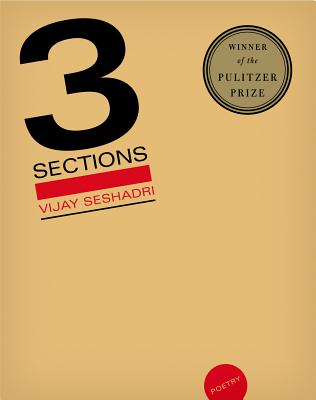
3 Sections


At the last poetry reading at the Folger, they brought together three poets published by Graywolf Press: Vijay Seshadri, Claudia Rankine, and Matthea Harvey. Stephen Burt moderated the conversation that followed brief readings, where he was, to be generous, more of an enthusiastic rather than moderating presence (he was deeply interested in hearing what all the poets had to say, but in his excitement, inadvertently made himself the subject).

Claudia Rankine’s fiercely political collection, Citizen: An American Lyric, is the poet du jour and she did not disappoint. But I had already bought Seshadri’s collection, 3 Sections, a month prior.

3 Sections9781555976620 is an interesting collection. There is a gentle thread of politics that winds through it all. At the time, it was hard not to compare that more wistful scent of the political to Claudia Rankine’s, who writes far less gentle political poems (which is not to say strident; but they are fierce). Maybe that less parenthetical word is the key: he does not write fiercely, but with a touch of melancholy, a lot of gentle humor, and something approaching fatalism.
Rankine participates in the Other as a black woman born in America. Seshadrii participates as an Indian born outside of this country. The comparison made vivid two different kinds of alienation.

There were several long poems, including a long (over ten pages) prose poem. During the conversation, he resisted the term ‘prose poem,’ as being something belonging specifically to the surrealist poets of the 30s. But it will do as a shorthand.

It’s about fishing, with discussions of the character and prejudices of fishermen in the American northwest, and also Russian fishermen. And also the Cold War. And a journey onboard a Japanese fishing vessel and the narrator (is he?) getting debilitating seasickness. It could be read as a longform essay, but it is, in a way I can’t articulate, definitely poetry.

He also has an ambivalent view towards technology. Or jaded. He doesn’t believe it changes much.

Here is the fourth (of five) stanzas from a poem entitled New Media:

It’s not the thing,
there is no thing,
there’s no thing in itself,
there’s nothing but what’s said about the thing,
there are no things but words

Fantasy Magazine, First Issue


As a birthday present, my mother found me a copy of the first issue of Fantasy Magazine, published in February, 1953. Inside was a then previously unpublished novella by Robert E. Howard, entitled The Black Stranger. It stars (actually, almost guest starring) his most famous creation, Conan. Howard killed himself in the thirties, so didn’t live long enough to see his character become an icon and his stories the foundational texts of modern fantasy.

Howard is rather like Arthur Conan Doyle, in some respects. The quality of the writing is mixed, to be generous (Howard is a worse writer than Doyle, but better than another foundational pulp figure, Edgar Rice Burroughs, without whose John Carter stories, we likely would not have Star Wars). But despite the obvious inadequacies of Howard and Doyle, they both created something ineffably compelling in their most famous characters. They have also both not always been well served by the onscreen depictions of their characters. Holmes has always been so much elusive and complex on the page than in any of the television and movie versions (I’ll make an exception for the old BBC series starring Jeremy Brett, which were quite literal). Conan, too, is a far more interesting and three dimensional character on the page than he ever will be on the screen. The (relatively) recent movie actually reflected the cunning pirate of the printed pages, but at the expense of building a small and petty character. Schwarzenegger brought the subtlety of sledgehammer to his acting, while Oliver Stone and John Milius brought all their respective left and right wing paranoia to the screenplay and direction, respectively, but at least they combined to make him into something mythic, even if the finer points were trampled on, ground into fine dust, and finally tossed under steamroller before being buried under a Walmart parking lot.

The Black Stranger is written in the third person, but, except at the very beginning and the end, keeps the focus on other characters. Even when Conan reappears in the middle, the effect is of viewing him through others’ eyes. It is far from the best Conan story, which are generally some of the shorter ones, but there’s not really such a thing as a bad one, if you’ve got a taste for pulp.

Like Burroughs, Howard wrote when genre designations like sci fi and fantasy didn’t really exist. Look at the names of the early magazine and what do you find? Weird Tales. Astounding Stories. Amazing Stories. Howard and Lovecraft were pen pals and (sort of) friends and both published in many of the same periodicals, though that would not be true today. Howard has such an outsized influence that he effectively created (with co-creation credit going to Tolkien) the genre of fantasy out of the more nebulous genre of ‘weird.’

IMG_7833.JPG


IMG_0563.JPG


IMG_0564.JPG


IMG_0565.JPG