
Heather McHugh & Geoffrey Brock Read At The Folger Shakespeare Library


brockcoverThis was a sadly sparse reading. Not empty, but perhaps just 80% full and with upper balcony totally empty. Which is too bad, but Brock gave a great reading.

McHugh was the judge of the latest Anthony Hecht Poetry Prize and she chose a manuscript by Brock as the winner (thereby getting it published by Waywiser Press).

Some years back, I spent too much money on an oversize paperback by Richard Howard entitled, Inner Voices: Selected Poems, 1963-2003. For the life of me, I don’t know why I bought it. I hated it. A lot of the poems are written in the voices of historical figures. I mention this, because that is much of what Brock does, only I like his poetry.

McHugh was a little confusing. She spoke a lot about personal challenges and about her support for a particular cause: people who are long term caregivers for severely disabled relatives (usually their children). At one point, I thought she was reading a poem and then she looked up and started speaking about the cause and I could never tell whether these were asides during the reading of a poem or if none of it had been a poem.

I bought and Brock read from Voices Bright Flags. Very enjoyable. He’s got a nice, light touch and recognizable style, without being repetitive. A lot of serious poems, with passages about John Brown and the Civil War and slavery, but also some light humor about being a father with an insistent toddler. I actually remembered reading the first poem in the collection, Bryant Park at Dusk, in Poetry (the magazine).

I’ll excerpt from a poem about Ulysses S. Grant. Mostly because it’s a good poem, but also because Brock drolly noted that no one writes poems about President Grant.

My heart then like a puffed-up private boasting
he’s cut the enemy’s leg off
– Not his head?
– Sir, someone else had cut that off already.
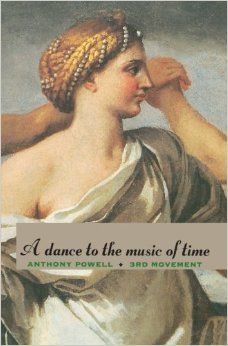
‘The Soldier’s Art: A Dance to the Music of Time Book Eight’ By Anthony Powell


63f5491de9bb3f204d274501fccbe53dSo… the revenge of Widmerpool. Maybe? Does he intend revenge? Or merely to remove anything which might cause embarrassment on his way to the top?

Stringham, one of the wealthier and more popular schoolmates of Widmerpool, had, after years of riotous living, dried himself and achieved a kind of peace. When he reappears, it is as private in the army, whose job it is to be a waiter in the mess hall. Jenkins (the narrator) suggests to Widmerpool that maybe Stringham could be helped.

The piggy (I can’t help but think of him that; in fact, I think of Widmerpool as being a malicious version of Piggy from Lord of the Flies) fellow agrees and transfers Stringham to a mobile laundry unit, knowing that it will shortly be deployed to the Far East and that he is sending Stringham from a comparatively safe position to one of far greater danger.

Is he trying to kill the man? Is this revenge for having been more charming, for being wealthier? Is he enjoying the appearance of meritocracy recognizing his own (evil) genius? Or is just afraid that his connection might be embarrassing so sends him as far away as possible?

I think that it is a kind of assassination. Which is supported because death, suddenly, becomes very real. On a single night, during air raid, bombs hit a night club and a house, each of which contained more than a few people of Jenkins’ long acquaintance. Death by way becomes clear after the first book taking place during WWII (The Valley of Bones) played almost like a melancholy. This one is melancholy, but not a farce. It could even be said to veer into Catch-22 territory, though Powell is a far more traditional writer than Heller and his novels are never so outlandishly absurd as that.

As a narrator, Jenkins is too phlegmatic for me here. It would be out of character, I suppose, for him to become openly emotional, but I wanted a bit more from him.

At this point, it must be nearly twenty years since the first novel and, despite that niggling criticism above, the scale of Powell’s achievement is becoming clear. A certain segment of English history (through the eyes of a very particular segment of the population) is being wonderfully chronicled in a subtle fashion. Things like Dunkirk are mentioned, but the focus is on the small scale. Just like the Great Depression was never mentioned, but its effects on the characters depicted.

R.A. Montgomery, Author And Publisher Of Choose Your Own Adventure Books, Dead At 78


Wow. Of course, I am of an age such that I read a ton of those books as a child. Though, if I’m honest, I read more of the Endless Quest books, which were put out by TSR, the parent company of Dungeons & Dragons (fantasy), Gamma World (post-apocalyptic), and Star Frontiers (science fiction). I actually bought one of those at the Royal Oak Bookshop in Front Royal, Virginia (my father and I took a trip there to celebrate his birthday).

But, this man started all that was either directly or indirectly responsible for dozens of such books that the elementary school version of myself relentlessly plowed through.

Alas, poor Yorick!


IMG_0560.JPG


IMG_0561.JPG


IMG_9275.JPG


IMG_0569.JPG


IMG_8353.JPG


IMG_8352.JPG

To Read, Or Not To Read


In bars, that is.

Because I saw this HuffPo post entitled Bars Are Great for Writers, But Not for Reading. Obviously, it was intended to gin up (did you see that pun I just made) some flames and back and forth and what not and it certainly got my goat.

You see, I love reading in bars.

I don’t get to do it much anymore. One of the things I really didn’t count when I became deeply involved with someone was that my solitary time at bars would greatly diminish. In fact, I think it’s safe to say it has nearly zeroed out.

But back in the day, it was my thing. And I loved it. The Pig an Whistle on Hollywood Boulevard was my haunt for several years. I would straggle in and belly up to the bar and drink Stella Artois and eat wonton chip nachos (so good!) and read. There are even certain books I have had trouble reading since my bar time diminished. Deleuze and Guattari’s almost deliberately unreadable Anti-Oedipus is actually more comprehensible when the intake of alcohol and alcohol absorbing nachos is properly balanced. Fully sober, the ‘body without organs’ means almost nothing to me.

There were novels and wonderful books that I read almost entirely inside the confines of a bar: Yabba Dew’s in Gulfport, Florida; the Pig and Whistle in Los Angeles; the Black Prince in Atlanta. The bartenders were understanding and I think the bars did okay, in spite of my apparently flagrant violation of the set purpose of the establishments.