Rae Armantrout At The Phillips Collection


For the last six years, one of the poetry readings in the Folger’s poetry series is held at the Phillips Collection, a private museum in DC. It bills itself (and I don’t doubt it) as the first modern art museum in America (it was founded in the twenties).

Rae Armantrout read in dialogue with an exhibit of Man Ray’s work entitled, Human Equations.

I got into the museum about twenty minutes early, so did a quick stroll through the Man Rays and also their permanent collection.

My father and I had just been talking about smaller, regional museums and their acquisition struggles. It is often a choice between buying first rate pieces by second rate artists or second rate pieces by first rate artists (the Phillips doesn’t have this problem – it’s got a first rate collection, through and through). Specifically, we talked about the Montgomery Museum of Art in Montgomery, Alabama. They have an excellent Hopper (my father noted) and a very good Rothko (I mentioned; though the Hopper is better).

Well, I’m strolling and what do I see but nearly half a dozen very fine Hoppers (though smaller than the one in Montgomery). A moment later, I walk by a sign for the ‘Rothko Room.’ Inside were four, good sized Rothkos (do you ever see a small Rothko? I don’t think I have). However, save one, they had color or color combinations that I found almost physically repulsive (that yellow!). I usually enjoy his work but… eewww.

Armantrout, it turns out, for me anyway, is better read on the page.

She admitted to not having a massive interest in art and having not had any particular interest in nor experience of Man Ray before being invited. Her comments about the pieces were shallow and the connections between her chosen poems and the art were flimsy and unconvincing. I can understand reservations about Man Ray, but she radiated a palpable disdain for the man and his work. I actually asked a question that came down to: Do you like Man Ray’s work? She said yes, but I am not persuaded.

Guy Raz from NPR moderated the conversation and it’s clear he know little about poetry. His questions were of a high school variety – variations on ‘how do you write a poem?’

Even though, once she’d signed my book, I still have forty-five minutes left to further peruse the museum (they’ve got a great De Kooning), I was so turned off by the event that I just left.


IMG_9390.JPG


IMG_0142.JPG


Be kind, for everyone you meet is fighting a great battle.

Philo of Alexandria

‘Mary Stuart’ (The Book)


In addition to going to see Mary Stuart performed at the Folger, I also have a copy of the play and I’ve been reading it.

There was no good way to do this: either I’m spoiling a play I’m about to see or else I’m rehashing in book form a play that I just saw. I went for the latter.

It’s good, but also reinforces something that nags at the brain.

It’s not as good as Shakespeare.

Well… duh. Neither is Edward Albee, yet we can mostly agree that Who’s Afraid of Virginia Woolf is pretty darn good. So what’s up?

Oswald deliberately uses iambic pentameter and the play itself actually takes place in Shakespeare’s lifetime, so the comparisons cannot be avoided. And some of the themes of power, nobility, loyalty, as well as the wonderful little plots and conspiracies are very much out of the Bard’s history plays. And it can’t stand up to the (admittedly, unfair) comparison.


IMG_9393-0.JPG


IMG_0376.JPG

‘Mary Stuart’


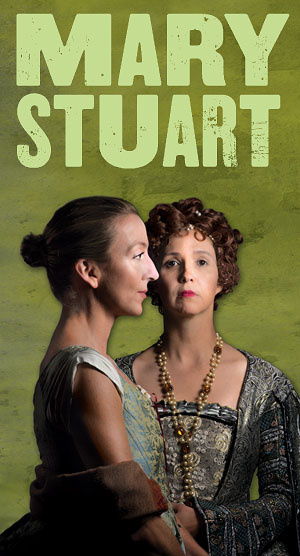
Mary StuartI saw Mary Stuart at the Folger the other day. It was a Peter Oswald translation of a Friedrich Schiller play that nicely combined the language Shakespearean style classicism and (also Shakespearean style) timelessness. He kept iambic pentameter rhythms and that certainly helped. Not the humanity spanning scale of Shakespeare, but good, nonetheless.

The set piece, as it were, was a meeting between Elizabeth and Mary, arranged so as to appear a chance meeting – with Elizabeth hunting near the castle where Mary was under lock and key and Mary, unusually, allowed some small taste of well guarded freedom in the outdoors.

In a way, the set piece was a let down. I was led to expect some showdown between the two that Mary’s wit, charm and inner nobility would win. Elizabeth, during part of Mary’s big speech, was looking up and to her right – directly towards where I was sitting. Her expression wonderfully captured a sense of contempt for Mary’s posturing.

Leicester was a wonderfully deceitful, semi-villain and Mary was great, but I was more impressed by Elizabeth – and not just that one moment. Her vanity and her fickle choice of favorites were well captured, but without sacrificing her realpolitik. It was all well and good to be high and mighty about royal prerogatives, but Elizabeth actually ruled, which came with as many compromises as powers.

Voltaire


I picked up a selected writings of Voltaire at the Dunedin Library book sale. The book is sort of a hodgepodge of stuff “not Candide.”

I cannot say I’ve enjoyed it so much. What is the value in Voltaire these days? Is his value as much for his image – the rebellious, bohemian, intellectual laying some kind of groundwork for liberty or revolution? – as for his actual output. I am excluding Candide here and that slim book alone might be enough to justify all sorts of deserved literary fame.

The first bit contains some letters written to friends in England and you read them, thinking, these are like a lot of other letters from the period. Better written and more interesting than a modern email, yes, but is it really that special? And where is Voltaire’s famed, biting wit? Later came some bite, which felt more like disrespect and some cultural criticism too timely to mean much anymore.

I have been left with an image of Voltaire as more of a p—k than anything else. I need to pick up some Kant or Rousseau or Montesqueiu or someone else like that to rekindle my affection for the enlightenment.

The Dali Museum


FullSizeRenderThe Dali Museum (or just ‘the Dali’) is the artistic and cultural crown jewel of not just St. Petersburg, but the whole Tampa Bay area. Really, it’s the only world class artistic institution in the region (though the Ringling Museum in Sarasota and it’s collection of Rubens and baroque art is a contender, but it’s not really part of Tampa Bay).

It was my first time visiting the new building. It’s definitely a more striking piece of architecture than the bland original home, but I was not convinced that they had necessarily improved the actual interior space in terms of its ability to effectively display the museum’s exhibitions.

There were two halls open: one containing a chronological retrospective of Dali’s career and the other jointly displaying Dali and Picasso side by side to illustrate the elder Spaniard’s influence on his famously mustachioed compatriot.

They were both wonderful, wonderful exhibits and provided me with a much better understanding of Dali. But it was also a little sad.

You see, because the Dali is such an important part of the cultural landscape of where I grew up, I take a certain familial pride, not just in the museum and the collection, but in the artist himself. He, as it were, belongs to me, if you take my meaning. I take pride in his position in the constellation of great artists.

The chronological exhibition showed his very earliest, adolescent works. There were painfully hackneyed and looked like stuff from the flea market. Of course, there were also his great masterpieces, of which the Dali has more than a few. But the memory of his juvenilia stuck with me like a toothache.

The Picasso/Dali exhibit similarly, by showing the great influence of Picasso and the occasional mimicry of Dali hurt my ego.

But that said, truly magnificent works. And Picasso is so overexposed that it is always a pleasure when some curator succeeds in presenting in a new light that actually reveals something about him and his work. I’ve more than a few Picasso exhibitions that come across like little other than a thin excuse for just putting some of his paintings in the same room. This was not one of those.

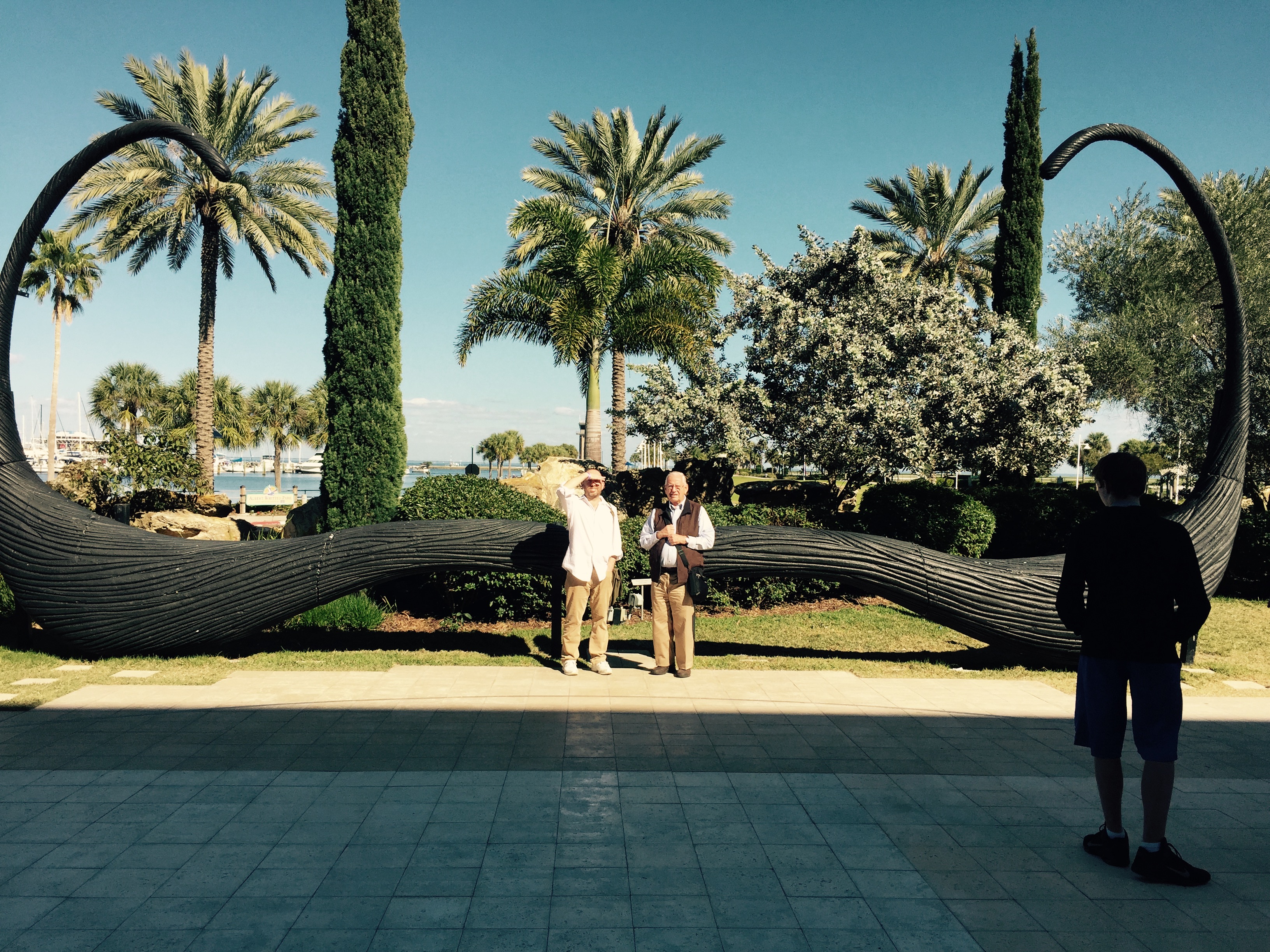
On another note, that it my father and I standing in front of giant mustache, outside the Dali.