What Kind Of Nation: Thomas Jefferson, John Marshall, And The Epic Struggle To Create A United States


This is a fascinating, reasonably brisk read and a worthwhile book, but the subtitle wildly overpromises.

Jefferson and Marshall didn’t like each other. In fact, it appears that Marshall positively hated Jefferson and during the near crisis of 1800, expressed a desire that Burr be made president instead of Jefferson.

I learned a great deal about Marbury vs Madison that I didn’t know and the cunning way that Marshall used it to establish constitutional review, as as well as much about the trial of Aaron Burr for treason. But here’s the thing, Jefferson was rather peripheral to those and Simon doesn’t even make a more than half-hearted stab at suggesting he was (at the time) terribly concerned about Marbury vs Madison, for example (though he was hellbent on leather on seeing Burr hanged). In fact, perhaps a quarter of the narrative takes place after Jefferson had retired from public office.

Ninefox Gambit


After reading this science fiction novel and then recommending it to a friend (I won’t say it was great writing, though perhaps it is better in the original, but it’s good writing and I just found it very fascinating), he immediately noted the en media res factor, with Lee tossing into a well thought out, but very outre science fiction universe and society. Mathematics based around calendars can, apparently, affect reality in some way that winds up wreaking havoc on technology based around other ‘calendrical’ systems. It’s like if the presence of a vinyl record player caused your all your iTunes songs to either blow up your phone or play nothing but ‘Baby Shark’ at ear splitting volume.

He also commented on how this society placed an emphasis on the wearing of gloves and how that was also part of the society of the Radch Empire in the amazing novel, Ancillary Justice.

This got me thinking and I eventually decided that Frank Herbert’s Dune was the forerunner of all this. The culture and the social and technological mores of that universe were detailed, well thought out, and completely alien to us. While Ninefox Gambit is no Dune, I can see the lineage.

Cyril Mango


I got this because it was the only thing in the library by Cyril Mango. I only heard about him an article mourning his passing, as a preeminent Byzantine scholar.

Ironically, his contribution is a remembrance of another deceased Byzantine scholar.

Look, obviously there were a bunch of other articles, but I just wasn’t feeling all those specialized pieces about Byzantine history.

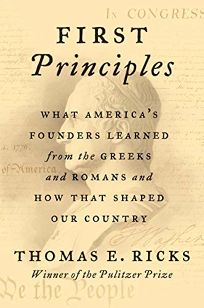
First Principles: What America’s Founders Learned From The Greeks And Romans And How That Shaped Our Country


I loved this book, because it’s all about the stuff that fascinates me about the Founders, particularly Jefferson. Does not necessarily make it for everyone. But if you wish you read Latin (or if you do and wish that everyone else did, too).

One of the central claims is that the early period examined – sort of late late colonial to the early 1800s – was heavily influenced by Roman and Latin history and philosophy. Later, as ideas of classical virtue declined, Greek to precedence.

He closes with an epilogue that addresses contemporary issues, including Trump, and how classical learning, especially Latin, can help.

While I don’t disagree, he never properly made that case in the previous two hundred odd pages. Too bad.

Brutus: The Noble Conspirator


Equal parts fascinating and maddening book which readily admits it is weaving a whole cloth out of not much thread. It asks an interesting question: Brutus is given a certain amount of respect, relative to his co-conspirators in the assassination of Julius Caesar, but why?

He is typically depicted as being rather more high minded than the ‘lean and hungry’ looking Cassius.

What does Ms. Tempest conclude? That he had a bit of a reputation as being a high minded person while alive and that he also actively sought to promote that image, even if it wasn’t always warranted (because there is, apparently, evidence that he was also greedy, rapacious, and rather petulant).

The primary sources appear limited and she relies heavily on the letter of Cicero, including his letters to Brutus (also, Plutarch’s biography of him).

It was a maddening read, the lack of certainty (which sometimes felt compensated for by a bit of padding). But also because he seemed like such a bright fellow. He was a well known orator (even if Cicero didn’t like his rhetorical style) and writer of philosophical texts, though no copies of his orations nor his treatises appear to have survived.

What I hadn’t really known was how long Brutus and the other conspirators were allowed to basically continue on after the assassination and how long it took for things to devolve into a(nother) civil war.

So having finished it, I picked up some Cicero I’d started but never completed, so that’s an accomplishment that book achieved.

Swords Of Mars


I was, at first, excited that Burroughs had returned to the original hero of the Mars (or Barsoom) stories: John Carter.

Read more

Confounding Father: Thomas Jefferson’s Image In His Own Time


I am not sure the McDonald’s book is quite so different from other biographies and studies of Jefferson as he thinks, was one thought that occurred to me as I read Confounding Father. Really, in trying to show how Jefferson is seen in his own lifetime, he is going over things I have read previously and I do not really see a very different shine on any of it.

Which is not to say that it isn’t a good book on the great man with interesting things to say.

He credits Jefferson’s rise to fame in part, at least, to Hamilton’s constant, public attacks on him, which served to elevate him as the leader of a certain democratic ideology, which I have read before, but which he describes in greater detail that I have read before.

The image of him as the philosopher on the mountain began, by this account, in the late 1780s (and has persisted to this day), but one of the things that comes up repeatedly is how little known he was for his (disputed) authorship of the Declaration until probably the 1790s and how much that was actively promoted by Jefferson himself, albeit in a slightly roundabout fashion (by contacting what we would now call thought leaders and gently letting them know about his key role and helping elevate the document to a place which it had not held before).

The best section by far is on the elections of 1796 and 1800. Specifically, on how electioneering took place. The descriptions of letters going back and forth and the wars taking place via partisan newspapers… it’s all the sort of thing that I love (he writes that in 1800, printers circulated 250,000 newspapers, pamphlets, and books each week in America, truly astounding number, greater even, I wager, than the amount of Harry Potter fan fiction produced last year). How the (now known to be true) tales of his sexual relationship with Sally Hemings circulated in the media even gets its own chapter.

So, in the end, it was a decent, if not terribly deep, biography.

The Four Horsemen: The Discussion That Sparked An Atheist Revolution


The title is writing checks that this transcript can’t cash. Or maybe it did. Maybe this banal festival of self-satisfaction did spark a revolution of people who think that reading Sam Harris makes you smart.

The thing is, I find half of the participants to be smug, shallow t—ts. Dennett is a legitimately fine philosopher and Hitchens one of the great raconteurs of the last fifty years.

But Dawkins cashed in his well earned fame from his early work as an evolutionary biologist into a second career as a low rent Jordan Peterson and Harris has been a first class a— for many years.

The format lets no one get a real head of steam going and if you’ve ever watched the video, you can see a progressively drunker Hitchens get frustrated at how boring his compatriots are.

I hadn’t any desire to read this, but my child and I were at the library and I wanted something to read while she did her thing, so looked to see if this branch had any Hitchens and they did… sort of. Best thing I can say about this: it’s short and fast to read.

‘Modern Philosophy: An Introduction And Survey’ By Roger Scruton


These were originally lectures and it can sometimes read like a textbook, but you are always, eventually reminded that you are reading Scruton. To read Scruton to understand another philosopher is like reading Heidegger on Nietzsche: the purpose isn’t to understand Nietzsche, if you’re doing it right.

So, if the purpose is to understand Scruton, what is his ‘philosophy?’

Well, this is still a set of university lectures on modern philosophy, so he’ll never say. He doesn’t enunciate much positive philosophy, but his criticisms give some guidance. Maybe the closest he comes is somewhere past the halfway point where he identifies rationalism as the key to what makes man unique. He specifically, yet also implicitly, suggests that Aristotelian rationalism is something very close to correct. This fits with interest in aesthetics and high culture. He appreciate religion, without being religious, so a certain rationalist uniqueness to humanity is what gives humanity its ability to create something important through the arts. I’m struggling to put myself clearly here and I’m both butchering and bowdlerizing rationalism in the philosophical sense, but I’m hoping someone can make sense of what I’m trying to say.

He is also, seemingly a bit of a Kantian. And his strange relationship with religion reaches it pinnacle in a chapter on the Devil, which is has maybe a few words on him (it) and then twenty pages Marx, Sartre, and Derrida. I felt like he could have found a subtler way of showing his feelings here.

My hackles were raised at his dismissal of pragmatism as ‘a peculiarly American tradition.’ He seems to try to ignore James in favor of Peirce, but his real target is Rorty, who he does (not incorrectly, I would suggest) say is perhaps better understood as a post-modernist. Having done so, he suggests that the whole affair (America’s most important contribution to philosophy) is ‘casuistry.’ Vexing.

Ayers’ classic (once recommended to me by my father; I have a copy I bought in Paris many years ago), Language, Truth, and Logic, is lovingly dismissed as Sir Roger says people should read it, but read it quickly and inattentively. Hard to think of a better way dismiss an historically important work you happen to find facile.

This appears in a chapter on knowledge (I don’t believe he uses the term epistemology here, which, if I am correct in my memory, must surely be deliberate) that is rather short considering the outsized role that this study has played on western philosophy (and Scruton is not particularly concerned with any other kind). Of course, he does talk about theories of knowledge and perception throughout. But he dismisses (often snidely) and quickly moves past ideas that cast doubt or aspersion upon the possibility that, basically, an intelligent person in more or less full possession of their mental and sense faculties, is actual perceiving what he (and, let’s be frank, he is probably picturing a man, not a woman) believes he is perceiving. If I think I see a table, there probably is a table and we can, more or less, operate on that premise.

In another classic ‘Scrutonism,’ he says the tracking theory of knowledge is ‘the name usually given to the theory advanced at tedious length by Robert Nozick.’ Nozick being a famously conservative figure, I appreciated his equal opportunity wit.

Despite his attitude towards Ayers, he seems to give especial consideration to British thinkers of nineteenth and twentieth centuries. Russell is oft mentioned (yet receives little affection) and figures like Bradley and McTaggart get plenty of attention. This seems only fair. I suppose that, as a sort of conservative traditionalist, he is not terribly concerned with topics that might undermine the ability to comment on other topics.

One suspects that he felt under appreciated as a serious philosopher and this book is, in part, a statement of erudition: see, look how deeply I have read and understood within the philosophical canon. He also takes time to show off his logical chops, despite, so far as I can tell, being not much interested in formal logic in what one might call the Scrutonian project. Which, again, points to a man proving himself to his critics.

He is a wonderful stylist. Less pugilistic than Hitchens, yet equally witty (and equally well versed in his chosen field). I was most deeply struck towards the end, where he seemed to reveal something almost personal, writing, ‘Yet possession is easy, provides one does not recoil from being possessed.’ It comes during a critique of Sartrean freedom, which drifted onto the subject of sex. A brief moment, yet glancing towards a personal theory of love and desire that does not shy away from a certain earthiness, yet also not viewing that as meaning it must be spiritually meaningless. Hard to sum up and I am also bringing in memories from other writings by Scruton. I will simply reiterate that it strongly struck me.

He concludes with a rather abrupt and incomplete call to future philosophers to adopt a study a community (viewed in opposition to the supposed self-centeredness of French existentialism), but what he really means (and he seems to stumble a bit) is aesthetics, in some roundabout way. A disappointing final page to an otherwise interesting book.

BadFaith: Race And The Rise Of The Religious Right


This book does not tell a new story. It is commonly understood that the evangelical political movement did not organically organize around opposition to abortion, but was woken from its Benedictine slumber by rulings that eliminated tax exempt status for whites-only schools, better known as segregation academies. Abortion was picked as the issue to speak about more publicly because the real inspiration was rather icky.

What is interesting is that Balmer grew up within the movement and has personally spoken with key figures like Paul Weyrich and was present for someone of Reagan’s less subtle dog whistles. It’s a short book, but while not an exemplar of style, does provide a pretty interesting and often insider’s view of the meetings and events that led to the evangelical movement becoming a right wing political movement, leaving behind, along the way, the social justice teaching of Christ.