A Gift


My father gave me this book for my trip to Thailand: lightweight and interesting.


Bangkok Spurs


At a night market in the Ramintra neighborhood of Bangkok, I opted to skip shoe shopping to drink Singha and Chang and watch Tottenham play Watford at a pleasant bar.

A group of young men sat behind me and by their cheers and groans were evidently Spurs’ fans. When Heung-Min Son scored a rabona to win it in the eighty-ninth minute, we high fived and showed that ethnic and linguistic differences can be overcome by the atavistic bonds of alcohol and tribal affiliation. In other words, world peace can be achieved if we all agree that #Arsenalsucks.

Note: the woman in the picture is not a Spurs fan but she is my sister and doesn’t really have strong opinions on the matter.


Wat Sothorn


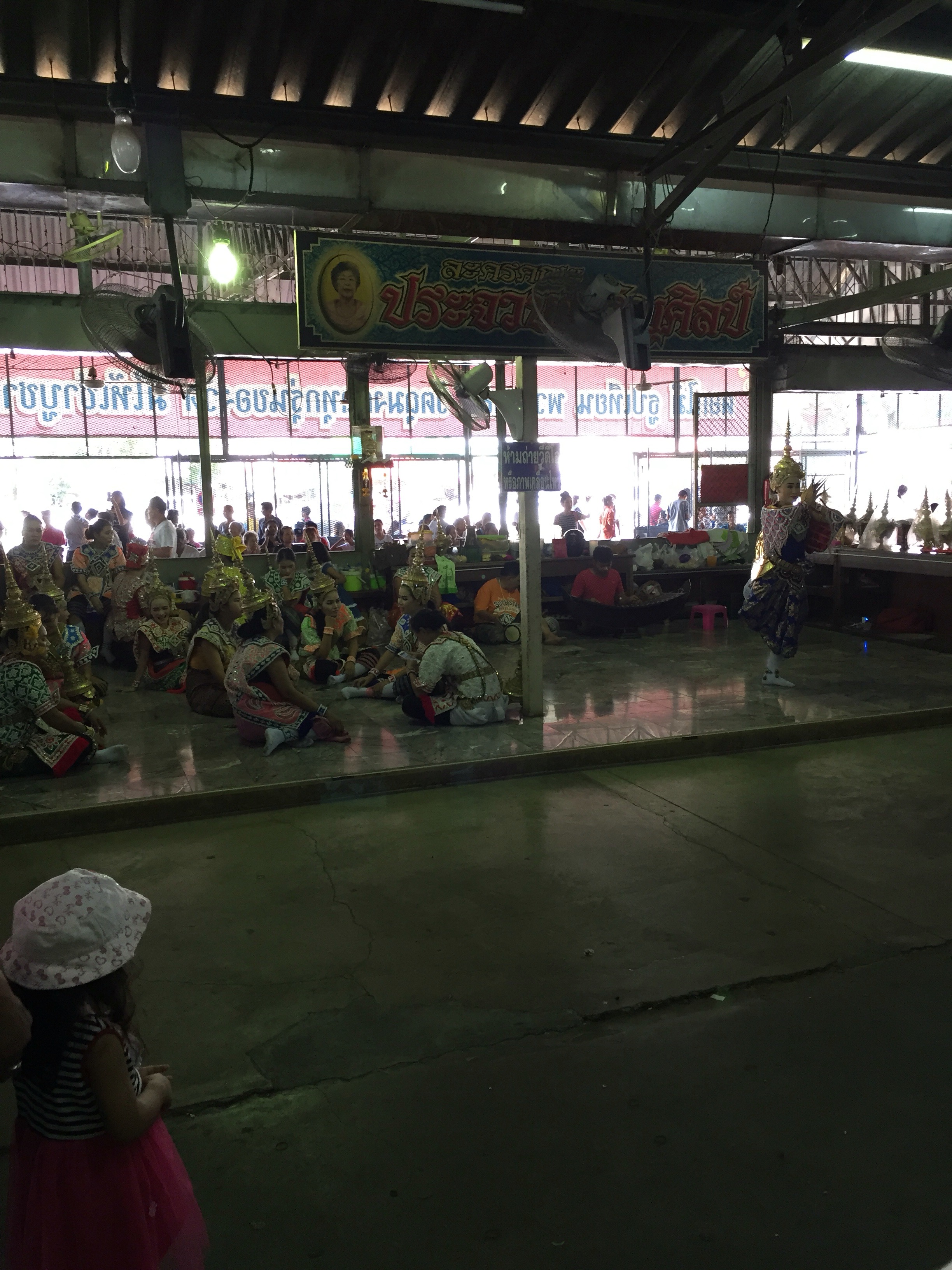
   I was brought here because khun meh had made offerings here so that we could get a house. Well, it worked. We need to come back and make a donation of five hundred eggs, but in the meantime, we got incense and oils. The oil I poured into a lantern for the health of a family member who is suddenly and frighteningly ill. The incense was lit at the lantern and small pieces of paper used to tie the three sticks of incense together. Those papers were used to wipe Buddhas coveted in gold flake. As pieces were picked up by the paper, you returned it by wiping them onto a different statue of Buddha. Later, we paid for eight dancers to do a dance, which, like the other actions, is considered a merit making activity, similar to lighting a candle or making a confession or reciting a rosary. I did a little bit, but then got uncomfortable. I was a tourist and didn’t want to disrespect deeply held beliefs by engaging in too much spiritual tourism, backed by respect but not by belief; just as a visitor to my church can partially participate, but the Eucharist and the sacraments are only for confirmed believers.

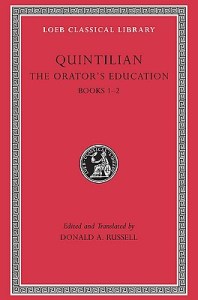
‘The Orator’s Education, Books 1-2’ By Quintilian


Orator's EducationI have mostly loved The Orator’s Education, as much for its insights into the Roman culture of its time as anything else – off handed remarks about gladiatorial styles, discussions that introduced me to how much constant interchange there was between Latin and Greek (with Latin even stealing letters from the Greek – I had had no idea what a state of perpetual transition Latin was in; such a difference from its current status as a ‘dead language’), remarks that showed how little formalized spelling and grammar could be, and more.

When Quintilian talks of ‘orators,’ he is, in the greater part, speaking of what we would call lawyers. Apparently, the pleading of cases was less a legalistic endeavor than it was a dramatic and rhetorical one. While legal procedurals on television make it seem like that’s still the case, believe me when I tell you that modern trials are almost always boring to watch and the average lawyer is not particularly eloquent.

At one point, Quintilian defends oratory against the claim that it cannot be an art because no art seeks to demolish itself (presumably, referring to how opposing orators will seek to demolish each other’s arguments). Leaving aside his actual refutation, what a different view of art! Now, we accept fairly readily the idea that an art is usually something in a state of constant oedipal rebellion.

He talks about three kinds of art: theoretical, practical, and poetic.

Theoretical arts include ancient astronomy, according to the author, and are what we might think of as scientific research, where the end is not a ‘thing,’ but understanding of the of the subject of study.

Practical arts are not things like carpentry, but rather actions. The example he gives is dance, where the end result is not a thing, but a properly completed action (oratory is this kind of art, he says)

Poetical arts are those which end with a work that can be seen, like a painting. I think this is awesome, because he uses the word ‘poetical’ to describe the most practical (in modern terms) of arts – that which ends in something. Gave me a smile.

Merry Christmas, Losers


I’m on a plane to Thailand today. Granted, spending my Christmas on a thirty hour flight is not ideal in many crucial aspects, but tomorrow, you will be wherever you are and I will be in Thailand. So, statistically speaking, I will be in a much better place than you, and I don’t mean in that Dickensian, Tale of Two Cities way. In the first place, it’s an overrated book and in the second place, his understanding of the French Revolution is like a schoolboy’s reading of Burke, filtered with a little Trumpism. Also, I don’t expect to be executed just yet. The Man ain’t caught up with me.

Good News! My Better Half Found A Fresh Notebook!


She found a nice, compact, black notebook, about 2.5×5 inches, with ruled pages. I’ll bring a back up, of course, but this is will probably be my ‘go to’ notebook for writing random stuff down while in Thailand.

I Forgot Something


As I sat down to do some writing in my current most used notebook, I realized that it was nearly full. I need a fresher notebook for Thailand. Not a new one, because I have plenty at home. Just one that is farther from finished.

Found The Perfect Book For My Trip


So I’ve been trying to figure out what reading material to bring with me to Thailand, besides the voluminous pulps downloaded to my nook.

I had been thinking about this Dover edition of Thus Spake Zarathustra that I bought in 2001 at Bridgestreet Books. And lo and behold, while unpacking, I found it!

Also while unpacking, I found this lovely hardback edition of Emerson. Positively perfect, except it is just too darn heavy. Nietzsche it is! Cicero is an outside contender, but Nietzsche holds most of the cards.

But now I need some poetry. In the past, I brought Wordsworth and he’s still my go to poet for this, but I’m hoping someone else inspires me. Tennyson would be great but I don’t actually own any Tennyson and I’ll be gone too long to use the library.

‘Elfstones Of Shannara’ By Terry Brooks


 It may be that, horror of horrors, I decided to read a Shannara novel because I read that MTV was making a television series based on the second book: The Elfstones of Shannara.

Many years ago, during a misspent youth, I read this first of the novels, The Sword of Shannara. Even as a callow youth, I could see that it was so shamelessly stolen from the Lord of the Rings that it seemed nearly unbelievable that no legal action had been taken.

The Elfstones is better, if not exactly original (‘Bloodfire’ beneath an ancient mountain in an evil land sounds remarkably like the fires of Mount Doom). I found a reasonable amount of enjoyment from the story. Like LOTR, there is a main quest and then a more military story. Here, the main quest feels surprisingly tension free and unstressful. On the other hand, the battles and the work if preparing for war and defense is pretty thrilling and tense.

Reading At Work


 I don’t read (except, infrequently, at lunch) at my regular job as minister of propaganda. However, I have a second job working for my better half, usually as a cashier/salesperson. On many such occasions, I read very nearly whatever I want and have recently been reading Remembrance of Things Past at Eastern Market. But lately, I have been at the Downtown DC Holiday Market and it is markedly more busy. It’s not impossible to read, but it is not conducive to the languorous hypnotism of Proust.

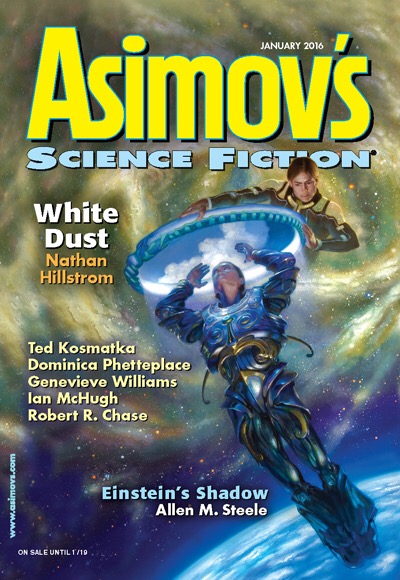
What turned out to be nearly perfect was the January 2016 edition of Asimov’s Science Fiction.

The big three of scifi are all owned by the same parent company: Analog Science Fiction and Fact, Asimov’s Science Fiction, and Magazine of Fantasy and Science Fiction. The last is thicker, but also a little more expensive, whereas the middle is so affordable as to be practically a negligible expense and is also named after the greatest science fiction writer of the last century (yes, I know we wasn’t actually a good writer, but he was so influential, especially in using hard science, that we have to give him his due), so the choice is easy. There are other magazines, like Lightspeed and Interzone, but they are but so easily found at my local bookstore.

So this edition was very, very good. Good writing, good ideas, good stories. One weak story near the end and there was a historicalish novella about Einstein that simply didn’t capture me and which I didn’t finish, overall, this boded well for the future of the genre.