‘Thunderbird’ By Dorothea Lasky
 I feel vaguely guilty about this book, because I got it for free from Wave Books, because they were late getting some books I’d ordered sent out (Wave Books is a great publisher of contemporary poetry and I feel guilty about inconveniencing them and cutting into their margins; on the other hand… free poetry!).
This was my first time reading Lasky’s poetry and, at first, I found it a struggle. Not difficult, just not my kind of thing.
But I persevered and was pleasantly rewarded by a series of political and feminist explorations. Basically, I didn’t like the first two poems in the book, but thought everything else was pretty super awesome.
From ‘I Want to Be Dead’
I want to be dead
After all the ultimate act of self-indulgence is to be dead
Histrionic bareback
I will make one tiny objection, though. The fonts are terrible. Or rather, the titles of each poems are in a terrible, bold, gothic-y font that strains the eyes and take me out of the poem whenever my attention wanders to the top of the page.
‘District Merchants’ At The Folger
 Written by frequent Folger production director, Aaron Posner, District Merchants is new take on The Merchant of Venice which seeks to tackle to elephant in the room: Shakespeare’s unforgiving and cruel and anti-semitic take on Shylock, the titular merchant.
Posner keeps the names, but shifts the action to Washington, DC and the time to the months just before and just after the Panic of 1873. He mostly keeps the original names, or else uses something very close (which sometimes seems jarring – especially the continued use of ‘Shylock’), but plays with race and ethnicity, making the majority of the non-Jewish characters black. This does create a more nuanced view of discrimination and prejudice (especially in the form of a young mixed race man who ‘passes’ as white), as does the addition of topics like the pogroms in Russia and war profiteering during the Civil War. Muddies the waters, those last two, though I’m not always sure to what end. I mean, I know to what end, but I guess that I’m not sure if it really succeeded.
But the play does succeed, sometimes, in spite of itself. But The Merchant of Venice, when it succeeds, does so in spite of itself, does it not? And, as a DC resident, references to places like Eastern Market made me smile with pride/recognition.
The Ladder In The Sky
The Ladder in the Sky, one half of an Ace Double (the other half being The Darkness Before Tomorrow) is an oft told tale of an ordinary man given amazing intellectual, including mystical/psychic/super-science powers.


It does nothing very well, but nothing badly and I was entertained for an hour or so. If there was something, not exactly new, but different, was that it took place in ‘the future.’ Normally, the ordinary person lives in more or less modern times, but in this case, it was already a science fiction setting with interstellar travel and what not.
That day I’d brought two books with me to read while I was working for my better half at Eastern Market. Unfortunately, I’d misjudged the speed of my reading and found myself bookless by noon, so I ran to Capitol Hill Books during a lull and grabbed this Ace Double – mostly because it was an Ace Double and I just think the idea is cool – for four dollars twenty-four cents, including tax.
Happy Birthday, Ginsberg
‘Elective Affinities’ By Goethe

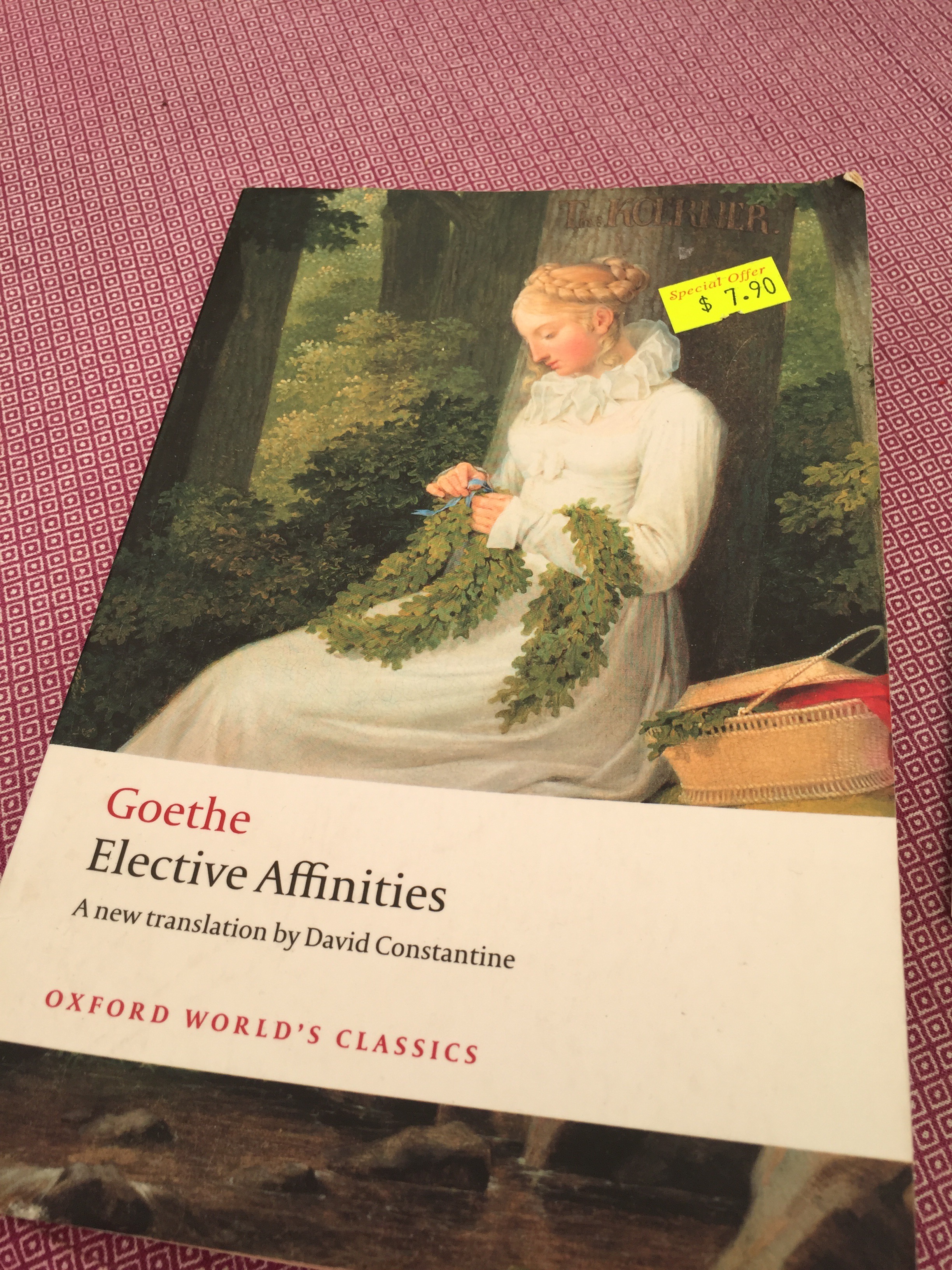 I found this book in a used bookstore in Singapore and first heard of it from the great French film, Jules et Jim. But all you can ever find of Goethe in America, if you can find anything at all, is The Sorrows of Young Werther and (maybe) Faustus.
I can’t believe it’s not more widely read. It’s got a strong current of sexy running through it and it’s relatively short. In some ways, it reminds me of J.K. Huysmans’ The Cathedral, except it’s digressions are not so much philosophical-theological as philosophical-psychological and about gardens and landscape, rather than the great cathedral at Chartres.
Basically, there is a couple, previously married, but in love for years, who married each other after their first spouses died. They seem happy, but then some other feelings interfere, when the husband, Eduard, invites his friend, ‘The Captain’ (later, ‘The Major;’ and never given a proper name) to stay with him and Charlotte in their country house. Charlotte invites Ottile, her ward (semi-adopted to be a companion to her daughter from her first marriage).
Charlotte and the Captain fall in love over their shared love (though differing philosophies) of landscaping. He leaves so as not to break up the marriage.
Meanwhile, Eduard falls passionately in love with young Ottile.
Where it gets tricky for the modern reader is that Eduard is clearly showing signs of being an abusive type. Possessive and manipulative and childish. It’s actually kind of scary and you worry that he will actually be granted a divorce and marry the poor girl. The fact that he hardly seems to care or be discouraged by the fact that Charlotte gives birth to his son while he’s sulking in a country cottage far away is not a good sign.
I would love to keep this book, but it’s got some mold or mildew on it (Singapore is pretty tropical) and my throat gets itchy when I read it, which is too bad.
It’s A Mystery!

…was the corny name of a fun little event put on by WETA, one of our local public radio and television stations. Professor Rebecca Boylan from Georgetown spoke about (primarily) British mysteries and the distinction between truth and justice, insider and outsider, etc.
It wasn’t as academic as I would have liked, but she did talk about three philosophical ‘truth theories’ and how various detectives use them to reach the ‘truth.’
First was the correspondence theory, which is building relationships or correspondences between facts to arrive at the truth. She mentioned Wallander of the detective show (and books) of the same name, though the classic Sherlock Holmes would have been a more obvious one, I think.
Secondly was the coherence model, which is less observational and more introspective; more about building a internally consistent model for the truth, for which the models were Luther (love Luther!) and Poirot.
Finally, was the pragmatic model, which was less about absolute ‘truth,’ than what worked.
Also, a neat and counter intuitive comparison of Luther and Morse, with Luther posited as the urban Morse and both being primarily representatives of the detective as outsider.
And they gave me this cool mug!

I’m Bummed About How ‘Castle’ Ended
What can I say? I loved Castle. I won’t attempt to justify that love, but it was really my only remaining connection to network television. Especially with my better half on far off foreign shores, I really only watch Netflix and Castle. And did you know that Nathan Fillion was in Firefly? Because he was.
But I’m bummed. Partly (mostly) because it’s gone, but also because of how it left. I really didn’t like when the show introduced extensive, overarching mysteries like, in this case, LokSat. I watch the show for the witty (and slightly homoerotic and non-gender normative) banter of Ryan and Esposito and to watch Nathan Fillion do spit takes and get really excited about stupid things. Things got too darn serious. I wanted to ‘mystery of the week’ stuff and most certainly did not want the tacked on ending to portray them gently aging into a traditional household.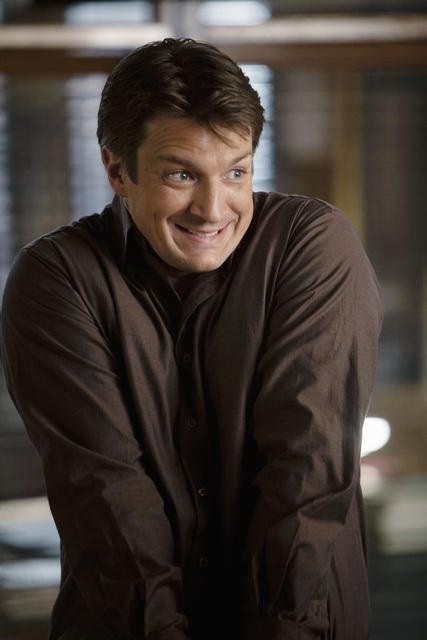
‘Except That I Have Bad Dreams’
HAMLET
Why, then, ’tis none to you; for there is nothing
either good or bad, but thinking makes it so: to me
it is a prison.ROSENCRANTZ
Why then, your ambition makes it one; ’tis too
narrow for your mind.HAMLET
O God, I could be bounded in a nut shell and count
myself a king of infinite space, were it not that I
have bad dreams.
The line, ‘there is nothing either good or bad, but thinking makes it so,’ came up in conversation recently.
I remembered the bit about the nut shell, but the last line of exchange escaped until, while later, I was driving, and it hit. And when it did, I realized how much it changes to whole color of the dialogue (though putting squarely with the rest of Hamlet which is, surely, at least partly about the existence/nonexistence of free will, maybe not in a metaphysical sense, but in the sense of being trapped by external events).
Taken of itself, that line, ‘there is nothing either good or bad, but thinking makes it so,’ is a wonderful example to (horrible) parents (usually fathers) who want their children to stop being upset about something that has, quite naturally, upset them. Because, really, it’s their fault they are upset, because it’s only their thinking that has made it ‘bad.’
But ‘were it not that I have bad dreams’ changes everything, doesn’t it? Even though dreams are an internal thing, they are also (at least partly) external reflections. You can’t make the world good or bad just by thinking, because the world will always intrude. Yes, it may all ‘be in your head,’ but the world is also in your head and the world has its own ideas.
‘When you’re accustomed to privilege, equality feels like oppression.’
I just heard that line for the first time the other day, but, good Lord, does it pithily explain so much resentment and misunderstanding.
It explains, in part, the rage of so many white (and, yes, racist) Trump supporters who see centuries of white privilege being eroded by a growing non-white population and a culture less overwhelmingly (though still very overwhelmingly dominated, in many very important ways) by the white population.
It also explains why so many white folks feel that ‘reverse racism’ is a problem (because, it’s really not; not even remotely).
Wish I’d thought of this phrase myself.
 the coffee philosopher