‘Sextus Empiricus And Greek Scepticism’ By Mary Mills Patrick


This book should really say ‘by Mary Mills Patrick and Sextus Empiricus’ because the final forty odd pages is actually a translation of a sort of primer on Sextus’ brand of Scepticism (Pyrrhonism, if you’re curious). As far as I can tell, this book (which I downloaded from Project Gutenberg) is an 1894 doctoral thesis.

Dr. Patrick certainly does fill up the original writing (not the translation) with a lot of filler, some of which feels contradicted by the subsequent translation of Sextus’ actual words. It’s not uninteresting; the section where she tries to determine where Sextus likely taught and lectured was pretty cool, actually. But then she goes into an odd attack on the Sceptics and Pyrrhonists for ultimately being a sterile school of philosophy. She writes that they set the stage for future scientific advances, with their focus on method and examination of phenomena, but kind of wuss out on actually taking it to the next level.

Especially after reading the actual writing of Sextus, I call garbage on that.

It reminds of when my former stepmother asked me about a college course I was taking – symbolic logic, so be precise. Though raised Catholic and, at that time, attending the Episcopal church, her personal brand of faith was very much in the Southern, white, evangelical tradition. So naturally she asked me what I was learning had to say about abortion. I really didn’t know how to answer that except, ‘well, um… nothing, really.’

‘Well, shouldn’t it?’ she asked.

And, of course, the answer was, no, not really.

And the same here. I’m sorry that a philosopher of late antiquity didn’t properly follow through and start the Copernican Revolution for you over a thousand years ahead of schedule, but maybe we could just be satisfied with what he actually wrote and did, which was pretty cool.

To briefly talk about the bits that make up the majority of the translation, it’s about various ‘tropes’ that explain why we should suspend judgement in terms of claiming knowledge. These are things like noting that various animals clearly perceive things differently, so why should we assume our perceptions are more accurate? Similarly, different people perceive differently. There’s more, but I’m not going to list them all because the book is free, for heaven’s sake, so you can read it yourself. But suffice to say, it made a lot of sense to me an I got a kick out of it. I do wish that she hadn’t chosen to leave so many Greek words and phrases untranslated. Sometimes, through context, I knew a word to be ataraxia (a state of being untroubled) and once I was certain it was an anecdote that I was familiar with (about it supposedly, according to ancient Greeks, being acceptable in India to have sex in public; a weird example of a two thousand year old urban myth), but often I just wound up shrugging my shoulders.

The Beer Goggles Of Late Antiquity


There are also differences depending on drunkeness and sobriety, as that which we consider ugly when we are sober does not appear ugly to us when we are drunk. – Sextus Empiricus

Supermarket Fantasy


I came across that term in an interview with the sound artist, Allen Mozek, and I instantly knew what he meant.

As a child, I remember that my mother would take me into this one, huge (it seemed to me) store. I think that it was a grocery store, but it might also have been something like a Target (though probably not a Target; maybe a Montgomery Ward). In that store was an enormous (again, it seemed so to me as a child) row of books and magazines. I loved best these hardback books that were mostly science fiction illustrations, like cover art for books and magazines. But that also had paperback fantasy and science fiction.

Recently, we visited my family in rural Arkansas. There was an old fashioned drug store that used to have a wire rack filled with cheap paperbacks.

Also, I can remember when supermarkets used to have books. I know that many still do, but back in the day, they were both cheaper and more varied.

I loved those supermarket fantasies. I wanted them all. I would read the backs of each one and pore over the covers with awe. Mozek is a little dismissive of them, but I am still engaged in an archaeology of those memories (hence, my love of Ace Doubles).

Another Bookstore Gone…


cq5dam.resized.270x180!While DC has been good about adding bookstores (like my neighborhood’s recent addition, East City Books), we do seem to be taking two steps back for every step forward (we lost Books for America and the downtown Barnes & Noble over the last year).

This time, it’s the only in DC World Bank Group InfoShop Bookstore.

That’s right. If you didn’t live in DC, you would never know such a thing existed. But it did. And it was super awesome.

In addition to World Bank publications, it had a fantastic array of very specialized books on economics and global development. I bought my copy of Tony Judt’s Ill Fares the Land from that particular bookshop.

And just… what a cool thing to have in your hometown?

Ugh. Another one bits the dust.

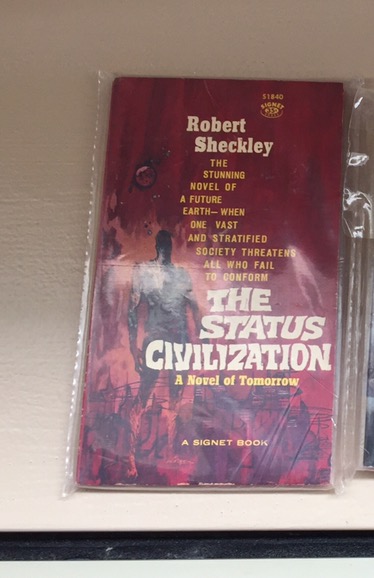
The Status Civilization


This 1960 novel by Robert Sheckley reminds me of a later book by Frank Herbert, of Dune fame. Herbert also wrote a novel about a place called Dorsai, which distilled ideas in some other of his books (including Dune) about an environment which hardens men into living weapons. After reading The Status Civilization, I have to think that Herbert read it, too. Now, don’t get me wrong – there is a reason Herbert is still widely read and this novel, maybe not so much. Herbert had a gift for world building, while Sheckley’s scenario is more tendentious.

In short, a man wakes up with his memories mostly wiped and learns he’s on a prison ship to take him to Omega – basically, a planet-wide prison. There is a surprisingly well-organized government, but it’s literally based around semi-legalized murder and the literal worship of Evil (always with a capital E). Our hero, like many heroes, proves not to be bad guy (he was sentenced for murder, but didn’t really do it) and also surprisingly physically adept and a pretty good fighter and killer for a non-murdering kind of guy.

The interesting bit is when he makes it back to Earth and finds a society which has been inculcated to extreme self-regulation. In fact, he realizes that he turned himself in for the murder, knowing he didn’t commit it, but also knowing that the ‘evidence’ suggested he did. There’s a weird, not terribly well done internal struggle (visualized through the recreation of his earlier battles, but with inner, ‘Earth’ self being the antagonist) where he tries to stop himself from turning himself in again.

It ends with him realizing he has to warn the incoming Omegans before they get their memories back and their conditioning and just wind up sending themselves back to Omega.

Ok.

The story is nicely paced and feels very full, despite being only a little over one hundred pages long and for the avid sci fi reader, there’s plenty to be had, especially if you are interested in some antecedents to a modern sci fi trope.


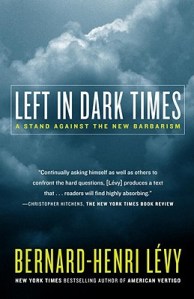
‘The Left In Dark Times’ By Bernard-Henri Lévy


9780812974720I bought The Left in Dark Times because I wanted to read something by Bernard-Henri Lévy and I thought that this book, rather than his reportage/current events style books, would be a good introduction to his actual thinking. While sometimes called a philosopher, I’m not really sure it applies, but I wanted something vaguely rigorous by him (which, as it turns, this isn’t, exactly).

You may know Bernard-Henri Lévy (sometimes known as BHL; he’s that famous in France) as that rick looking French guy on TV with the leonine mane of grey/white hair, dark suit, a white shirt that is always unbuttoned two buttons below what is appropriate to the situation, yet always staying above the critical belly button line.

The Left in Dark Times feels terribly dated. It is something from a time that feels very long ago; before the ‘Great Recession,’ before the more recent global economic contractions (Greece, China, etc). Before we were expelled from an economic eden where risky trade and capital entrepreneurship would lift all boats, if we just let it. In this book, economics aren’t a ‘thing’ at all.

The left is in dark times because, he writes, economic democratic-socialism has been, somehow, disproven, by the good times of the early and mid noughties. For him, the true Left (capital L) is in international humanitarian interventionism. Which is not, in itself, bad, but now, things feel so tied to the economy as causing so many humanitarian problems through indirect means. He scoffs at the idea of a malignant economic imperialism and colonialism, but these days, their ill effects feel all too true.

Let’s just say it: his Left feels more like neo-liberalism. The vapours hanging over his exhortations are pre-lapsarian, before Tony Blair and New Labor fell from grace. We can no long say, can we, that humanitarian crises are unrelated to the failures of unregulated, neo-liberal, rentier capitalism.

He writes a lot about the anti-semitism and the ‘Palestinian question.’ I agree with him on a two state solution, but I don’t agree with his positioning on things like BDS and attitudes towards Israel, but as a Jew (BHL, not me), I give him some leeway here, especially since I am not so blind as to understand that anti-semitism is a much more pervasive problem in France and in Europe, in general, than it is in America (or is worse in America than I know? with Trump’s appropriation of anti-semitic imagery, is it an underappreciated issue here, too?).

He ends (not really; there’s a meandering and surprisingly long epilogue) with a passionate defense of the Universal, by which he means universal human values. He does defend Europe, but is careful not to mean merely an extension of an idea of western values to the world. His Universals are, though, the justification for interventionism. Reading just made me sad, coming on the heels of the Brexit and dissolution of trust between northern and southern Europe (really, between southern Europe and Germany). He becomes oddly religious. Or almost religious. He defends (sort of, and then backs away) Jewish concepts of prophecy and the prophetic tradition as linked to the Universal. I like one phrase, near the end: “The Universal works more by influence than incorporation.” I can get behind such a Universal. It feels kindred to King’s moral arc.

Ultimately, he is a Hitchens like figure. Tied to a time and a place and an ideology that makes him more than normally timely and less than normally timeless. And, while it might be the translation, he lacks Hitchens’ genius for scintillating polemics that make him, still, a worthwhile read for students of essayistic style.

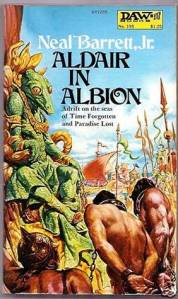
Aldair In Albion


Aldair in AlbionI was in Chicago a few months ago and used a few free minutes to walk from my hotel to the nearest, open bookstore (I forget the name). Whenever I’m in a new city, I like to visit a local, non-chain bookstore and buy a book. It’s just a thing I do.
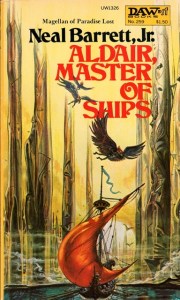
While browing an old fashioned metal wire turn rack (like they used to have on drugstores, stocked with things like Doc Savage novels and Harlequin romances), I saw Aldair, Master of Ships. It looked cool, so I bought it, but later realized it was a second book in a series.

So, here we are, reading the first book, Aldair in Albion.

It’s nothing groundbreaking, but does offer a nice, new twist.

The world is similar to late Republic/early Imperial Rome, with various people’s given names similar to things like Gaulish tribe (the Venicii) and the Vikings (Vikonen), but all filtered through a Robert E. Howard-esque, Hyperborean sensibility. But while not state outright, the author quickly lets us know that the characters are not human. They aren’t properly described, because the third person limited perspective of Aldair, via the narrative, already knows what people look like. But words like ‘pelt’ and ‘snout’ are dropped, as well as the fact that Aldair’s girlfriend, as it were, has more than the usual (for a human) number of nipples.

AldairMasterofShipsA reader of very basic knowledge will peg this as a post-apocalyptic novel, where animals have evolved and become dominant and the titular Albion is clearly England.

But, after 200 pages of standard, but generally exciting fantasy adventure, we get an interesting twist in the final five pages. No sign of a nuclear explosion, but rather, humans apparently genetically engineered the various humanoid peoples from animals (Aldair is descended from cows), dropped them in sci-fi style sleeper pods that opened all over the world. No word of where humans are, but the whole thing looks more like an experiment and Aldair commits himself to helping the genetically modified peoples of the world build their future, having been disgusted by humans.

‘Writers that only add their own verbiage to existing knowledge’


I was talking with a friend, about a mutual acquaintance who the friend of our good friend (did you understand that sentence?).

I don’t like this acquaintance. Never have. Just something about him.

He writes for blogs in a recognizable style of pseudo-ironic mockery. His writing, like much in the genre, can be funny.

But I was trying to articulate why that wasn’t enough. It’s not enough to mock the silliest and most mock-able aspects of modern life (usually politics) when it’s not combined with research and and investigative reporting of some kind.

Then my friend summed it up:

It’s writing that only adds its own verbiage to existing knowledge.

Quite possibly I have been guilty of that. Actually, I can say for certain that I have been. But it’s also becoming a problem, I think. I’m not talking about a Facebook post or meme, but writing that theoretically purports to be more – to be an essay, a polemic, an article.

Anyway. That’s my rant for today.

American Marxist


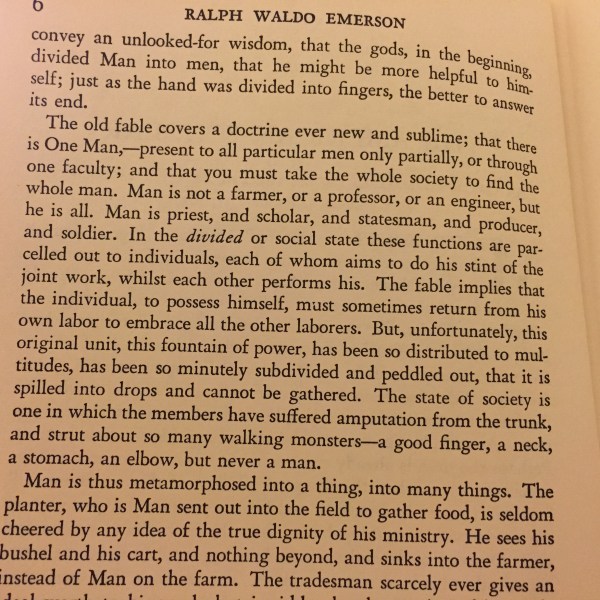
The paragraph is from Ralph Waldo Emerson’s essay, The American Scholar. While reading it before bed the other night, I wondered whether or not it was just or whether he really seemed to be describing the Marxian concept of people’s alienation from the fruit of their labors? Of course, his solution is more spiritual, combined with what might now be described as college town, farmer’s market, DIY liberalism (and Marx never really wrote out the solutions, did he? No, not really).

Robert Irwin Exhibit At The Hirshorn Museum


After opening with one of his later, convex disc sculptures, the exhibit moved on to a series of thickly painted, mannered pieces, with a three dimensional effect caused by the thickness of the layers of paint and the areas carved out of the three dimensional layers (some seemingly carved with a palette knife). The appearance, then, of his classic, geometrical, and spare line paintings was like a Stendahlian explosion (as in the syndrome). In some, the lines were so narrow and precise that I had to look closely to convince myself that they weren’t glued on. The dot paintings that followed, though, left me cold. Even though close examination allowed me to see the diffusion. shapes, and patterns, they felt contemptful of the viewer. Likewise, his ‘light and space’ sculptures – mostly convex discs (like the first item) and a couple of columns only made me want to walk back and see the line paintings again. At the end was a massive, site specific trompe l’oeil installation that has to be seen to be understood, so I won’t try to describe it. If you can’t get here to see it, well that doesn’t feel much like a ‘me’ problem, now does it?