My “Man Cave”


I have been given a “man cave” in the new apartment. I don’t exactly know how it got to be called a “man cave.” I feel like “man cave” should be the name of a low budget, swiftly cancelled sitcom starring some particularly egregious and misogynist comedian.

Had I been asked – I would have suggested the room by called “my study.” Because the point is to have  a place to work and write. My current contract will eventually end and I will find myself back at home and unemployed, scrounging for gigs. No doubt, a study would be a relaxing and utilitarian sanctuary. I have a desk – custom made by a furniture maker from Staunton, Virginia out of recycled wood stained black. Some bookcases, which are in no way exceptional, being your standard IKEA fare. My record player – a gift from many years ago to replace the massive old stereo I lugged around to play all my vinyl LPs. A little leather covered chest, designed to hold files and papers, but re-purposed to contain my record collection (a gift from my Uncle Kim that I couldn’t figure out what to do with for years, until I discovered it was the perfect size to hold my LPs). And, of course, my old black typewriter.

I’ll post pictures when it’s completed.

Voice of Ice, Voix de Glace: Redux


I actually contact Alta Ifland to compliment her on her collection. During our brief correspondence, I asked in what language she had originally written Voice of Ice, Voix de Glace – French or English. Contrary to my original assumption, she assured me that French was the original language – sort of. Many of the pieces were essentially written simultaneously – the French and English, I mean. She also said that she has given up (for the moment) writing in French.

National Poetry Day


Thursday, October 7th is National Poetry Day.

Please, please remember to celebrate it, even though it is, technically, an English holiday.

I intend to listen to Maxine Kumin read poetry on Thursday at the famed Politics & Prose Bookstore in Washington, DC (well known to geeks like myself who actually watch  BookTV on C-SPAN2’s weekends).

Les Figues Press: Voice of Ice, Voix de Glace


My books from Los Angeles’ own Les Figues finally arrived – are:evolution, and Voice of Ice. They also sent me a bonus – Stephanie Taylor’s Chop Shop. Very, very generous of them. I love free books. In fact, I encourage all publishers of poetry and quality literature to send me free books. I promise to review them all for you!

[Pause]

[The sound of crickets]

Well, no takers so far. I will continue to pay for my books, on the whole, it appears. On to Voice of Ice, Voix de Glace.

Basically, I love it.

I have mentioned in the past how I have difficulty really getting into some genres of avant-garde poetry. I respect Ron Silliman, but I don’t pretend to understand Tjanting. +’me’ S-pace (another Les Figues publication) confused me.

One sort of expects that virtually everything that Les Figues publishes would be a bit out of my league. Not so, this time.

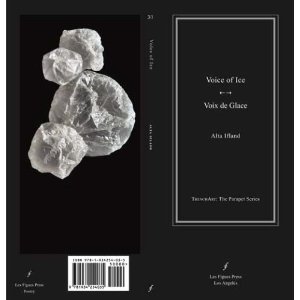
Voice of Ice, Voix de Glace is a series of prose poems written in French on the left hand side and English on the right. This was almost certainly written in English and then translated into French (the absence of translator credits and my meager French are the basis for this assumption). The poems follow a sort of life cycle pattern, from birth to death. There is an obsession with the body (and the destruction of the body), particularly with eyes and tears. At first, this might make the focus seem ontological – which, according to Fredric Jameson, who, in his Postmodernism, or the Cultural Logic of Late Capitalism, wrote that the difference between modernism and postmodernism was paradigmatic break between the epistemological and the ontological. In that sense, it would suggest that a focus on the nature, construction, and dissolution of the body would place Voice of Ice firmly in the ontological category. However, the use of the body seems strongly metaphorical, as a means of self-awareness – putting it squarely in the epistemological side of the equation (though something so stark as epistemological versus ontological is always going to be false dichotomy – but that doesn’t mean it can’t be a useful tool).

The style is vaguely surrealistic, but unlike, say, an Eluard or Char, whose surrealism is marked by ontological shifts within a poem, Ifland, once she has established the “reality” of a particular poem, tends to stay within that reality. The best comparison would probably be to the prose poems of Arthur Rimbaud, rather than surrealists of the early twentieth century. Which just goes back to my assertion that the poems are more within the realm of modernism than postmodernism.

* * * * *

I just read that the poems were originally written in French and then translated by Ifland into English. From reading it, this seemed unlikely to me (the French seemed to close to a word for word translation of the English and what I saw lacked colloquial phrases that resist literal translations), but lacking inside knowledge, I will defer to others on this.
The Waker’s Corridor


The Waker’s Corridor by Jonathan Thirkield is the kind of poetry that probably drives Ron Silliman completely insane (though he also probably derives some little pleasure from the confirmation of his opinion of the poetry establishment, such as it is). The collection was the 2008 winner of the Walt Whitman Award from the Academy of American Poets for the best first collection (so maybe my criticisms are just jealousy – a failed poet lashing out at one succeeding in his chosen craft).

By which I mean, Thirkield is a Quietist (apparently, he has also been lumped in with Expansive Poetry – a school that I, in my ignorance, had never heard of until the other day). I don’t always agree with Silliman – many of my favorite poets are surely on his “Quietist hit list” and many of his favorite poets are on my “Huh – I don’t get it list.” But in this case, I totally get it.

None of which is to say that Thirkield is a poor writer. But let’s just say, I could have guessed that he studied at an MFA program (the prestigious Iowa Writer’s Workshop, in this case). Again – don’t get me wrong – I would give my right arm to attend the Iowa Writer’s Workshop (but only because I’m left handed – I would not give my own left arm, though I might be willing to give them someone else’s, were it truly required).

He enjoys narrative poetry and has a good turn of phrase (though phrases like “promise of renewal” from the poem White Coves make me cringe). For no particularly reason, I thought of William Wordsworth while reading him – or perhaps for his tendency to try and write pastoral poems within the dense urban landscape of the New York.

Online Rejections


Rejections appear to be on a lot of folks’ minds these days.

Not exactly my reasoning for being wary of rejections through online content management programs, but the Broadside blog has an interesting (and deliciously visceral) objection to such things and also misses the days when we received letters.

Banned Books Weeks


September 25-October 2, 2010 is Banned Books Week (BBW).

I hope you’re celebrating by reading Howl or A Farewell to Arms or Huckleberry Finn or Ulysses or The Interpretation of Dreams or Madame Bovary or The Flowers of Evil or A Season in Hell or The Divine Comedy or The Prince or The Communist Manifesto or Naked Lunch or…

Well, you get the point.

‘My Vocabulary Did This To Me’


I picked up a copy of Jack Spicer’s My Vocabulary Did This To Me. This was an “it” book a while back, so I am totally just following the herd on this one. Except, I waited until it came out in softback and was significantly cheaper. What can I say?

My time living in California was a wonderful and creatively fertile experience for me. Spicer primarily interests me as someone who saw himself as a regionalists – almost never selling his books outside of the greater San Francisco area during his lifetime. Of course, I am also interested in periods like the Berkeley Renaissance of the late forties and fifties as an example of those glorious moments in literary history that I keep on missing.

Stylistically, I can appreciate Spicer as synthesizing Language Poetry (which I don’t always understand/appreciate) and Surrealism (which I generally feel that I do understand/appreciate).

Free E-Books


It’s worth it to pay for e-books.

This is the inescapable conclusion I have reached, based on a couple of weeks now with my Nook.

There is a ton of free stuff out there, but basically, you get what you paid for. As a result, my Nook is now filled with free books I will never read, because of the relative quality of the transference. I would have been better off paying a couple of bucks for a good copy of Ann Radcliffe’s The Mysteries of Udolpho.

So, instead of reading the freely downloaded correspondence of the eighteenth century economist, David Ricardo, I am reading an inexpensive e-book version of Kim Stanley Robinson’s Red Mars. Nothing wrong with that, of course. But it is a reminder that I will have to buckle down and purchase myself some David Ricardo.

[If Barnes & Noble would care to compensate me for this little plug for both the Nook and for the concept of actually purchasing books, by all means – bribe me!]

Politics and Literary Movements


Obviously, some literary movements are intrinsically tied up with politics – the anarchical writings of folks like Vaclav Havel, whose writings were part of the long history of the literature of resistance movements.

But beyond these more overtly political movements, are literary movements and schools inherently political? One thinks of Camus – a leftist, to be sure, and a member of the Resistance to boot, but also one who resisted many kinds of politicization.

When we talk about modernism or post-modernism or whatever being “right,” “left,” “conservative,” or “progressive,” are we saying anything of value at all?