John Carter of Mars


I’m actually pretty excited about the new John Carter movie.

From a business point of view, it seems like an absolutely insane decision to spend a rumored $200 million on it. Is there that much pent up demand for early twentieth century planetary romances?

I’ve been reading a decent bit of Edgar Rice Burroughs lately. Not the Tarzan stories. But his hollow earth stories and his Mars novels – I’m all about those.

So, I read this first book (upon which, presumably, the movie is based) A Princess of Mars and am halfway through its sequel, Gods of Mars.

As noted, they are considered, genre-wise, as planetary romances. Essentially, they are science fiction novels that are a little loosey goosey with the science and big on finding excuses for strapping men and hideous monsters to fight with swords for the honor of scantily clad women. So really, it’s just begging to have a movie based on it.

Monday Morning Staff Meeting – Inkwood Books


Just some old articles about the coolest bookstore in the Tampa Bay area.

Last year, Inkwood Books celebrated its twentieth anniversary.

And it was cool.

The Hirshhorn Museum


Just wanted to share this picture I saw of my favorite museum in DC, the Hirshhorn.

Concert Note – Sunday, February 12th At The National Gallery


I’m feeling lazy, so I’m basically just going to transcribe my notes from that night. It was a series of performances by the Cavatina Duo, a guitar and flute duo. Enjoy.

J.S. Bach
Sonata for Flute and Basso Continuo in E Major 

Listening to the opening sonate by Bach made me wish I’d spent more time browsing eighteenth century paintings of nymphs,  satyrs, and idyllic forest gods and heroes. My personal highlight was the third of the four movements, the ‘Siciliano.’ A slow dance, it made me wish I had a partner with me and space in which to dance (though I have little knowledge of the forms of eighteenth century dances except that gleaned from BBC miniseries). The frenetic fourth and final movement suffered from the comparison to the ‘Siciliano,’ though intellectually, I understand that a defining feature of baroque music is those changes in mood and tone within a single composition (though not to the extent of the desperate, unnerving, and glorious mood swings of a Mahler symphony).

Astor Piazzolla
Adios Nonino
Flute Etude No. 1 

I discovered Piazzolla via an album of his tango music performed by the inimitable Kronos Quartet (who I had the good luck to see live in Atlanta, performing Philip Glass’ score to the original Dracula with Bela Lugosi – and you probably didn’t know the 1931 movie was actually produced without any musical score, did you?). These pieces were not tangos, but the sensibility was still there. They had the bad luck to follow Bach, which is a hard act to follow. The first composition had some interesting experiments with dissonance and tempo and, in place, I swear sounded like music you’d expect to find in a James Bond movie.

The second composition, the etude, even more than the first, sounded like it could have been from a  movie score, especially the more romantic bits (romantic in sentiment, I mean).

Miroslav Tadic
Four Macadeonian Pieces for alto flute and guitar

For some reason, the Macedonian pieces made me think of the mythic west or perhaps of the multicultural, nouveau western sensibility of Firefly. With Piazzolla acting as a palate cleanser after Bach, I was in a much better place to enjoy this music. Also, I watched some Firefly on Netflix when I got home.

Unfortunately, the flutist developed a painful sounding cough during the third of the four pieces, which was mostly a work for solo flute. Luckily, she got better.

Vojislav Ivanovic
Cafe Pieces for solo guitar

Fortunately for the poor flutist, the first works after intermission were for solo guitar. Romantic and lovely, they were also slight compared to what preceded them, so that I found it hard to lose myself in the music.

Toru Takemitsu
Toward the Sea
          The Night
          Moby Dick
          Cape Cod 

They shifted the order of things, one suspects in order to give her throat a little time to before diving into the song for solo flute by Debussy. But since they jumped ahead to a short song cycle by Takemitsu and since it was the thought of listening to his compositions that really drove me to come out, I can hardly complain.

There had been some clapping after each song or movement earlier, but there was silence after each of Takemitsu’s (except for the final one, of course). His melancholy silences silenced the audience.

Claude Debussy
Syrinx for solo flute

The flutist described the Debussy song as the first significant work for solo flute of the twentieth century. No doubt, even more than in the Bach sonata, you could hear the god Pan for whom it was written (or rather, the character of Pan in a now forgotten dramatic poem, if you want to be picky). A dying Pan, too, making one think of the dying god chronicled in Frazer’s The Golden Bough.

Alan Thomas
Variations on The Carnival in Venice 

The final piece was specifically written for the duo. It also suffered from following a far superior composition. It was pretty and romantic but… well, you know. Debussy was writing for the death of a love sick god. Plus, I enjoy French impressionist music. I will say though that this final piece could have been written for Pan in heaven, reunited in death with his music and nymphs, and I’m okay with that.

Weekend Reading – Reading Is Good For You


Earn more money by reading fiction!

Libraries prove that Darwin was right.

Books will survive, just like vinyl records (I know that sales of vinyl have jumped over the last couple of years, but I’m not sure that’s really very reassuring – will books be sold at exactly one quirky store in half of all cities with at least one million and more than two universities and also at ridiculous prices at Urban Outfitters, but with a selection of no more than twenty-five books?).

Thursday Staff Meeting – Philosophy Is For Children


Trying to like Philip Glass on his 75th birthday.

The life and thoughts of Charles Johnson.

I want my children to be taught Plato in elementary school, too.

Blurbs. That is all.

The Gaming Table


I saw The Gaming Table performed at the Folger Shakespeare Library on Friday. I went into the  Restoration comedy (which are usually bawdy, funny works) with high hopes that weren’t disappointed.

The Gaming Table is actually less dirty than other Restoration comedies you might have seen. Perhaps the filthiest remark was a woman talking about needing to examine a ‘worm’ while ‘on her back.’ And if you can’t figure out what the means, you should ask your parents if you’re old enough to be online yet.

When watching an older piece, it’s always interesting to see how the social restrictions of the time are incorporated – the Hayes Code of the early eighteenth century, if you will.

One of the leads was a widow, and while it was dropped in passing and never brought up again, in light of what I just referred to as that period’s ‘Hayes Code,’ it was an important item to drop. Not in terms of the plot, but in terms of keeping a PG-13 rating, so to speak. While very deliberately never explicitly said, one can’t help but feel that the female lead is sexually intimate with some of her admirers. By making her a widow, while the hint it scandalous, a widow will not suffer the same ostracization within society as a never married woman might for her flirtations. No one expects a widow to be a virgin. In fact, because women were actually considered more sexually voracious and libidinous than men, a widow, who, by definition, knows what she’s missing, is almost expected to be lusty. That’s why the lusty widow is such a common comic trope.

Leaving aside my historical observations, the play was funny and very well acted across the fairly large main cast and all the characters were pleasantly three dimensional. Four stars.

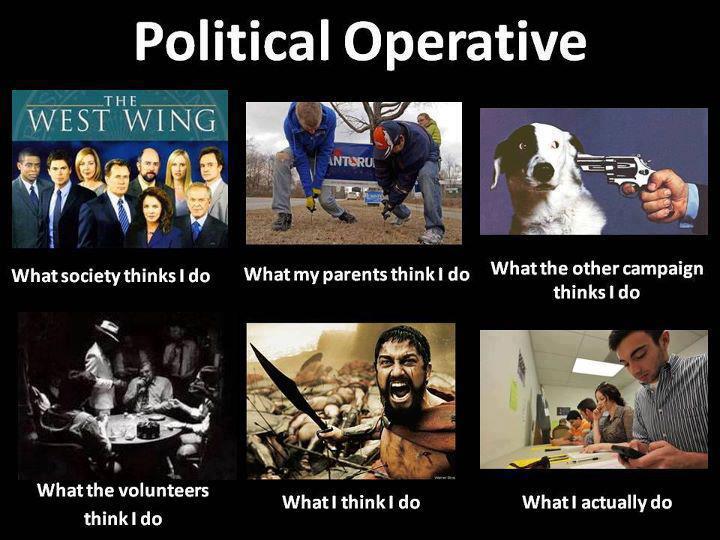
The Truth About Political Operatives


Midweek Staff Meeting – What Drink Goes Best With The Music Of Beethoven? What About Mahler? Or Copland?


Do liberals get it?

‘Slop’ from reactionary politicians who hate when voters in Florida, you know… vote. Better just to skip that part.

A review of Timothy Donnelly’s poetry collection, The Cloud Corporation.

Don’t listen to Beethoven while sipping just any ol’ cocktail!

Who doesn’t love Leonard Cohen?

‘Best Of’ Lists – Fantasy


Some fine folks put together lists of the Top 25 Best Fantasy Books and then further created lists of standalone fantasy and fantasy series.

I love reading through these kinds of lists and finding books to delve into for the future.

But…

How in the hell is The Lord of the Rings not number one? I understand that these particular lists skew fairly contemporary, but come on! Seriously! This isn’t up for freaking debate. Tolkien is the greatest fantasy writer period. Full stop.

And by the way, numbers 2 and 3 (I’ll leave you to sort out the order) are C.S. Lewis’ Chronicles of Narnia and Ursula K. LeGuin’s Earthsea novels.

Not cool, guys. Not cool. Too much testosterone. Not enough credit to Tolkien’s elegiac remembrances of a lost, pre-industrial English countryside, Lewis’ devote allegories, nor LeGuin’s gentle feminism.