
The Best Espresso Ever


While overall engaged in the classic Washington activity of waiting for a phone call telling us our table at Sticky Rice (featuring the most hipsterific wait staff in the DMV) was ready, we walked down H Street towards the Atlas Theater. On the other side of the street, I saw Sova Espresso & Wine, which served, I had read, some of the best coffee in DC.

Sova is actually two places. One is wine bar (which I have not yet been inside) and the other a small, but classic coffeehouse.

The coffeehouse (or should I call it an ‘espresso bar?’) has only a few seats, but is appropriately cluttered with weeklies and flyers and pamphlets for protest marches and yoga classes. A single man behind the counter carefully assembled each order (which waiting in a for longer than one might normally expect, considering how few people were ahead of me).

I ordered an espresso.

Ordering an espresso is an exercise in unfounded faith. Because, let’s be honest, 99.9% of all espresso are terrible. The harsh flavor of burnt, bitter coffee completely drowns all the possible flavors of the coffee bean.

But this was different.

It was the best espresso ever.

It didn’t taste burnt or bitter. The aromatic oils of the coffee were present and the overall flavor had the notes of full bodied red wine.

I told the barista, “That was the best espresso I have ever had.”
Monday Morning Staff Meeting – Bridging The Continental Divide


Philosophy is a science.

Why should they not meet?

Limbaugh and language.

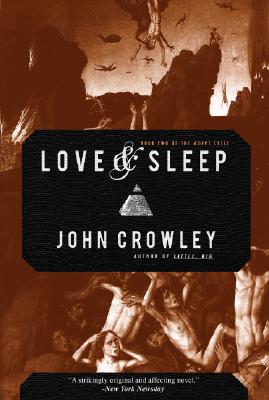
Love & Sleep


Having nearly finished the second of John Crowley’s AEgypt novels, Love & Sleep, I was finally beginning to understand Crowley’s purpose in his Aegypt novels: he creates a sort of dreamy atmosphere, topped with some new age mysticism, whose purpose is to capture the small mysteries of life.

The long digressions into Elizabethan and Renaissance alchemy and magic serves mainly to inform the sense of mystery and confusion Rosie Mucho feels when her daughter picks up an ordinary ear infection. In short, it is not really fantasy. Nor is Crowley attempting to be the American Umberto Eco.

But then, when I reached the last few pages, he threw in this bit of fantasy, implications of a possible real mystic conspiracy (though admittedly, a low stakes one) and the possibility that all the discussions of magic and alchemy was not actually a means to understand one’s present life, but that actually there used to be (and maybe still is) such things.

I should step back and talk about one premise of the book. The main character, Pierce Moffett, is writing a book. The premise of that book is that things changed. That sometime in the sixteenth century, magic ceased to work. Not only that, the records of it truly working are gone. Erased. All those miracles happened. But not really. Because when the shift occurred, the world changed so that they never happened. But some memories remain of the world where they did happen (could happen again). In short, that our world, is not the first (which, by the way, is the premise of the whole Maya 2012 prophecy thing – not that the world will end, but that the world will change dramatically, so that, in a sense, the old world will have ended and a new one begun).

So, I’m curious what the next volume (Dæmonomania) will hold.

Nathaniel Hawthorne


Nathaniel Hawthorne, the godfather of brooding, Protestant-American guilt, died on this day in 1864.

Have I mentioned that Pearl always creeped me out?

Why England Will Do Poorly At Euro ’12 Tournament


Their central midfield will be picked from: Steven Gerrard, Gareth Barry, Frank Lampard, and Scott Parker.

All players worthy of being on that plane (except maybe Barry).

All over 30.

There is Phil Jones, who is listed as a defender, but can also play as a defensive midfielder, but ultimately lacks the right kind of positional sense for that role and would probably be overrun by the opposition. And James Milner, who can play as an attack minded central midfielder, but is more likely to play as a defensive minded winger.

So, not a single likely starter under thirty.

Like it or not, you’re not going to win a major international tournament without more youth, because those legs will get tired if they make it out of their group.

Dave Aronberg’s St. Pete Fundraiser


Former State Senator Dave Aronberg is having a fundraiser in St. Pete and I’m pleased that a lot of popular and well known pols and activists are coming out to support him. Dave is a great guy and he’s running for State Attorney in Palm Beach County. In 2010, he lost the Democratic primary for Attorney General to Dan Gelber (also a good guy, though I enthusiastically voted for Aronberg in that race). Of course, that year was bloodbath for Dems, especially in Florida (ironically, Obama is even money or slightly odd to win Florida this year).

So if you can, stop by and say hello to Senator Aronberg and give his campaign a little love. Whatever bench Florida Dems have, you can bet that he’s one of the best prospects sitting on it. Let’s get him on the field.

Critique Of The Collins Way


I am not a fan of Billy Collins. I have not been reticent about that. So that’s why I want to highlight this blog post by Elisa at The French Exit which provides a lovely critique of Collin’s poetic ideology.

I’ll let Elisa speak for herself.

I went to a reading and talk by Thomas Lux yesterday, and I was disappointed to hear him espousing Collinsian rhetoric (he actually name-checked Billy Collins) to the effect that poetry should be “accessible,” the poem should be “hospitable,” and even that difficult poetry is “rude.”

I don’t understand this mindset. It’s one thing to prefer a simple, straightforward, user-friendly, and personable poetics. It’s quite another to turn your tastes into an ideology, to frame accessibility as some kind of moral imperative. How exactly are we supposed to manage the arts so that everything is equally “accessible”? And isn’t “accessibility” almost entirely subjective, depending on one’s education, class, race, sex, culture, and so on, not intelligence per se? Accessibility, as far as I’m concerned, is racist (and sexist), because it’s defined so often by white men who assume that what is accessible to them is accessible to everyone. (Sorry to be picking on white men this week; fight racism with racism I guess.)

If you like “accessible” poetry (whatever that means to you), then write and read accessible poetry. But leave me my Stevens (not accessible at all), my Anne Carson, my Lyn Hejinian, my Kirsten Kaschock. You can have your Billy Collins.

Weekend Reading – The Reason For Poetry Is Hope


Ariana Reines reviewed.

Of what stuff books are made of.

Less than you might think.

An analysis of lyric poetry reveals hope.

Heloise & Abelard


On this day in 1164, Heloise was buried beside her one time lover and lifetime friend, Abelard.

Corcoran Gallery of Art


The other night, I attended a fundraiser for the Center for American Progress, a progressive think tank and strategy clearinghouse at the Corcoran Gallery of Art.

Mostly, it was a crowded room filled with progressive semi-luminaries (Andy Stern, Ruy Texeira, etc), your usual political/policy hacks (no disrespect intended).

But some of the galleries on the first floor were open, containing a beautiful collection of about half American and half European art, mostly from the late eighteenth through the late nineteenth centuries. And that was why I came. In a city filled with free museums, I am resistant to paying for one and the Corcoran is not free, so I naturally finagled myself a couple of tickets so we could go and see what was open to see. We had done the same thing when we went to an inaugural party there in January 2010, though far fewer galleries were open.

My date and I were cornered by two strange men. One man named Bill described his tangential participation in that nastiness in Beirut in 1982 and the other, named Jean-Pierre described how he had begun “treating his glaucoma” at age twelve (I’ll leave you to read between the lines as to his true meaning).