Warrant: The Current Debate


I finally finished Alvin Plantinga’s Warrant: The Current Debate. I’d already written him a letter apologizing for bad mouthing it and got a nice response back. But I hadn’t actually finished it. And that was a while ago, though I did write him that I was in the process of reading it and did not claim to have finished and/or fully understood it.

And I still don’t fully understand it. Or rather, there’s nothing there to fully understand.

It’s like that movie where it seems to have been entirely created to set up the sequels.

While I am looking forward to trying to read and understand Warrant and Proper Function, I hadn’t realized the extent to which Plantinga would not be making his own, positive case in Warrant: The Current Debate.

The first book is entirely dedicated to taking apart and criticizing the works and theories of contemporary epistemology and epistemologists.

I can see the value of this as a learning tool. After all, the extent to which I have kept up with modern in trends is… well, actually, I haven’t kept up at all. So the experience can be classified as a ‘learning experience.’ I know now more about contemporary theories of epistemology. But I hardly know a damn thing about Plantinga’s epistemology.

Actually, the only thing one gets from this about Plantinga is that the idea of ‘warrant’ was not something that was in wide use when he wrote the book. I got this because he quote extensively from other philosophers and no one is using that term. Which is fine. Alvin’s going out on a limb here, forging his own path. I’m down with that. That’s why I’m here, in fact. But because he doesn’t advance any positive ideas, it’s almost like ‘warrant’ is something he built to characterize other theories as comparative straw men when actually, the reader has no one idea if that’s correct because ‘warrant’ is a fully owned subsidiary of Plantinga, Inc. and he doesn’t actually say what he thinks it means.

He writes that ‘None of these views, as we saw, offers the resources for a proper understanding of warrant or positive epistemic status.’

Well, how can they (they being philosophers who argue for an internalist view of justification or, if you prefer, warrant, I guess) offer resources for a proper understanding, since, apparently, know in the world can actually know what warrant is until reading the second book.

He writes that ‘Warrant is that (whatever it is) such that enough of it together with truth (perhaps a codicil aimed at Gettier) is necessary and sufficient for knowledge…’

Really? Is that what warrant is? Because I distinctly recall him consistently talking about warrant as replacing ‘justification’ in the classic ‘justified true belief’ formulation. Apparently now, it’s fulfilling a larger role (except for this possible codicil that… wtf? where did that come from?).

Oh, and he also writes about the idea of proper function as being key to warrant and of many folks he criticized struggling with resolving it. Funny, I don’t remember this coming up before… and wouldn’t you know that the phrase ‘proper function’ appears in the title of his next book.

I’m sorry. While this book is learned, educational, mind expanding, and fascinating, it is also sometimes an exercise in playground games, where the leader of the group keeps all the other kids in second place in a made up game by raising the bar or changing the rules ex post facto.

But I’ll still slog my way through the sequel (that’s gonna be like thirty-five bucks… but this one was something like seventy bucks, so we’re moving in the right direction, not that I begrudge Professor Plantinga his royalties…)

P.S. – In a bit of fortuitous timing, I just came across this review of a more recent of Dr. Plantinga’s books.
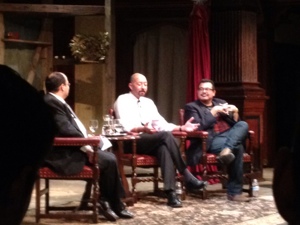
Poets Francisco Aragon, Carl Phillips & Eduardo Corral At The Folger Shakespeare Library


20120919-141913.jpg

Folger Poetry Series Kicks Off


Carl Phillips and Eduardo C. Corral kicked off the 2012-2013 O.B. Hardison Poetry Series at the Folger Shakespeare Library on Monday night. Phillips was the judge for the last Yale Series of Younger Poets and Corral was his chosen winner.

Corral was introduced, both by Phillips and by the program with some beautiful, haunting, and challenging lines from a poem in his debut collection. And it was all down hill from there. His poetry never hit those heights again, which is why I purchased a book by Phillips (I limit myself to buying just one book at these things, no matter how much I want to splurge; discipline, discipline).

Can I admit to being a bit hierachical? I found Corral to insufficiently respectful beside Phillips. Or maybe I found his efforts to portray himself as Phillips’ equal too forced and overdone. Corral may become a great poet. But he just published his first book and the man beside you has been there and done that, as it were.

During the question and answer portion, the last question came from a local poet, Sandra Beasley (well, sort of local; I suspect she doesn’t live in SE). She asked about how first books and publishing had changed.

I rather felt her question was more about the contest culture of getting first publication and perhaps the greater difficulties of the process now (but what the hell do I know? I’m inserting myself into the mind of a stranger; but she spoke like she’d memorized the question and seemed to orate as much as interrogate, which leads me to believe that there was some point in there that I don’t think was addressed). The answer given was actually about ‘project books,’ as both men called them – things like books about just one thing (fleas were mentioned – though Virgil wrote a poem of that title and Phillips did say he liked Virgil; also collections of just sonnets).

Many of Phillips’ poems spoke lovingly and elegically of sexual love and desire, frequently tinged with memories of when sex and love between men was more verboten than it is now. His known for the influence of Greek and Roman literature on his work (though he dismissed that being overemphasized; he also said that, excepting The Iliad, he didn’t much like classical poetry, but preferred to read the great orators, like Cicero and Quintulian) and of the two books available (the other being Double Shadow), I made my selection because Speak Low featured more poems the explicitly referenced the classics.

When I asked Phillips to sign my book, he was extremely personable and reached out to me (I tend to be a pretty basic, ‘here’s my book’ kind of guy when it comes to getting autographs) and spoke for a bit. Certainly, I can see him as very generous teacher in many respects (he does teach university).

This Is Why I Don’t Buy From Amazon


You think they have your interests at heart? You think that once they’ve driven out all the brick-and-mortar stores, from Barnes and Noble to Inkwood Books, that they’ll keep prices low? If so, I’d like to sell you mineral rights in Costa Rica.

And our Justice Department carryied Amazon’s water for them, helping them to build monopoly.

Plainly, Amazon’s behavior didn’t resemble that of a retailer laser-focused on serving consumers. It resembled the behavior of a cable company fighting with a TV network over transmission fees by cutting off its viewers’ access to the network’s programming. You want to buy your books from a company that models itself on your cable provider? Me neither. – Michael Hiltzik, Los Angeles Times
http://www.latimes.com/business/la-fi-hiltzik-20120912,0,1949778.column

Book Reviews


The nature of book reviews has become rather controversial lately. Especially as high profile book reviews, in magazines and newspapers, have become more precious as newspapers and magazines reduce or eliminate the amount of space given to books. One question is: should one be critical? Not critical in the sense of critical thinking, rather, in the sense of writing negative things about a book. This is an especially poignant questions when it comes to poetry. With so little space left (and please, let’s not count blogs like this one – they are no substitute for the Sunday book reviews that your local newspaper hopefully still includes), is writing about a book we don’t like worthwhile? Or should we focus on book reviewing as promoting quality books? But even when writing online, if we truly care about book culture and poetry culture, does writing harsh reviews hurt it, but making it seem less worthwhile, or support it by building an honest dialogue and culture of critical thought? It’s easy to take the high road and say, the latter, of course. But it is true that literary culture is suffering from a debilitating sickness, I think. And if it is, does the latter actually speed its sickness towards a nasty end?

Below are some articles and arguments on this subject:

Against Enthusiam

Some Notes Against Enthusiasm

In Celebration of Enthusiasm

Has Twitter Made Book Reviewers Too Nice?

Arthur Krystal: The Excuses of a Mean Book Critic

A Critic’s Case for Critics Who Are Actually Critical

Is This Book Bad, Or Is It Just Me? The Anatomy of Book Reviews

How Is the Critic Free?

Nice Book Reviews

How to Be a Critic

A Failure in Four Parts

Meet Your New Dungeon Master


Well, not yours exactly. Not unless you want me to be. And even then, I’d have to run it by my lady friend and I can’t see her agreeing to it.

But I’m someone’s dungeon master! But not my lady friend’s because, well anyway, what I mean is, that I’m trying to run my own Dungeons & Dragons campaign.

One hundred percent from the ground up. I’m kind of proud. I’ve only done it once and that was semi-successful, but we’re up again next weekend, in our secret space (actually a large meeting room above a bar in Alexandria, just outside of DC). And my three companions have been patient with my learning curve (which has been relatively steep). And they have graciously consented to let me continue on.

I’ve never written fan fiction, but part of me relates the process to what I suspect the process of composing fan fiction to be like. The characters were created by someone else (in my case, by the people you play the game with) and the plotting is driven by many nearly oulipian level restrictions that make for what can be a satisfying game (or fan fiction story), but which is rarely of publication worthy quality – but which can still be (I hope) useful in learning how to plot (especially because one’s fellow gamers and, I suspect, the fan fiction community, can be tough critics of one’s failures).

Maybe later I’ll tell you what it’s all about. But not for a few more sessions…

What Critiques Of Presidential Campaign Advertising And Spending Strategies Are Getting Wrong


I’ve read a lot of stories criticizing Romney’s campaign for ceding the airwaves to the Obama campaign this summer, sitting back while they blanketed swing states with advertising.

I’ve also read a lot of stories about how the Obama campaign has been hemorrhaging cash and spending more than he raises.

Virtually every critique fails to mention a key point of federal campaign finance law that has been driving this: there are two pots of money, primary and general election money.

Someone who donates the maximum to candidate gives $5,000. But that money is divided up into two parts, half for the primary and half for the general election. You see, the maximum is actually just $2,500, but the primary and general are considered two different elections.

Much of those great flipping wads of cash the Romney pulled in last year and in the spring went to pay for his surprisingly expensive and drawn out primary season. When he finally killed off his opponents (at least, for all intents and purposes), he had to conserve what primary election cash he had left to keep his operation running and he couldn’t spend his general election cash until the he was officially nominated at the Republican National Convention.

Meanwhile, Obama found himself with a lot of cash that he had to spend prior to officially becoming the nominee at the Democratic National Convention. So he had to burn through it, which made it look like he was being profligate.

Poetry Currents


Is Free Verse Killing Poetry? (I don’t think so)

Has Poetry Changed? (I certainly hope so – change is part of life)

What Are Poets For? (I don’t know… poetry, maybe?)

What Are We To Make Of This?


That Paul Ryan is buying $2 million worth of air time in his congressional district? Besides that he is also running for re-election to Congress and is worried about losing.

I assume he’s accepted the fact that he will not be vice-president. Nor, one day, president (I think that this current little debacle will incur brutal a round of pseudo-soul gazing that will end with anyone associated with Mitt’s campaign being excluded from higher office as a matter of course).

I assume that this is about whether he keeps his chairmanship (or position of ranking Republican, should Democrats win back the House) of the House Budget Committee and whether he can work his back into being a leading voice in the GOP.

And you can guarantee that, behind the scenes, he’s laying the groundwork for the future claim that his ‘bold, Republican ideas’ were overruled by Romney’s band of weak kneed RINOs and that this why they lost, or at least why they lost shamefully.

Klinsmann Gets It Right(er)


I sat down with some soup and cheap table wine and later some cheese and crackers to watch the USA-Jamaica rematch. And it was much more fun than last time, I can assure you.

Obviously, there was Clint Dempsey making that face (see video):

But there was also some nice tactical decisions by Klinsmann to get the some good, intelligent play out of his team, as well as address the tactical issues of the last game.

Dempsey was kept in a central role behind the striker (though he tended to drop deeper than last game).

Zusi and Torres were kept on the wings, but rather than playing as traditional wingers, running up and down the sidelines, burning the field with pace, the took on a slower roles, more focused on tempo than speed. They played operated as outlets on the wing, slowing the play down and picking out passes. They maybe played a little narrowly, but definitely as outside midfielders.

Actually, that’s very similar to the 4-2-2-2 formation that Klinsmann’s predecessor, Bob Bradley played. But Bradley played Donovan and Dempsey as the middle ‘2.’ They played as somewhat narrow wide midfielders, but each is more of a driving player, using acceleration, quick first touches, and the ability to ghost in the area to attack. Zusi and Torres played much slowly, focusing on possession and also being more willing to play longer passes (though not long balls, per se).

In the midfield, only Danny Williams was tasked to stay deep and defend, while Jermaine Jones stayed around the center circle.

For the first time in a long time, Torres looked good for the USMNT. He was a steady, patient outlet for teammates who were under pressure and played some decent balls into dangerous areas. He wasn’t as good as Zusi, but Zusi benefitted by playing with Steve Cherundulo behind him at fullback, whose smart runs gave Zusi a lot more cover cut inside slightly while Cherundulo overlapped. Fabian Johnson on the left didn’t make nearly as man good runs from fullback, so Torres had to be more careful about coming inside.