Pound Is Dead


I can’t believe I forgot. This day in 1972, Ezra Pound died. God rest his soul.

Want To Order A Book From Shakespeare and Company?


It’s Not Much


But for what it’s worth, I’m glad that Random House sealed the deal with Penguin. Penguin is a great resource, with those distinctive, lovely orange spined paperback volumes and their focus on classics and should be classics (not that I always agree with their choices for the latter). And it might have been nice if they’d stayed on their own, the British-based bastion. But when I heard that Rupert Murdoch might be getting his culture crushing, deceptive, and just plain nastily evil arthritic claws on Penguin, I was horrified.

Bertlesmann (Random House’ parent company) is broad-based German media company and while anyone should be nervous at the idea of 25% of publishing being controlled by one company, it’s not nearly so unnerving as the monopoly on distribution that Amazon is in the process of constructing. And the europhile in me trusts a German company to be better caretakers of the cultural ideal and symbolism that books possess. I trust Rupert Murdoch and News Corp to publish risible editorial opinions, tap my phone, and lie to my face. See the difference?

But there other, more depressing ways to view this whole thing.

Bubblegum


So, without getting into the details of how this circumstance came to be, I was watching WWE Monday Night Raw during a hurricane with an elderly Thai couple.

My friend Rocky, who now has a respectable(ish) job is a big fan of this kind of wrestling (I also have a friend, Paul, who’s a big fan of the actual sport of wrestling, as practiced at the Olympics, for example).

About seven years ago, my father took me to see a wrestling program at the Staples Center in Los Angeles and Rowdy Roddy Piper came out and wrestled.

Piper, of course, starred in what has been described as the ‘Marxist movie par excellence in the history of the seventh art’ by Christos Kefalis, editor of the Greek journal, Marxist Thought.

The movie has, of course, one of the greatest, longest, and most head scratching fight scenes ever filmed (two friends in their early middle age slug it out for ten minutes in an alley over one of them not wanting to wear sunglasses).

But this whole post exists just quote Piper’s character.

I have come here to chew bubblegumand kick ass…and I’m all out of bubblegum.


Terrible, Terrible…


Not just another day trapped inside by the so far disappointing Hurricane Sandy (while I understand it’s pretty freakishly bad – or soon will be – in the place where Chris Christie uses tax dollars to pay an intern to videotape him screaming at kindergarten teachers, formerly known was New Jersey; but here in Washington, DC… well, in Florida, we’d still be on beach drinking). Though that is not what I’m talking about.

Some ridiculous front group, probably set up by the NRSC to pass through money for IEs on behalf of George Allen, are running this attack ad on Tim Kaine. And it’s terrible. I’m not being self-righteous here. I’m not commenting on the misleading nature of the ads. Meh. That’s business. And ’cause, oh no, another Republican group is lying. Somebody call H.L. Mencken and pretend like this is even news anymore.

No. The ad itself is just… awful. Embarrassing. If you’re going to be spending six figures in the pricey, pricey DC media market, then spend it on something that doesn’t suck. It’s a 1998 vision of what ‘high tech’ looks like. Frankly, it looks like some kid just got the latest version of Windows Moviemaker or some other program and is just having a blast with it. The result is an ad that is visually cluttered and irritating and doesn’t have a clean line or visual in the whole damn thirty seconds.

Bayern Munich


I’m watching a replay of the Bayern-Lille Champion’s League game. And with a central midfield of Javi Martinez, Bastian Schweinsteiger, and Toni Kroos, Bayern has the sort of possession based, tempo setting lineup that could (maybe?) think about going toe to toe with Barcelona. Especially when you toss in Lahm, who right now is a better fullback than Alves, and Ribery who likes Iniesta right now, except he plays wide rather than centrally and has a burst of pace that Iniesta lacks.

Should note that Javi hasn’t really grown into the team yet. At Bilbao he was a combination of Franz Beckenbauer and Andrea Pirlo. But the generalissimo role he played there belongs to Schweinsteiger at Bayern. The logical solution is to let the German player push a little higher while Javi plays the regista but that shift will take time.

Hyperbole? Probably. There’s a freaking hurricane! I’m bored.

Speaking Purely As A Floridian Transplanted To Washington, DC…


Frankly, I am disappointed in Sandy. So far, that other one we has was worse. And Snowmaggedon was way worse.

Still, not discounting that I will be impaled and die slowly of sepsis after being struck by a wind blown energy lobbyist. Climate change. Hah. Irony. Sad.

Embarrassing


I point to this piece only to note what c–p it is.

‘In the face of the openness and honest labor of engineers, the priestly class closed ranks.’

So, authors and publishers were the ‘priestly class’ (Pharisees?) interfering with these yeoman engineers. Nothing at all about the fact that their intellectual property, which is also their economic property, was being put online to used however one like without the creator having any ability to control its publication nor receive compensation. And a (I don’t say the) reason, let’s face it, was for Google to make money. To make Google to source for one more thing (literature), thereby making their ad sales that much more valuable.

The essayist tries to create the unsubstantiated straw man argument that the ‘priestly class’ acted out of some kind of luddism, a refusal to accept change (some pointless crap about literature becoming data; correct me if I’m wrong, but isn’t ‘data’ really just information, knowledge? and was there ever an argument that, Great Expectations, for example, contained words which conveyed information and knowledge?), when it was actually about something far closer to theft of future economic value.

The Mancini Conundrum


Roberto Mancini was let go by the management at Inter Milan for his failure to do enough in the Champion’s League. He was a near sure thing to lead the side to domestic titles, with AC Milan on a downward stretch (which is now threatening to become less merely downward and more downright plummetous) and Juventus taken down by dubious match-fixing scandals, but never seemed to really threaten the big guys to reach the next level.

But he was a good bet for the oil-rich sheikhs to take on at Manchester City. He knew how to handle expensively assembled teams and could achieve that critical first step of domestic dominance. He was also a good bet to flounder when it came to big matches in European competition.

Mancini doesn’t know how to take it to the next level. And when he tries, the results are often tragicomic.

For a stretch at Inter Milan, he knew that the talented and egotistical striker, Zlatan Ibrahimovic, could get them the points, week in and week out in those workaday games the team needed to win to stay top of the league. But come those midweek games in the Champion’s League, when every game is against the best teams each league has to offer, where every team has the players and tactical nous to isolate Ibrahimovic, he stumbled regularly.

And it’s happening again.

When Jose Mourinho took over Inter Milan, he got rid of the big striker in favor of harder working, team players who, while less outrageously skillful, would also buy into a tactical scheme designed to build create multiple danger points so that opposing teams would struggle to close down them all.

Mancini has done some important things. Reinventing Yaya Toure as a new kind of no. 10, surging from deep as what some commentators have taken to calling a ‘plongeur’ (plunger), using physical force to drive through and create space. Toure also uses his underrated passing skills, but he’s certainly no artiste de pass like your classical trequartista (Totti, Zidane, Sneijder).

But mainly, he has depended on a handful of super talented players to bail the team out. When the player he’s depending on has a bad game or worse, a bad patch, he is at a loss for ideas.

Actually, that’s not true. He has ideas. Just bad ones. The only good idea he ever has is to toss Edin Dzeko onto the field and hope the talented striker bails him out. Mancini has famously been experimenting with a 3-5-2 formation. While he theoretically has the players for it, the players never looked prepped for it, with the result that the team looks scared and uncertain.

He knows he needs to take the team to the next level, where they can go toe to toe with the best teams in the world with something approaching regularity. He’s not doing that and he’s taken the approach of throwing things at the wall and hoping something sticks. They’re not sticking.

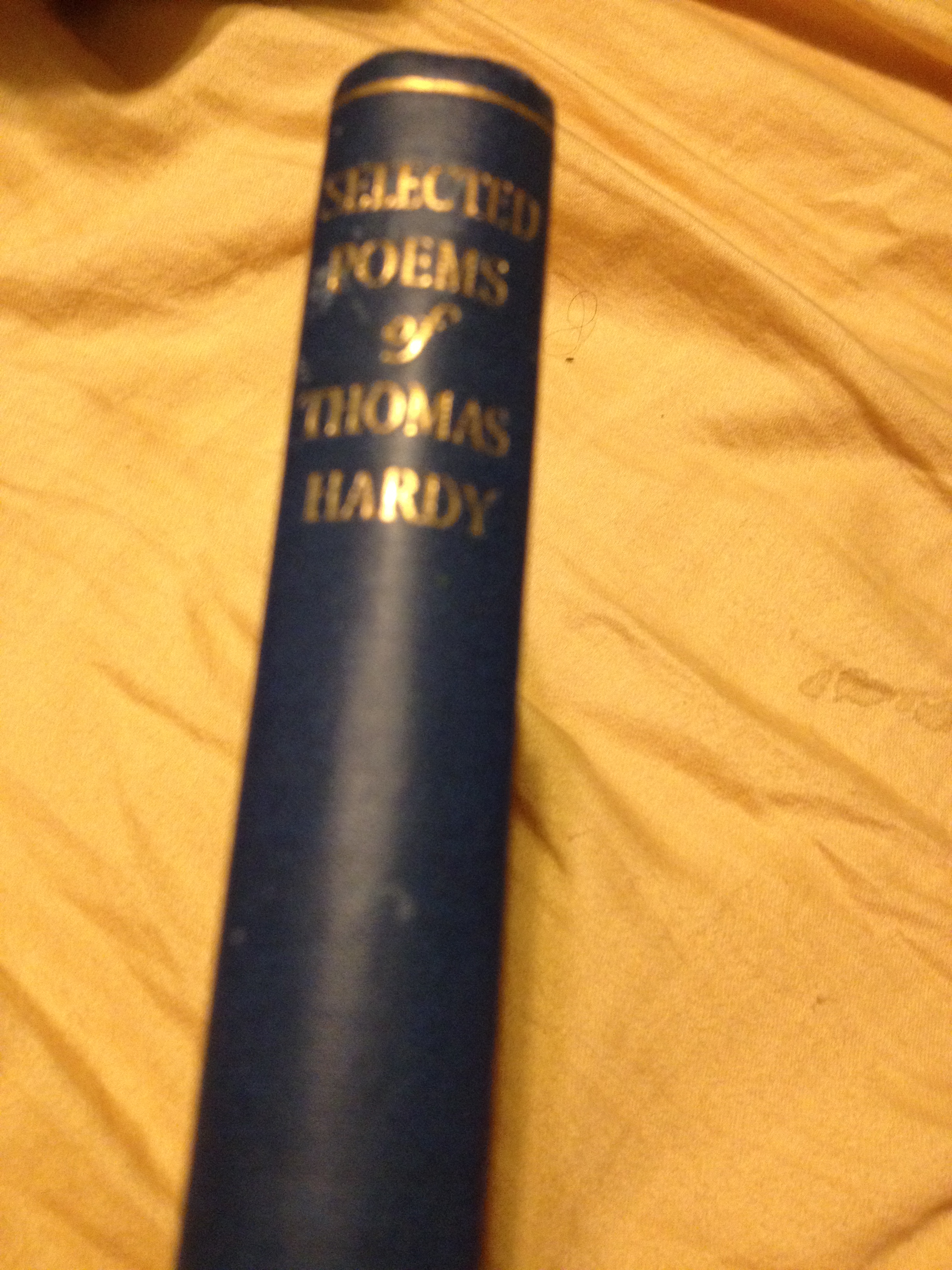
Selected Poems Of Thomas Hardy


For some reason, they made us read several books by Thomas Hardy when I was in high school. Jude the Obscure, The Mayor of Casterbridge, and Tess of the d’Urbervilles. The first was unrelentingly depressing. The second I can’t even remember (some dude some sells his wife and kid to some sailor who turns out to be a good guy; some dude feels bad, stops drinking, becomes upstanding citizen and titular mayor; wife and kids move to Casterbridge and hilarity ensues; did I say ‘hilarity?’ I’m sorry, I mean hundreds of pages of unrelentingly depressing prose). The third had one really good scene: when the whiny b—h Tess got herself hanged at the end. I liked that part, but the rest had a lot of depressing pages where you were in the presence of the supremely irritating Tess.

So, is it a wonder that I did not go out of my way to read anything that came out of the suicidally bleak and muddy mind of Hardy?

Hell no. It’s a miracle that I’m still willing to read the English language after the kind of torture put together by whatever moron came up that high school English curriculum (I mean, folks, what about including some swashbucklers or romances instead, like the novels of Dumas or Austen? something that won’t encourage teenagers to put down books… forever).

But, I kept running into references to Hardy’s poetry.

So I finally bought some.

Like his prose, it’s muddy, mournful, and parochial, but the compact nature of a poem compared to a muddy doorstop of a book makes a huge difference. Formally, he is very old fashioned compared to what others poets were doing in the late nineteenth and early twentieth century, but even that reinforces his depictions of these rural communities, which are necessarily behind the times.

His focus (obsession) was the dirty, rural lower classes who failed to live up to supposed Victorian ideals. By which I mean a lot of unwed pregnancies and more than a few abortions (generally by use of folkloric abortifacients and rarely very successful). It’s all very slow and mournful. Elegiac, even. He is writing about a lost, or at least dying, culture. He doesn’t pretend it’s a great culture, only that, like anything that is passing, deserves remembrances. In later poems, you can feel Hardy, who still comes across as more of a nineteenth century writer, feel left behind by the approach of modernity and the very different ravages of the Great War.