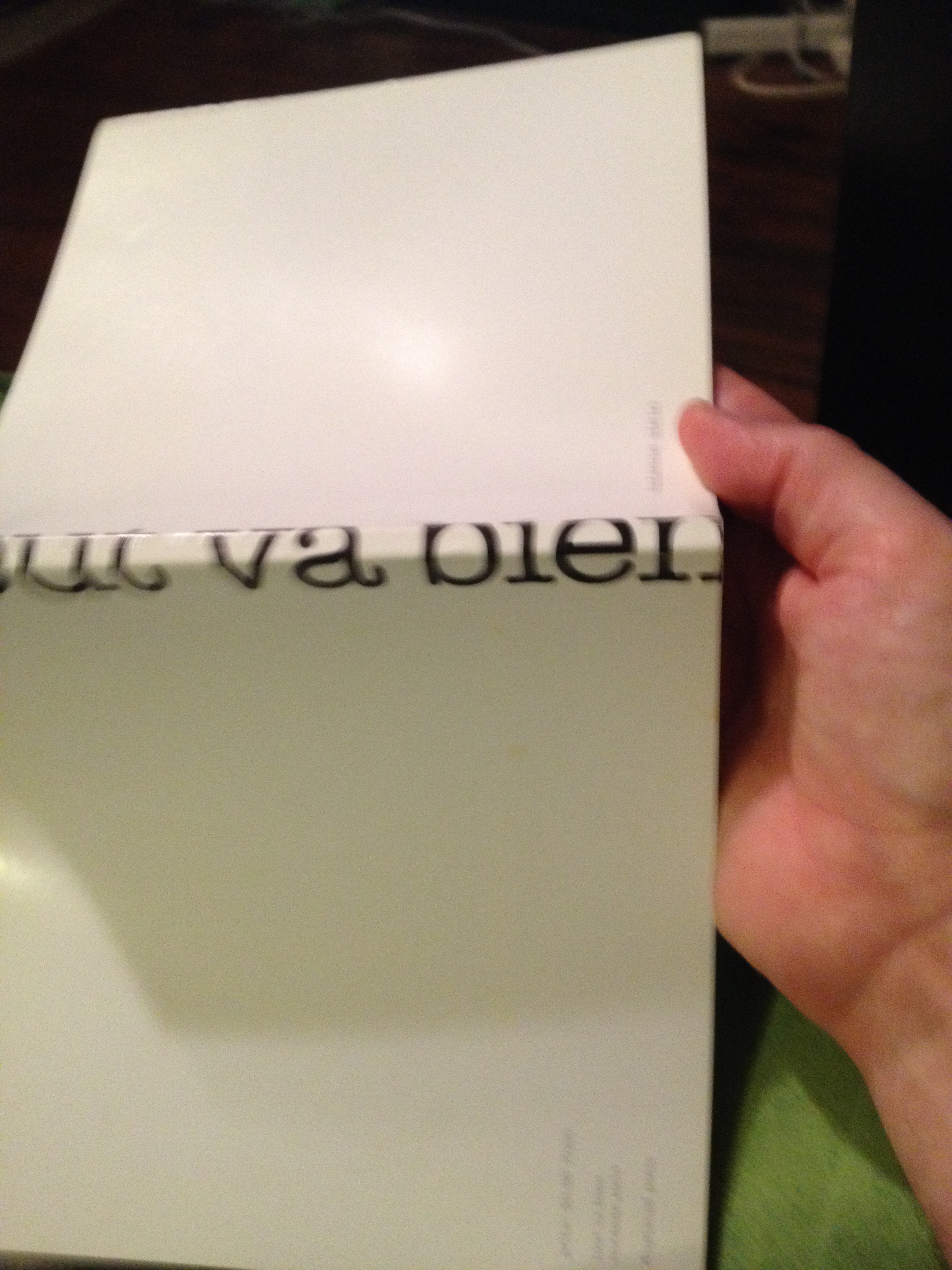
TOUT VA BIEN By Suzanne Stein – HOLE IN SPACE


I’m going to try to do a close reading of Suzanne Stein’s . I can’t remember where I got this – I think it came with something I ordered (TOUT VA BIEN has only been given away, rather than sold).

It’s divided into several sections, the first of which is HOLE IN SPACE.

HOLE IN SPACE is the transcript of Suzanne Stein speaking extemporaneously at St Mark’s Poetry Project in 2008. ‘Hole’ is apt, because a significant portion of the text are ellipses and ‘um’ or ‘uhhh’ – each of those being a ‘hole’ in speech. On the other side of things, it’s hard to see much else. I just read it and I can barely remember what it was about (which is primarily a discussion of space and place – how the internet has changed the sense of place, what site-specific work would/should look like in the current environment; which presents a contrast to the title, which translated means, ‘it’s going well;’ while that’s just a colloquial phrase for ‘things are okay,’ looking closely, it does use ‘va’ or ‘goes;’ motion in the title, but the first section is about not about ‘going’ or motion, but about mindfulness of place).

The effect is very similar to some of the works of Kenneth Goldsmith. Like his complete transcription of single issue of the New York Times or his transcription of a year’s worth of traffic reports or his transcription of a year’s worth of weather reports, HOLE IN SPACE encourages a center mindfulness, if one is willing to enter an empty, meditative state. However, that effect is not to make one aware of ostensible meaning. Reading Goldsmith’s transcription does not give one greater understanding of the meaning of that day’s New York Times, but rather of words and repetitions without meaning. Free from connection to literal meaning, it takes lectio divina another level. Which is why I struggled to remember the meaning of the talk she was giving, but remember very clearly the holes in the transcribed language. Looking for meaning between the words and sentences of language rather than within the words and sentences in language.

Tuesday Morning Staff Meeting – Whistle While You Work


Are readers & publishers whistling past their graveyard?

The women of Poetry.

Buffalo honors Di Prima.

Remember WENN


I used to love this show, though sadly, I can’t find anymore episodes online and it was never released on DVD (though there are, apparently, some old VHS copies of some of the episodes running around…).

http://www.dailymotion.com/video/xkesqz_remember-wenn-season-01-episode-01_shortfilms

Battle Royale


Yes, the chatter about Jeb 2016 has begun (did it ever stop?).

2016 looks to be a particularly interesting bloodbath on the right. It will be Jeb’s last chance. It will probably also be Chris Christie’s last and best chance, as well. So unless one or both of them gives up on the dream, expect to see ’em in the ring.

And Jeb’s fellow Sunshine Stater… Marco Rubio? It won’t be his last chance, but it will likely be his best chance. The talk and enthusiasm will not have waned after years in office, the youthful (but not green) mystique will be there. And if a Republican wins in 2016 and he doesn’t run… well, but 2024, his moment will have passed.

Happy Monday, Now Enjoy One Of The Most Satisfying Drum Beats This Side Of A Max Roach Track


Congresswoman Elect Tammy Duckworth


My mother-in-law was thrilled to meet the first Thai-American ever elected to Congress. She had asked if knew Ms Duckworth when she arrived here from Bangkok. I did not but she stopped by Eastern Market just in time for me to snap this picture.

20121125-172827.jpg

Jacques Mauritain Explains The Teleological Argument


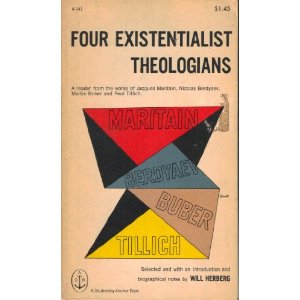
Some time ago, I picked up a book at Capitol Hill Books (I can’t remember whether it was filed under theology or philosophy) on existentialist theologians (the cover design, for all you fans of those Masterpiece Mystery title sequences, is by Edward Gorey). It began with Jacques Mauritain.

I first came across his name in a book my father got my some two decades ago called Inventing the Middle Ages, a fascinating work of historiography (which also led me to read The Waning of the Middle Ages by Huizinga and a couple of others).

Mauritain was a dedicated Thomist for most of his intellectual life. Now, I can’t pretend to have read much by Aquinas and I understood not all of what little I read (though I’ve read plenty about his writings, so I understand the basics, unless everyone I’ve read who wrote about Aquinas was lying to me).

Anyway, he (we’re back to talking about Mauritain) puts a nice spin on Aquinas’ teleology, making it far more palatable.

If, like me, you were taught about Aquinas spin on Aristotle’s ‘unmoved mover,’ you were probably less than impressed. Purely philosophically, I don’t think I’m generating controversy by saying that it’s lacking.

But Mauritain is looking at things as more of a hybrid theologian/philosopher (I don’t mean that he was necessarily trained or studied theology; but that hybrid role could, perhaps, could be said of all philosophers who come at their studies from a specifically religious-minded position; also, this rather suggests that if the book wasn’t filed under theology, maybe it should have been, except the theology section is a lot more Purpose Driven Life and a lot less I and Thou). He comes at his teleological argument implicitly tolling the primacy of faith. For him, likely as it was for Saint Thomas, the ‘unmoved mover’ is not so much a way to ‘prove’ the existence of God as it a way to create a means for fellow men of faith to improve their understanding of God; not by truly ‘understanding’ God (impossible, surely?), but by rather by providing a framework to understand one’s relation to God.


The Rules


Cool


Though it feels creepy to write it, this polygamous community looks awesome (architecturally speaking).