Seriously. It is. So… take your child already, will ya? And no, browsing on Amazon doesn’t count. Can’t believe you even tried to pull that stunt. A bookstore, people. Take your child to a real bookstore.
Saturday Post – B.S.
Weekend Reading – Political Geography
 ‘War is God’s way of teaching Americans geography.’ – Ambrose Bierce
Poetry calls to us, like wild geese
Did a collector of Symbolist paintings orchestrate this museum heist?
D’Nealian
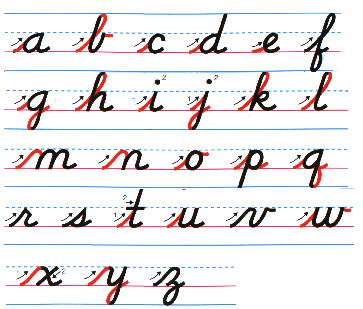 I want to bring attention to this satirical screed against pensmanship for one reason: it references D’Nealian.
If you are of a certain age (I don’t know… my age? Mid to late thirties? Okay. Let’s be honest – late thirties), then you may have been exposed to this pointless monstrosity.
D’Nealian (I didn’t even know how it was spelled until I saw this article) was some stupid thing we were taught in the third or fourth grade as a bridge between longhand print and cursive. In other words, it was some sort of reason to delay just reaching us cursive, as well as reason to take time out of our day to learn something verifiably useless – time that, if it had been used to drive home the reality of evolution, could have saved America from some of its more baffling cultural wars.
Culture Participation An Important Of A Healthy Lifestyle (Unlike Those Sugary Cereals On TV, Which Are Not Actually Part Of A Healthy Breakfast)
At least that’s what the Norwegians discovered!
The cultural part, anyway. I don’t think they studied sugary cereals. And I only like frosted wheat, but not very often.
Anecdotally, it makes perfect sense. Generally, I feel too tired to attend cultural events (museum exhibitions, concerts, jazz clubs, galleries, Warholesque ‘happenings’), but when I do, I tend to leave feeling energized and creative.
What stood out about the study was the gender difference. Males, like myself (or least so my ex-girlfriends assured me I was), get the effects from what is described as ‘passive activities.’ Attending cultural events and activities.
On the other hand, women benefitted most by the active creation: painting, playing music, writing, etc.
In any case, it sounds like the poetry reading I’ll be attending at the Folger will make me happier, more upbeat, and less stressed. Sounds like a win-win thing for me and the Folger and the featured poet (Kay Ryan, former U.S. Poet Laureate). And I’d already bought the ticket anyway, so unless the study said ‘passive cultural activities causes immediate and fatal scrotal cancer,’ I’d probably go, whatever conclusions the Norwegians reached.
Happy Birthday, C.S. Lewis
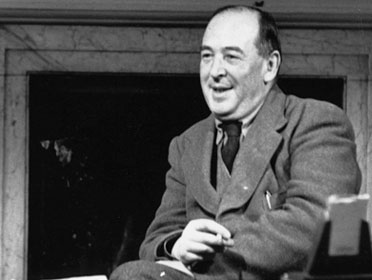 Despite being named Clives Staples Lewis, he apparently went by Jack. Must be an English thing.
Lewis is a writer who I have gone back to at various times in my life. As a child, naturally, I read the Narnia novels. The Lion, The Witch and The Wardrobe being the first and best loved, of course (it has the most ‘magic,’ you might say – and the description of Lucy’s tea with Mr. Tumnus, with the sardines on buttered toast and a dozen other lush, tasty descriptions of the sorts of traditional English food that an American boy in a naval town had never heard of; still makes my mouth water). Though I gather it has a poor critical reputation, I always loved The Horse and His Boy. It’s a great book for a lonely boy who doesn’t feel quite at place in the world (am I Freudanizing myself? maybe, I don’t know – piss off). Also, the romance in that one is of a perfect level for a child who isn’t quite old enough or is only barely old enough to appreciate the opposite sex (or same sex, depending on orientation).
His science fiction books were never of great interest to me. The Christian apologetics never quite felt natural in Out of the Silent Planet, the only one I read (though as I think about it, I want to read it again, partly to trace its lineage back to A Princess of Mars).
My mother had a boxed set of some of his treatises and explicit apologetics: The Screwtape Letters (which I read several times in junior high), The Great Divorce (which I read once in junior high, but didn’t have the theological background to understand what he was driving at), Mere Christianity, The Problem of Pain, and I think one other…
Later, as an adult, I read A Grief Observed, a naturally heartbreaking but comforting book (I was mourning a love affair, not a death, actually).
Basically, he’s got something for everybody.
TOUT VA BIEN by Suzanne Stein – FUGITIVE STATE
The second part of TOUT VA BIEN is entitled FUGITIVE STATE and is a more traditional poetic form.
Actually, the first page and a half consists of three line stanzas, with relatively lengthy lines, focusing on forms and framework and things that limit. It’s all very good and I wish she’d kept it up. Not that the rest of FUGITIVE STATE isn’t good, it just isn’t as good. The changing formal nature (shorter lines, longer and shorter stanzas, prose poem paragraphs) doesn’t add anything for me. Partly, this is because I was so wrapped up in that initial bit that the shift was disappointing for me. It’s like reading a novel and discovering that the guy you really liked at the beginning is not actually the main character. Sure, maybe you’ll like the rest of the book and this new, real protagonist, but you were really into that first guy.
The focus also shifts to identity. Now, that’s a complete break, because, after all, isn’t identity a limiting agent? And Stein definitely explores that, but also gets into the meaningless of identity (the repetition of a line about an ‘anti-terrorist’ who is financed by terrorists), but that subject is a little worn over for me. She does take it over to the subject of political alienation (as you can guess by the ‘anti-terrorist’ bit).
I should note that she does go back into (mostly) using the long lined, three line stanza structure, but even then, it’s broken up with other forms and the spell (a repetitive spell that brings attention to form) is broken (though breaking the spell also brings attention to the form), or leastways it was for me.
Stein also has tendency to let cool sounding phrases take the place of lines and stanzas that actual move the poetic project forward.
I was an American correspondent in America, who could no longer correspond to anything…
I don’t know. Too me, that’s cool thing said in a coffee house to a friend after too much coffee and collegiate philosophizing (or after too much time in the bar after too much alcohol and barfly philosophizing). Not so sure it belongs in a work of poetic creation.
But credit where credit is due. The ending, the final page of FUGITIVE STATE is magnificent and could stand as a fine poem in its own right:
so How long until How make long the lost bucolic?
there’s a descriptive act and a de-descriptive act
surface-oriented slippage I wanted to Ask
internal Organ failure internally
accurate and externally Sordid
as gestures that aren’t That didn’t
make
I wanted to Make
it was building it was irreparable
taken apart Under Accidentally Right on Target
with the script flipped I once there was
Absolution, once Have you taken stock of your Conduct?
The crowds inside, or the Trap as, we were well before
the fact
Desire’s a Tool to put to use I wanted to
That’s a great bit, and also crystallized for me the implicity touches from Gilles Deleuze and Felix Guatari’s book, Anti-Oedipus, with its ‘bodies without organs’ and ‘desiring machines.’
Speaking of which, did you know that Anti-Oedipus is now being published by the Penguin Classics imprint? Seriously. I feel old.
Depression
David Foster Wallace wrote, in the pages of Infinite Jest, about it being
a nausea of the cells and soul
Marvelously apt, but also reminds one of the great ancestors in the literature of depression, Jean-Paul Sartre. I hadn’t thought about it at the time, but more than misanthropy, aren’t plays like Huis Clos (No Exit) really about the alienating features of depression? But, really, what that phrase drove me to was Sartre’s Nausea.
We are trained to look at it from a rarefied angle: Kierkegaardian anguish of the soul (though not ‘soul,’ this is Sartre, but anguish of the ‘being’ isn’t so Kierkegaardian as of the soul) and anger at the shallowness of other people and their inability to comprehend the absence of outside meaning in the world.
But the red-haried protagonist and his writer’s block (he can’t finish a book about Gustave Flaubert) and his inability to connect with a past lover he desperately wants to re-connect to… isn’t he depressed? And lashing out at his former flame, sabotaging their connection, that pained combination of pushing away and begging for someone not to be pushed away by one…
Sartre would probably hate this comparison.
 the coffee philosopher