Circle City Books


la-et-jc-now-thats-a-wall-of-books-20130123-001

The Abandoned Former Friendship Baptist Church On 700 Delaware Ave SW Is Now Public Art


largest1

architizerhense2-600x399


6

5

NSFW


Ha! I tricked you! It’s not pornography after all – it’s poetry!

Though it does have some profanity. A lot actually. Don’t actually play this at work. You might get in trouble.

Essay On Man And Other Poems (New Year’s Resolution, Book Seven)


While I had surely read some snippets of Pope before, this was my first real dive into his writings. The shorter pieces, the lyric poems, were good. Good enough to say that, had Pope written nothing or little else, he would still be remembered as a worthwhile minor poet of his age. Rather like Ralph Waldo Emerson. But like Ralph Waldo Emerson (who was a serviceable poet, but no great), he is better known for his essays.

But Pope’s essays tend to be a little different from the New England mandarin’s.

This really struck me while reading the poem, Essay on Criticism: Alexander Pope is writing a critical essay entirely in verse form. In heroic couplets, to be specific (which are, and I had to look this up, rhymed couplets written in iambic pentameter).

Imagine opening a copy of The Nation, The New Republic, Harper’s Weekly, or The American Conservative and reading an article on a serious subject, like drone war, that written entirely in rhymed verse form. And written seriously, not as a meta-commentary on something or as a joke (which is why I left out The National Review, because, since Buckley’s death, that rag is more home to a particular brand of youthful idiocy, like Jonah Goldberg’s unreasoned idiocies, than anything serious). Go back further and what if Podhoretz’s editorials for Commentary had all been rhymed sestets or Petrarchan sonnets?

Beggars the mind.

Oh, and the Essay on Criticism includes the line:

A little learning is a dangerous thing;

Pretty cool, huh?

He gets into a great many localized, time specific references – The Rape of Lock is entirely about a particular scandal du jour – and my edition doesn’t really give the reader an heads up on this stuff.

Though not a long collection, Pope is slow read. To appreciate his rhymes and also the lines of his arguments is not a fast process. I had thought to finish it in well under a week but actually struggled to finish it by today.

Conclusion? I would read Pope again.

20130218-105456.jpg

Flash Gordon: An Underappreciated Masterpiece


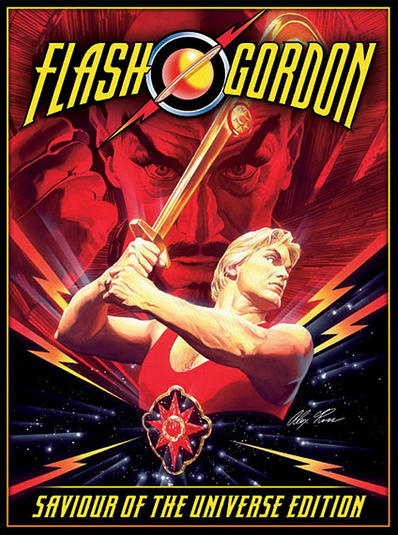
flashgordon-DVD-coverFlash Gordon is the greatest comic book movie ever made. It also contains one of the finest action sequences ever put to celluloid.

Yes, it’s high camp, but the strong actors (Max Von Sydow, Topol, Brian Blessed) chew the scenery appropriately and the merely adequate ones take the movie just seriously enough, but not too seriously (all in the proper spirit, is what I’m saying) that it doesn’t degenerate into something too ridiculous to watch.

And I will put the early action set piece where Flash defeats the elite guard of Emperor Ming using his skills as a running quarterback (with intergalactic fabrege eggs as footballs). No big stunts or wires or special effects needed. Just good ole American gridiron ingenuity.

Almost is good is when the hawkmen attack the space ship. Yeah, hawkmen, led by Brian Blessed, no less. Imagine the Battle of Agincourt from Kenneth Branagh’s Henry V, except that instead of playing of the Duke of Exeter, he’s king of the hawkmen, and that instead of wearing armor, he’s wearing leather hot pants and has wings. It’s that freaking cool.

Oh, and Queen did all the music. (‘Flash!! Ooohhoohh…’)

Who Would Have Thought That An Article In A Magazine Called ‘The American Conservative’ Could Be So Wrongheaded (Sarcasm)


Headline aside, I actually respect a good deal of what’s in The American Conservative, but this is just such a wrongheaded piece, that I felt compelled to spend entirely too much time on it.

High Art of the Bourgeoisie by Matthew Taylor is just full of… it.

Taylor is presenting some supposedly radical views of Edouard Manet that will just

Primed to see a parade of characters memorialized for posterity by a realist master, a visitor may be struck by how brief and sketchy the characterizations are and wonder at how this limitation only improves their aesthetic.

Who goes to see a Manet exhibition expecting to see realism and who is surprised to find the ‘brief and sketchy characterizations’ that were taken to another level by Monet and the Impressionists? This sounds more like a Matthew Taylor problem than something experienced by anyone who has ever read anything about western art ever in their life. Frankly, I am having trouble picturing what Taylor’s teachers taught him about the birth of Impressionism or European art in the nineteenth century that he would think that Manet is your go to guy for bourgeois realism.

What a betrayal then, of the militants of modernism, that Manet was by turns surprised and despondent at his repeated rejections at the hands of the academy, the critics, and the public.

Who are these militants that are offended that Manet wanted to traditional critical success which was, generally, necessary for, you know, monetary success, i.e., selling your paintings. It’s hard to find an artist, but that artist ever so avant-garde, to take joy in being rejected, not just by the academy and critics, but also by the public that artists depend on to give him or her money in return for the sale of artwork. Oh, and it should be noted he followed that remark up by quoting from a epistolary exchange between Manet and his friend, Charles Baudelaire. Baudelaire, the iconoclastic rebel who wrote a poem about cutting a woman and having sex with the wound as a means of giving her syphilis. Taylor, your non-iconoclastic, bourgeois, middle class man does not ask a man like Baudelaire advice on handle approbation without being just teensiest bit avant-garde.

There is an admirable humility in Manet’s corpus that separates him from his contemporaries. He turned down an invitation to join a dissident art exhibition held by Monet, Renoir, Cézanne, Degas, and other budding impressionists. He preserved that artistic integrity in which art must flow from the soul of the painter, and without which art is merely brittle canvas splashed with resin and oils, without succumbing to the self-satisfied pleasure at the contempt of the ignorant that characterizes the soldiers of the avant-garde.

Okay. Nice straw man there to describe the entirety of every avant-garde movement ever. And Manet didn’t turn down the dissident art exhibition out of humility. Rather the opposite. He wanted to wider acclaim that came with recognition and respect in the official Salon. Also, the Impressionists were the brash, new kids on the block. Manet was from an earlier generation. I don’t go partying with twenty-somethings, but it’s not out of humility.

Taylor even ends his essay with ammunition for the opposite argument he is attempting to make, by quoting Manet: ‘Who is this Monet whose name sounds just like mine and who is taking advantage of my notoriety?’

‘My notoriety,’ Manet said. He was friends with the radical poets Baudelaire and Mallarme. He supported a female painter, Berthe Morisot. And, of course, he was friends with Monet, Degas, Renoir, Cezanne, etc.

No. Manet wanted acceptance and acclaim from the main tastemakers of his time. But he was not a bourgeois painter. He was a radical and did set the stage and tone for modernism in the visual arts.


Poor Marco Rubio


He just can’t catch a break. After a solid twenty-four hours about his unique, humiliating brand of physical comedy (desperate dives for the water bottle, plus a nationally broadcast flop sweat), the story has switched to, ‘in our frenzy to write about Waterbottlegate, we neglected to point out how awful the actual speech was.’

When this happened to Bobby ‘Kenneth the Page’ Jindal, it got his rising name wiped off the shortlist when Mitt was looking for veep.

A smart consultant might have told him not to deliver the rebuttal, but apparently, Rubio either doesn’t have such consultants right now or he’s not listening to them.

Weekend Reading – We Have Ways Of Making You Talk, Professeur Derrida!


40-free-mac-fontsWhen Jacques Derrida was arrested.

“It is hard to imagine a destination like Union Station without a fully stocked bookstore…”

“We lost Borders. We cannot bear to lose you too.”

You are your font.

Treasure Them – They Don’t Come Around Very Often


I’m talking about poetry book reviews!

On Adrienne Rich’s posthumous collection of new and selected poems. Somewhat surprisingly (though refreshingly, even though I love Rich’s work from the 70s through the early 90s), a tepid review.

Nearly a thousand pages of Edward Dorn’s poetry is reviewed here, in a surprisingly short piece.

Seth Abramson is becoming more measured and more interesting to read, at least, as a review (I haven’t read his poetry, though I reckon that I should). He writes some longer review in this, his usual collection of individual reviews of five different works. He offers some criticism and damns with faint praise, rather than universally lauding. And his final review is less a review than something deserving of its own space: an essay on the changes and developments of the various publication philosophies of poetry book publishers.

And a decidedly mixed to poor review of W.S. Merwin’s translations.

Two minimalist poets.

The Graveyard


While no one could have predicted that Rubio would suffer from a hilarious flop sweat and embarrassingly intense dry mouth on national television, the slot following a president’s state of the union address is a notable graveyard of failed national ambitions; a high risk opportunity without a lot of real upside (you’ll always look less presidential than a president addressing congress and the nation).

Which leads me to ask: did Paul Ryan, Chris Christie, and Bobby Jindal (himself a noted failure in the same slot) engineer Rubio’s appearance just to take him down a notch?