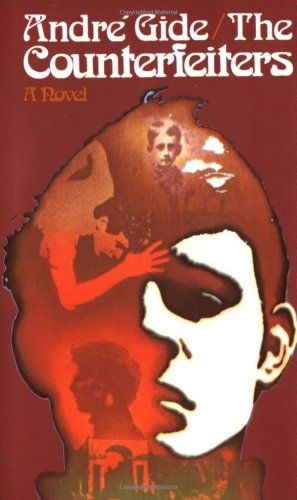
 This is the first book I’ve read by the Nobel Prize winner, who won in spite of defending pederasty, but we do (or should, I would say) award literary prizes based on literary quality. Now, I’m reading this in translation, of course, but The Counterfeiters seems to have plenty of quality.
It’s an intelligent read, an insightful read, and a brisk read. I breezed through it, really. If you’re looking for one of the literary volumes that will not only expand your mind, but also expand your ability to show off that you’ve expanded your mind by reading great literature, you could do worse than this book. It’s French and it’s by a Nobel Prize winner, but you’ve also got a decent chance of being the only person in the room whose ever read it, so you get points for that. And you’ll enjoy it and, despite coming it at roughly four hundred pages, you’ll be able to finish it quickly.
The main characters, after a fashion, are two school boys. Sort of. Named Bernard and Olivier. They’re not really school boys in that they are about the take the finishing exam that will (or will not) allow them to go to university. But anyway. They are pursued by two men with more or less unstated sexual desires for young men. One is intended to be a rather villainous corruptor (I can’t help but compare him to the Lord Henry who corrupted the handsome, young Dorian Gray) and the other… not. The other, a writer named Edouard, who is also the uncle to Olivier is a major character, a sort of narrator of the tale of the two young men, with much done from his perspective and a great deal of the book being written in the form of Edouard’s diaries. Edouard, unlike the corruptor (Comte Robert de Passavant), does appear to have some romantic, if not obviously sexual, feelings for women. Passavant, in one delicious passage, does flirt with a girl, but only to hide his sexuality. It takes place during a wonderful party for a literary review, which features a drunken challenge that almost evolves into a duel and some characteristically crazy behaviour by the writer Alfred Jarry, who was a very real and very eccentric writer, who was (in)famous in the late 1890s and early part of the twentieth century, which I take to be the period in which the novel takes place (it’s never really said, though it was published in 1926, but clearly takes place before the Great War).
The oddest passages, at least by my reckoning, are towards the end when for an entire chapter (though Gide’s chapters tend to be short) Bernard finds himself (literally) guided by an angel – an angel with whom he later wrestles, Jacob-like, even ending with what seems a similar blessing. He gives up the woman he has been sleeping with (who is the sister of a woman he fell in love with, that woman being sort of beloved by Edouard and who had been impregnated by Olivier’s older brother, despite said woman, the sister of Bernard’s mistress, being married to a boring accountant) and decides on a career in something touching the literary (he talks about becoming a proofreader or the secretary of a writer, but is thankfully offered a position on a literary review). While there is some ‘growing up’ that takes place, plus some realizations that formerly admired figures aren’t so admirable, it’s not otherwise a book that features much religious/spiritual awakening. Not really its thing. There are some late attempts to tie things together, but the novel itself is episodic and the effort reminds me of the end of A Clockwork Orange, where Alex simply grows up (as someone who saw the movie first, reading the book and its ending was a shock), and the ending of The Counterfeiters is similarly unsatisfying. Not dreadfully unsatisfying. Just slightly so. Also, it conspires to make the whole read like a response, or perhaps making fun of, Decadent literature (Decadent with a capital “D,” as the writings of J.K.Huysmans or the earlier mentioned Wilde novel).
 Economy. I’m going to keep using that word as I read through David Eddings’ multi-volume opus. It’s economical. In a good way. Usually. Not always. Economy of writing (and therefore, economy of reading). At $7.99 pop at the bookstore (assuming you can’t find a used copy of a particular edition), it’s also economical to purchase.



 the coffee philosopher