‘Archy And Mehitabel’ By Don Marquis (New Year’s Resolution, Book Thirty)
Archy and Mehitabel is a collection I’d read and that I’d stored away somewhere in my head to find and read later. So some years later, I found it in the poetry section of Capitol Hill Books for just just four dollars. As luck would have it, I had six dollars store credit remaining.
What is it? Is it poetry? Maybe.
Archy is a vers libre (free verse) poet who has been reincarnated as a cockroach and who chronicles his own adventures and thoughts and those of his companions (mainly, a cat named Mehitabel and a rat named Freddy) by jumping up and down on the keys of a typewriter in the dead of night in the office of a newspaper. Because he can only jump on one key at a time, he can’t make use of the shift key, so writes everything in lower case (and doesn’t use apostrophes for the same reason).
Mehitabel claims to be the reincarnation of Cleopatra, among others, though her story often doesn’t hold water. She comes across as a working class gal with a vulnerability to the charms of manipulative and cruel upper crust bad boys. The only vague indication that she might once have been a bit more couth is that she knows (and frequently describes herself as being, despite setbacks) toujours gai.
The chronicles are written as poetry (mostly free verse, naturally), but what are we to think of them as poetry? They lack the genius of a comic verse genius like Lear, but they are lightly amusing and I read it fairly well through in a short burst, so it held my attention.
The writing is witty, in a workmanlike way. The conceit is amusing. Most of it is downright fun (highlights include a suicidal struggle between Freddy the rat and a tarantula, which results in Freddy’s demis and after which Freddy is dropped into the alley with ‘military honors’ by the various vermin of the office; also when Archy takes the wrong train and types a note on a typewriter in Long Island, asking the owner to mail said note to the newspaper office where Don works so that he will know to pick Archy up at the station).
They were written as filler for a six day a week column, starting in 1916 and going through the thirties and I can’t help but feel that if I knew better the politics and gossip of New York City during the times when they were written that I would pick up on a great many funny references. Alas, I do not. Nonetheless, if you see an affordable copy, pick it up.

Midweek Staff Meeting – Another One Bites The Dust
It’s About Time

Martina Hingis & The Washington Kastles
The Washington Kastles of World Team Tennis is a great night out in DC.
Having shamelessly hawked their corporate product (it is great fun, though, and a neat little stadium right on the water), I’m going to comment on Martina Hingis, who has played with the Kastles this season.
At thirty-four (still looks she should be carded for cigarettes), I won’t say she’s still the player she used to be. Heck. She hasn’t been the player she used to be for fourteen years, but she was one of the all time greats.
In her singles match against a youthful Sachia Vickery, she absolutely crushed her opponent. Against a painfully overmatched player, it was easier to see her former greatness, because she had time to do all the things you remembered. So patient, so intelligent on the court. Never trying to overpower, but just consistently moving her opponent around for a series of back and forths until she’d pulled poor Vickery into a place where Hingis could put a little pace on the ball and hit the winner. I’m not even sure if Vickery won more than a couple of points (she didn’t win any games).
Though, as is usual in Kastles games, Bobby Reynolds was the hero (the way it’s set up, with Men’s Singles coming last and the rules making winning it nearly a necessity, is perhaps a tad sexist and almost guarantees that the best male player is the star; but Bobby seems so likable, one can’t be resentful).

‘The Renaissance’ By Walter Pater (New Year’s Resolution, Book Twenty-Nine)
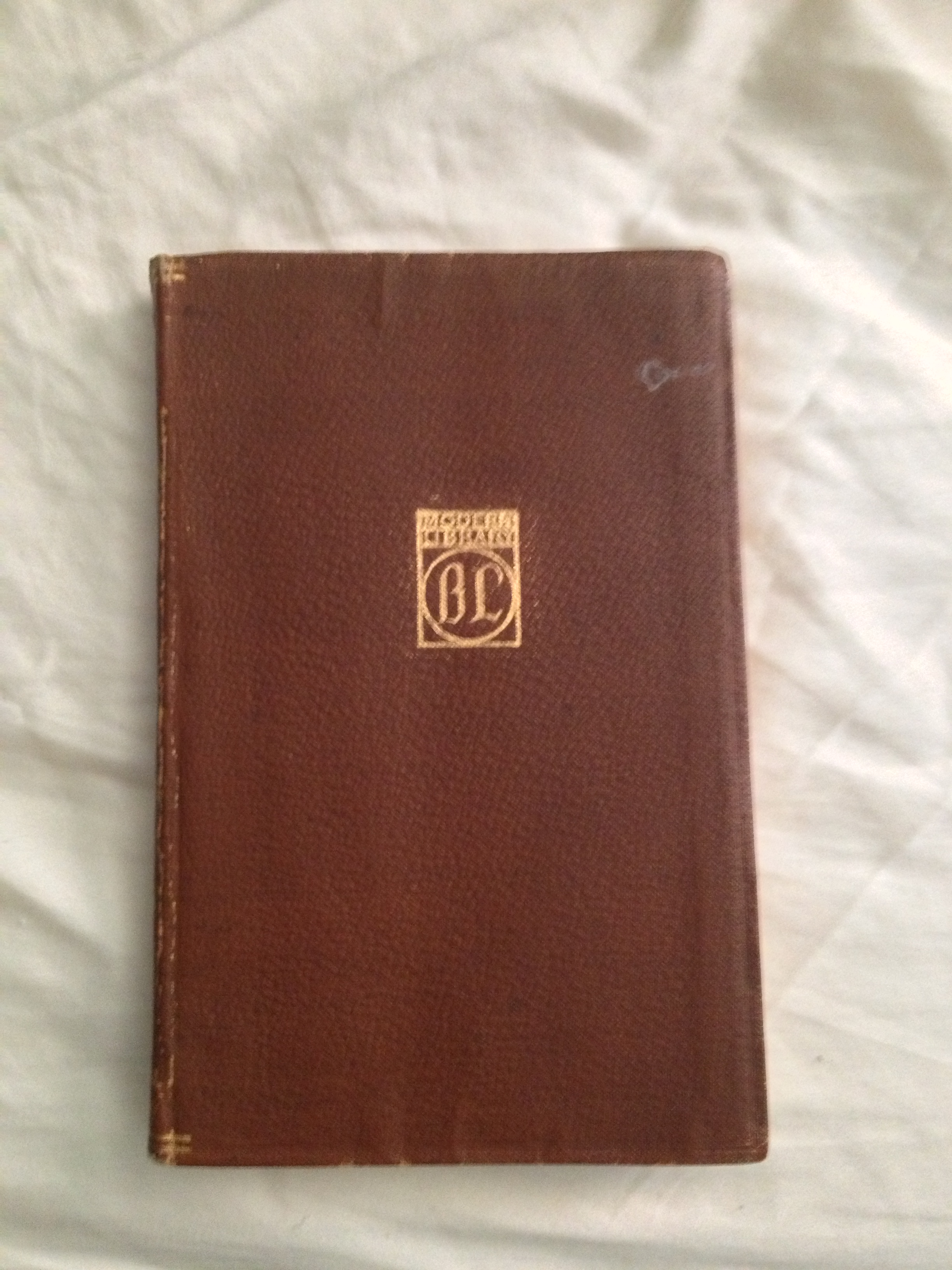 Walter Pater’s Renaissance is a collection of essays mostly, though, oddly, not exclusively, on topics related to the Renaissance. The introduction (by Arthus Symons) acknowledges Pater as being among the second tier of nineteenth century British prose stylists and historians, but still worth reading. He’s basically right. This book is a light and airy pastry, dusted with fine sugar. Delicious and sweet, but quickly dispatched and and forgotten (except should one see it again on the shelf, in which case some fond memories might re-emerge).
An effort is made by Pater to recognize some of the lesser lights and aspects of the time. Botticelli, for example (who is only lesser in comparison to Michelangelo, Da Vince, and Raphael), and some French writers and literature. A sort of aesthetically minded humanism unites his writings, but there is little enough that passes for a thesis in any of the essays. He tries to find something new to say about the works of the artists, but he never quite settles nor properly explains it. For example, there’s something he wants to say about the poetry of Michelangelos’s statues or how the art of poetry is somehow expressed in them (while failing to say much about the rather good poetry that Michelangelo happened to write), but I don’t really know what it is that he wants to say.
Excepting an author’s conclusion, the final essay is the best. It is also not about the Renaissance. It’s about Johann Joachim 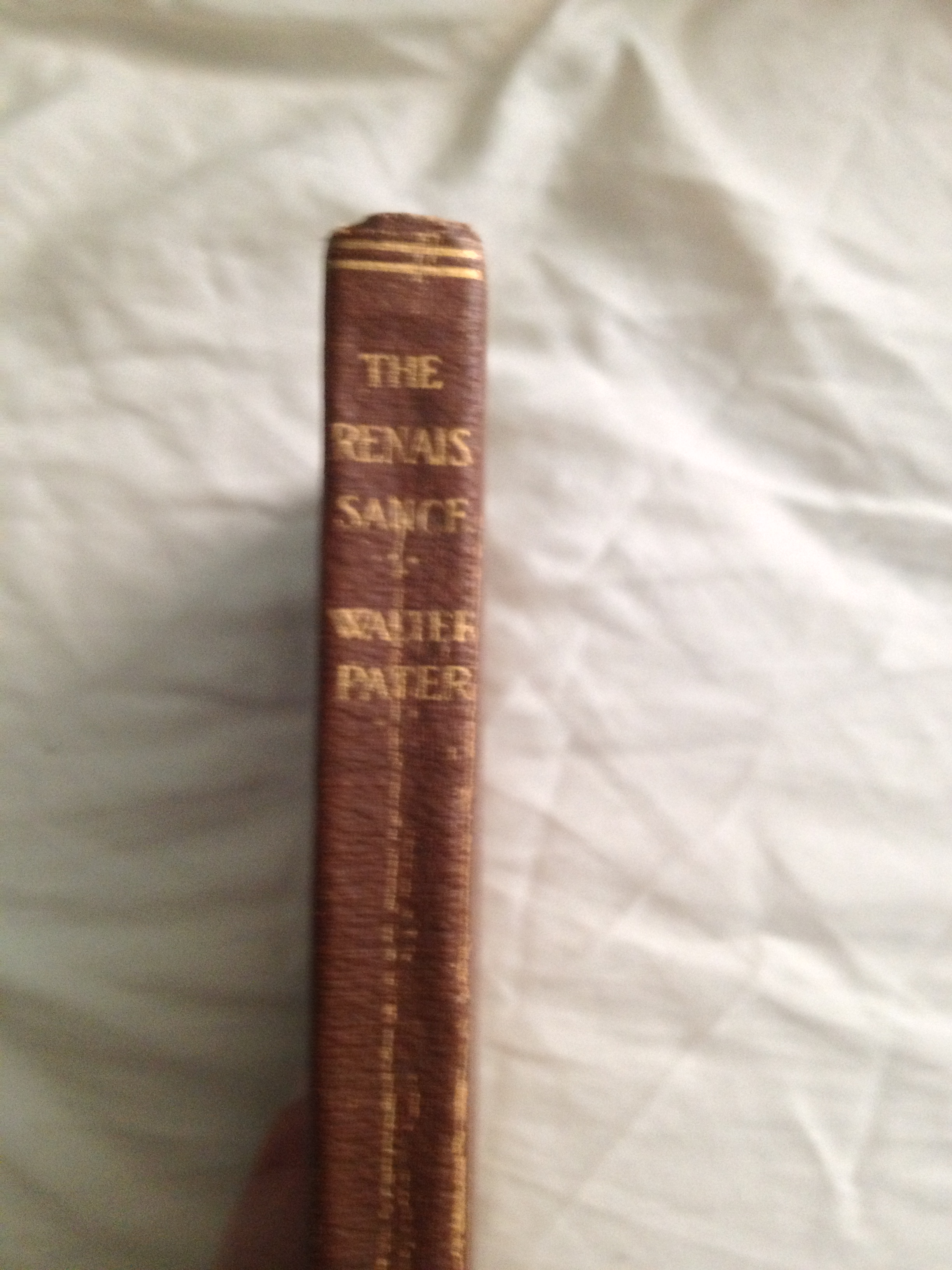 Winckelmann, an eighteenth century art critic/historian who wrote about Greek art and literature. It’s the longest essay and a real passion comes through. For Pater, I think, Winckelmann represents a scholarly ideal that critics like himself should strive to emulate. Winckelmann’s love for the Greeks is well captured by Pater. This essay, I could see myself going back and reading again.
Overall, Pater is no Ruskin. But it’s a reminder that the great nineteenth century essayists were pretty wonderful. Makes one adopt a sort of declinism when thinking about the modern essayist (who is, often, really a humorist).
Finally, there is an inscription:
M J Hutchins
July, 1920
This book was gifted nearly a century.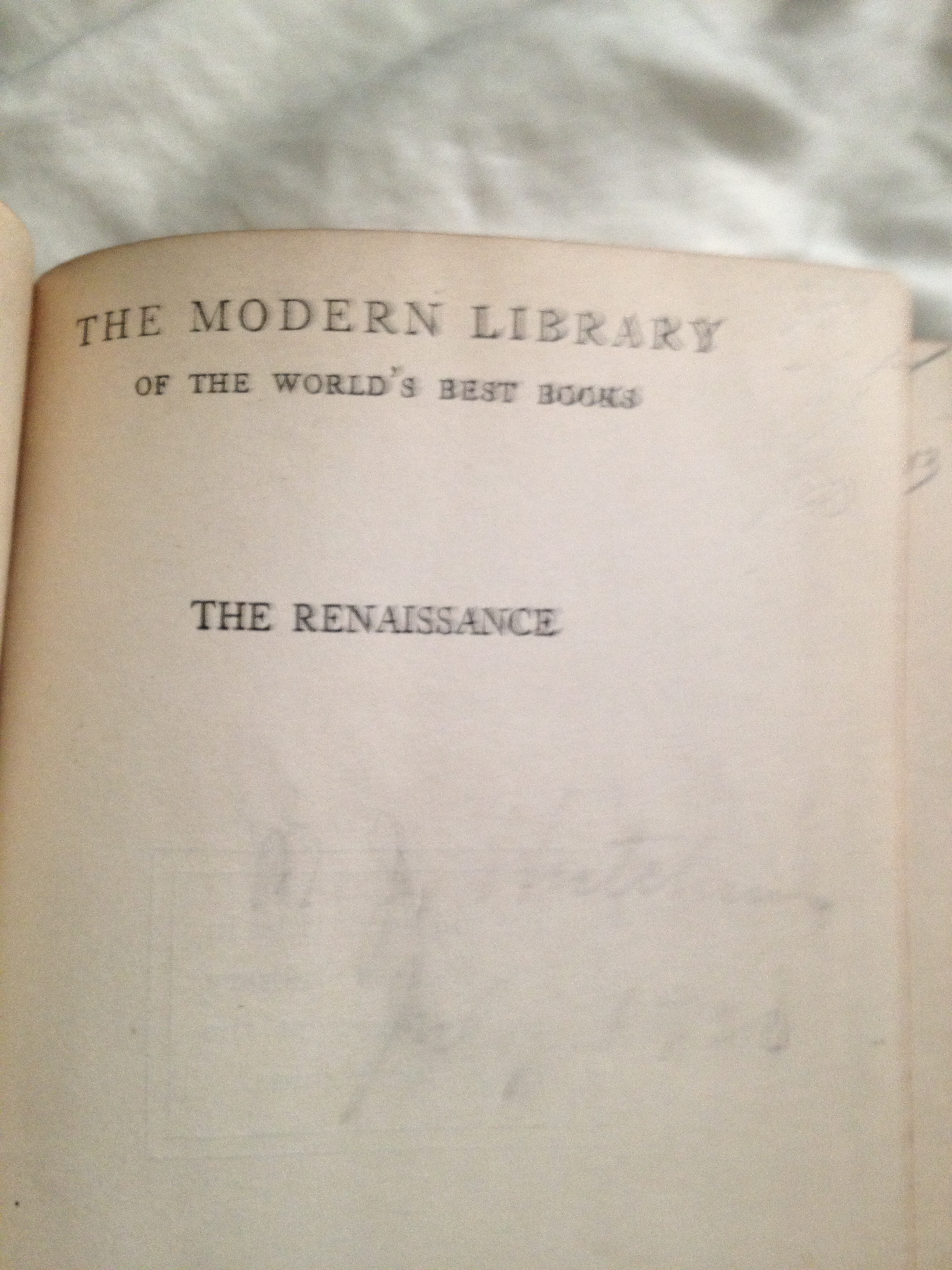
Monday Morning Staff Meeting – Retrieval Versus Creation
‘Enchanter’s End Game’ By David Eddings (New Year’s Resolution, Book Twenty-Eight)
 I had been hoping that the Belgariad was a trilogy when I started it. Now, I really wish it had been a trilogy, not in the least because the drop off between the first three books and the last two is pretty sharp.
The prophecy (or really, prophecies) driving the action end up making the whole thing seem too fated. It’s not so much a lack of tension as it is too many things coming across like a deux ex machina.
There is a great big battle which is very exciting and well done, but the long marches leading up to it get entirely too much detail.
Credit where credit is due. There is a bit where the hero (Garion) and the two most interesting characters (the wizard Belgarath and the sneaky spy, Silk) head off on their own. It reminds me of The Fellowship of the Ring, when Aragorn said he had intended to enter Mordor with just Frodo, Sam, himself, and Gimli and not to bring the whole troop. But ripping off too blatantly from Tolkien is another problem.
Anyway. Don’t think I’ll be reading more Eddings for a while.
 the coffee philosopher