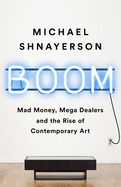
Review Of ‘Boom: Mad Money, Mega Dealers, And The Rise Of Contemporary Art’


Boom was a nice counterpoint to Warhol, so I’m glad my library holds arrived in such close succession.

Andy Warhol actually appeared prominently in the book and one of the most interesting insights was how much the largest dealers actively worked to make his work valuable in the years after his death.

But though they are a major part of the book, Boom is about the dealers and gallerists, not the artists. And it provided a nice, reasonably in depth, chronological history of major galleries (mostly American, mostly beginning in New York City), beginning just after World War II and continuing up until very nearly the present day.

Of course, the present day, this time of plague, feels so different, so even 2019 can feel like a different world. But, for at least some perspective, the sections on how major economic downturns affected the art market provides possible the best view on how it will emerge from… whatever this is.

Cicero On How We Know The Gods Exist (And An Implied Epistemology)


For the belief in the gods has not been established by authority, custom or law, but rests on the unanimous and abiding consensus of mankind; their existence is therefore a necessary inference, since we possess an instinctive or rather an innate concept of them; but a belief which all men by nature share and must necessarily be true; therefore it must be admitted that the gods exist. And since this truth is almost universally accepted not only among philosophers but also among the unlearned, we must admit it also being an accepted truth that we posses a ‘preconception,’ as I called it above, or ‘prior notion,’ of the gods.

Cicero, De Natura Deorum

Sword Of Destiny


This is by the best of the three Witcher novels I have read. Much better.

Sad, wistful, hopefully. Emotionally satisfying, is what I think I’m trying to say.

Like The Last Wish, it is a short story collection, taking place before Blood of Elves, but leading up to it (and also contains some of the stories upon which the Netflix show was based). There is a novella that takes up a good portion of the book and it is that novella and a story about the relationship between Geralt and Yennefer (and the failure, thereof) that gives the book its heart (and that also tug at the heart’s strings).

Anyway, now I get why people love the Witcher stories.

The Burning God


Magic schools or science fiction academies almost always make for good reading. JK Rowling made a billion dollars out of writing novels that almost never left the grounds of Hogwarts. Probably because the next step is almost always the hardest. I would argue that only Ursula LeGuin’s Earthsea novels every featured stories taking place after the magic university was finished that match up to (and even surpass) that time in college. Maybe it’s like real life. Nothing really beats those school days.

Credit to Kuang for trying and for writing a non-western themed fantasy. But she didn’t stick the landing. She struggled mightily and came close in this final book, taking the logical conclusion, while still giving her protagonist redemption… but it didn’t quite work.