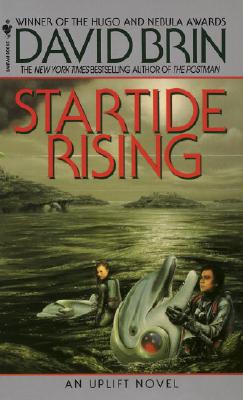
 Sundiver was an Asimov-style sci fi mystery, but it’s ‘sequel’ (it takes place in the same universe, so it’s a sequel in the same way that a book about the sixteen century is a sequel to one about the fifteenth century), Startide Rising is more like an old fashioned space opera (though definitely with deep roots in Asimov’s hard sci fi style).
I had trouble finding this one in bookstores, so I ordered this one from a bookstore (not Amazon! not Amazon!) and had it shipped to my office to hide my book buying habit from my best gal (Peg at the front desk was very understanding of this need).
Brin’s characterizations are good for genre writing (not great, but more than adequate), but sometimes his dedication to a carefully crafted, scientifically sound (he does have an advanced degree in applied physics) universe gets in the way of writing an exciting yarn.
But, he’s clearly head and shoulders above most sci fi out there.
Some of his most space opera-y moments come in brief, italicized chapters or interludes that capture a space battle going above the surface of watery, earth-like planet where a small group of intelligent, genetically modified dolphins (who make the bulk of the crew, including the captain), a few humans, and an intelligent, genetically modified chimpanzee scientist seek ways to: repair their crashed space ship; escape from the angry hordes of warring galactic fleets above them; and take back to Earth their scientific/archaeological discoveries (lost artifacts and space ships from the Progenitors, the first space faring race and the source of most of the universes’ scientific and engineering knowledge).
In those interludes, he quickly dives into a particular aliens’ ship and their efforts to win the battle for the planet on which the Earthlings are trapped so as to acquire whatever information the Earthlings have uncovered. Though short, they are a marvelous way to describe the space battle going on and also to give the reader a glimpse at various alien societies in Brin’s ‘Uplift Universe.’ It also provides the reader understanding that the battle is long and complicated, so that no one starts questioning how the stranded dolphins, chimps, and humans are able to hang out on the planet for weeks without being, you know, captured and killed.
When he drops some of the dedication to hard sci fi and starts in on some really fascinating fights and escapes in a metallic sea and between warring varieties and between warring allegiances of dolphins… well, things get good. His characterization may not be great (frankly, I couldn’t really distinguish the personalities of several of the dolphins ; generally, the ‘good’ dolphins were pretty similar to each other, and likewise the atavistic, ‘bad’ dolphins were sometimes hard to tell apart). He just needed to start that sooner. He’s not skilled enough at the building up process to wait two hundred pages (almost half the novel) to really kick into gear. By the end, it’s moving very, very quickly. Frankly, too quickly. It’s exciting and well done, but I can’t help but keep harping on the pacing issue.
Will I read the final novel in his first Uplift Trilogy, The Uplift War? Probably. Will I read his second Uplift Trilogy? Maybe, maybe not.
 the coffee philosopher