Does This Mean Borders Will Be Saved?


Does this mean Borders will be saved? The bookstore chain finally presents a business plan to its unsecured creditors (which basically means the landlords who own the shopping centers where you find the stores and the publishers who print the books that they sell). One thing that caught my eye was moving their corporate headquarters from the relatively affluent college town of Ann Arbor to the struggling former industrial leviathan of Detroit. The Motor City could certainly use a major company moving their HQ into town, even if it is a struggling a company. Should Borders ultimately survive, it may even draw other businesses into Detroit.

Unfortunately (?), analysts are not so sanguine that this will work. Specifically, whether publishers trust that Borders has actually figured out a business plan going forward that will enable them to be pay publishers in full and on time for, you know… books. This has been a long running problem, as the bookstore has been trying to classify the money they already owe to them as “loans.”

As I have noted before, I cannot wish ill on Borders. Though I may prefer to shop at an indie bookstore, the book publishing industry as whole will be gravely hurt if the second largest chain in America falls. And those hurt won’t just be the Random Houses, but also the Copper Canyon and Graywolf and Coffeehouse presses.

DC United


In addition to my love of poetry, bookstores, and politics, I am also a soccer fan. A couple of things happened this weekend. Firstly, the Tampa Bay Rowdies were reborn after more than twenty years in abeyance. They also chalked up a win against Montreal. When I was in junior high, my soccer team’s assistant coach played for the old Rowdies (this was back in the late eighties) and my mother generously took me across the causeway to Tampa for some games.

The other thing that occurred is not so much a single occurrence as an ongoing concern. And that is the failure of DC United to score in open play. In their home opener, they defeated the Columbus Crew 3-1, scoring two goals from open play and one from a penalty kick. Since then, they have depended on the ability of some of their attackers to make solo runs and draw fouls in the box to score from penalties. Needless to say, this is not a long term strategy for success.

The consensus seems to be that DC is lacking that killer, final ball – the creative player who can play that that defense splitting pass that the team’s speedy (at least over short distances) strikers can take advantage of.

Over the offseason, former DC United playing legend and current head coach, Ben Olsen acquired central midfielder Dax McCarty from FC Dallas. It was a good pick up and, except for salary cap space, it came at no cost to DC. Olsen made it known that he was giving McCarty to keys to the midfield and handed him the #10 jersey (the number ten is typically worn by a central attacking midfielder, a team’s creative fulcrum; the classic #10 is called a treqaurtista in Italian because he tends to roam the space between the opponent’s midfield and defense, looking to create opportunities for his strikers).

McCarty is a very good midfielder who has been forcing himself onto the U.S. National Team on the basis of his club performances. But he is not a classic #10. He’s a midfielder organizer or general. Adept at winning the ball from the opposition, keeping possession for his team, and starting attacks, but not the man whose primary job is to play to final pass that directly leads to a goal. Rather a Kaka or Zinedine Zidane, he is closer to a Claudio Reyna or Michael Ballack. Capable of creating the assist, or surging forward and scoring goals, but whose main job is in a deeper midfield role. This is what he did in Dallas, where the #10 role was played David Ferreira and McCarty’s job was to support him and play off him.

What I have seen happen is that McCarty tends to push up and attempt these deft flicks and tricks that don’t come off that well. He has also been given set piece duty and I haven’t been convinced by his delivery. When he has dropped deeper and played the role of the organizer (which I am distinguishing from an offensive playmaker), he has been the player we had hoped for when DC United acquired his services.

But…

There’s always a “but.” DC’s version of the 4-4-2 formation depends on the outside midfielders (usually Chris Pontius on the left and Santino Quaranta/Andy Najar on the right) generating the offense and linking the midfield and attack and delivering that final ball I’ve been talking about. They’ve done a good job, but haven’t provided the solution we the fans have been looking for.

What boggles the mind is that frequently left on the bench is DC’s highest paid player, the thirty year old Montenegrin international, Branko Boskovic. Able (in theory) to play in a free role on the left (meaning that he will tend to roam inside and switch wings frequently, as opposed to playing the traditional outside midfielder’s role of taking the ball to the touchline and crossing it into the box for the strikers) or to play just behind two strikers at the top of a midfield diamond or in a free role behind a lone striker with four midfielders behind him. In these scenarios, Dax McCarty can play like he did in Dallas, passing the ball to Boskovic (playing in a more advance role than McCarty) and making timed runs from a deep position into the opponent’s box to either receive the ball back from Boskovic or to pull defenders out of position to create space for others (which is basically how his highly successful partnership with Ferreira worked).

If Boskovic is not capable of taking on this critical role, it begs the question: what are we paying him for? And if he can’t, Olsen needs to start scouting players to pick up when the transfer window opens in the summer.

New York might be willing to part with Mehdi Ballouchy (though he failed to impress for them playing at the top of a midfield diamond) or – and this is a bit of fantasy fulfillment – AC Milan looks not to be signing the thirty-five Clarence Seedorf to a new contract when his current one expires at the beginning of June. He has long wanted to be given that role behind two strikers and still has the skills to pull it off at the MLS level, if he is willing to close out his career in our nation’s capital.

In the meantime, if Olsen is unwilling to hand the keys to the team’s offense to Boskovic or if he proves incapable of pulling it off, then one of our outside midfielders need to step it up and take responsibility for the attack (probably Pontius; Najar is supremely talented, else he would not have supplanted the veteran Quaranta, but too young; Pontius is comfortable cutting inside and his experience as a striker means that he should also be able to pose a strong enough goal threat to keep defenders honest).

Ok. Back to either poetry or politics soon, I promise.
 

National Library Week


Monday marks the beginning of National Library Week (are the libraries trying to steal the thunder from National Poetry Month?). These days, I tend to be more of a haunter of bookstores than of libraries. It’s very American of me – I want to own my books, not borrow them.

But that doesn’t mean I don’t have very fond memories of libraries and don’t respect and value (and am willing to pay additional taxes to finance) them.

As a young child, we lived in Scottsdale, Arizona. At the time, I was too young to realize that Scottsdale was an overgrown, soulless, suburban strip mall. But  was not too young to love going to the library – mostly because they had these enormous (or so they seemed at the time) white sculptures you could climb on.

Later, I loved the Dunedin Library. They spent what seemed like a long time building a wonderful new building, but it was well worth it. It’s not a huge library, but it’s comfortable and inviting and hosts some wonderful events (I remember attending a performance of an artist and scholar dressed as Zora Neale Hurston).

Even later, there was the Gulfport Public Library. A short walk from my apartment, it was a cozy place. A satisfying if not overwhelmingly comprehensive collection. Mostly, I went there to read both daily papers and numerous magazines. It was a daily ritual that I treasured.

April 14 Is “National Poem in Your Pocket Day”


Are you planning on celebrating “National Poem in Your Pocket Day?” I am. I may even try some of the suggested “guerilla poetry” maneuvers.

It is fortunate that most poetry collections are not so large. It  is also fortunate that I like to carry a black canvas shoulder bag with me. Though I may change my mind at the last minute, I’m inclined to bring some Fanny Howe.

Derrick Weston Brown’s “Wisdom Teeth”


Busboys and Poets featured a reading by their poet-in-residence Derrick Weston Brown in honor of his first collection of poetry, Wisdom Teeth.

I had not heard Brown before the reading. I never went to the open mics nor the slams he hosted. In fact, when I looked online for some of his poems, I felt pretty sure that I would not like his writing.

Much of the reason for this is cultural differences – differences at least partly resulting from race. I am white. I was raised by white people who primarily inculcated me in the cultural specifics white American and Anglo-European culture. The culture of the poetry at Busboys and Poets is inextricably tied to Washington, DC’s African-American history and culture.

The disconnect for me is that, for me, poetry is always most deeply informed by the written word. By the physical page and appearance of the words upon it (my parents each spent much of my childhood reading in silence, especially during difficult or upsetting times, and this made my ties to the written word almost unavoidable). Slam poetry, hip hop inflected poetry – these are forms more deeply informed by the oral word.

But…

Once I was able to flip through Wisdom Teeth, I loved it. Really loved it.

Brown’s poetry is still intimately and predominantly informed by oral culture, but also by the formal techniques of the written word. A series of poems near the beginning about a group of slaves in the American south is especially affecting in its combining of colloquial language and oral traditions with the contemporary forms of written poetry.

Of course, now the question becomes, do I like his poetry only because it touches on the poetic traditions of “my” (read: white, European) culture?

Such tricky ethical, philosophical, and sociological questions aside, check out Wisdom Teeth.

How to Celebrate National Poetry Month


The poet Kim Rosen suggested (among other things) making thirty copies of poem you, in particular, love. Then, to read that poem to someone in your life and hand them a copy.

It’s a wonderful idea, though I will probably never do it (I am too non-confrontational, too uncomfortable with salesmanship). I like it because it gives the people who receive it a very manageable way to enter into the world of poetry and forces them to look at it and try to understand and appreciate. They are forced to this because they know that this poem is uniquely meaningful to the giver.

Should someone actually attempt this, I would hope that it would not just be something by Robert Frost or a sonnet by Shakespeare, but something that digs down deeper into the world of poetry.

And now that I have pondered this further, I think I will do it. I will bring a copy of a poem by Cavafy to my Dungeons & Dragons group (I named my character after him, so the idea of a poem by Cavafy will have some meaning for my compatriots) and maybe even embarrass my significant other by handing some out to her fellow vendors at Eastern Market. Or maybe I will forget or lose my nerve and not do it after all.

Though for me, National Poetry Month is something to be celebrated, however flawed, others see the flaws as far outweighing whatever positives may exist.

Charles Bernstein, for example, is very put out by the whole spectacle. I cannot disagree with his arguments, either. He posits that NPM (National Poetry Month) becomes a means to promulgate the safest and most milquetoast poems. Even worse, that the Poetry Foundation (which is behind NPM) does not actually promote poems and poets during April, but merely the idea of poetry. In general, the critique is well worth reading and I suggest you click on it and read.

Nonetheless, though I tend to agree with every word Bernstein writes in that article, I still treasure NPM. Not because the Poetry Foundation takes out full page ads, filled with the names of their sponsors rather than poems and poets. But because of what people unaffiliated with them do with it. Independent bookstores rush to bring in poets for readings. Even the big chain bookstores will have enterprising managers put books of poetry on the tables near the entrance. So what if the books in question are by Billy Collins or (heaven forfend) Jewel. It’s still poetry. People like me make a conscious effort to support poetry even more than usual this month. Isn’t that worth something? No one loves NPM for what the establishment does with it, but what individual people, libraries, teachers, students, and bookstore managers do with it.

I myself will not do as much with it as I should. But damn it, I will celebrate it.

Happy Birthday, Father


Today is approximately the fiftieth consecutive time that my father has turned twenty-five, which is impressive, because I only did it once and that more than ten years ago.

Though he may not appreciate contemporary verse, he cooks a mean chocolate milk mashed potatoes.

George LeMieux, You Are Going To Lose So Badly It Isn’t Even Funny


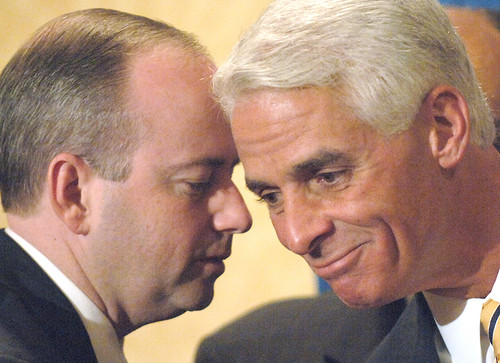
George LeMieux snuggling up to Charlie Crist

I’m just kidding, it’s going to be fricking hilarious. And no one will be laughing harder at his former pygmalion and consigliere than Charlie Crist. In the event that every one of George LeMieux’s opponents in the Republican primary is found out to be Manchurian candidate from the “atheist-Islamists” of Newt Gingrinch’s fevered imagination (imparted to reporters in what I can only assume was a drunk dialing incident), George will still be the victim of an old fashioned beat down by Bill Nelson.

In fact, let me go on the record as saying that if George LeMieux and Bill Nelson physically fought, the former astronaut would have Georgie boy on the ground crying for mommy/Charlie Crist to kiss his boo boos better.

Of course, Crist would tell his one time errand boy to suck it.

Because that’s his real problem. Because LeMieux would be a nobody without Crist. Because if Charlie Crist had never been born, LeMieux’s career ends with him losing a state house by double digits some twenty years ago. His website tries to paper over this fact, but it can’t he is little more than Crist’s “papier-mâché Mephistopheles” (as Joseph Conrad once described a character from Heart of Darkness).

LeMieux’s best hope is money, and it seems pretty clear that Mike “the Appeaser” Haridopolos will be the strongest fundraiser. And even if Haridopolos’ snowballing series of financial scandals, each one carrying that unsubtle whiff of the appearance of corruption, finally results in a public and ugly federal investigation or an indictment, well, I have little doubt that all of Haridopolos’ donors will (after some indiscreet urging by Florida House Speaker Dean Cannon) all scurry like frightened mice over to the waiting arms of former Florida House Majority Leader Adam Hasner.

So good luck, George. You’re going to need it, but it won’t be enough to save you.

Ceremony


The postman delivered to nice package today – a copy of Ceremony, a small quarterly out of Pennsylvania. The reason this is exciting is that my poem Pontiac Sunbird, 1994 is included. This is the first of two publications I have on deck for this spring, though sadly I don’t have any other lined up. Though I also haven’t been aggressive about sending out my stuff. Partly because I’m in a bit of transitional stage and evaluating the quality of some of my newer pieces and also trying to figure out which of my older ones stand the test of time.

In any case. It was a nice surprise.

Griffin Poetry Prize Nominees


No, I wasn’t on the list.

Even worse, they succeeded in completely showing me up as painfully ignorant of contemporary poetry, as I have only read poems by two of the nominees: Seamus Heaney and Adonis.

And knowing who those two are is no great shakes. Heaney is a Nobel Prize winner and Adonis is perennially shortlisted for that prize. Sigh. I feel so ashamed.