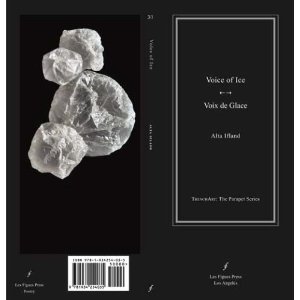
 My books from Los Angeles’ own Les Figues finally arrived – a, re:evolution, and Voice of Ice. They also sent me a bonus – Stephanie Taylor’s Chop Shop. Very, very generous of them. I love free books. In fact, I encourage all publishers of poetry and quality literature to send me free books. I promise to review them all for you!
[Pause]
[The sound of crickets]
Well, no takers so far. I will continue to pay for my books, on the whole, it appears. On to Voice of Ice, Voix de Glace.
Basically, I love it.
I have mentioned in the past how I have difficulty really getting into some genres of avant-garde poetry. I respect Ron Silliman, but I don’t pretend to understand Tjanting. +’me’ S-pace (another Les Figues publication) confused me.
One sort of expects that virtually everything that Les Figues publishes would be a bit out of my league. Not so, this time.
Voice of Ice, Voix de Glace is a series of prose poems written in French on the left hand side and English on the right. This was almost certainly written in English and then translated into French (the absence of translator credits and my meager French are the basis for this assumption). The poems follow a sort of life cycle pattern, from birth to death. There is an obsession with the body (and the destruction of the body), particularly with eyes and tears. At first, this might make the focus seem ontological – which, according to Fredric Jameson, who, in his Postmodernism, or the Cultural Logic of Late Capitalism, wrote that the difference between modernism and postmodernism was paradigmatic break between the epistemological and the ontological. In that sense, it would suggest that a focus on the nature, construction, and dissolution of the body would place Voice of Ice firmly in the ontological category. However, the use of the body seems strongly metaphorical, as a means of self-awareness – putting it squarely in the epistemological side of the equation (though something so stark as epistemological versus ontological is always going to be false dichotomy – but that doesn’t mean it can’t be a useful tool).
The style is vaguely surrealistic, but unlike, say, an Eluard or Char, whose surrealism is marked by ontological shifts within a poem, Ifland, once she has established the “reality” of a particular poem, tends to stay within that reality. The best comparison would probably be to the prose poems of Arthur Rimbaud, rather than surrealists of the early twentieth century. Which just goes back to my assertion that the poems are more within the realm of modernism than postmodernism.
* * * * *
I just read that the poems were originally written in French and then translated by Ifland into English. From reading it, this seemed unlikely to me (the French seemed to close to a word for word translation of the English and what I saw lacked colloquial phrases that resist literal translations), but lacking inside knowledge, I will defer to others on this.
 the coffee philosopher
2 thoughts on “Les Figues Press: Voice of Ice, Voix de Glace”